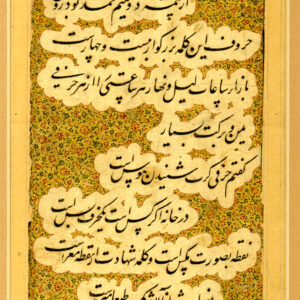
Ṣāʾeb Tabrīzī. A Persian-language poet of the 17th/11th century, and one of the eminent poets of the Indian style.1
His name was Mīrzā Muhammad-Ali, known by the pen-name Ṣāʾeb, and also referred to as Ṣāʾebā or Mīrzā Ṣāʾebā.2 He was likewise given the epithet afṣaḥ al-mutaʾakhkherīn (“the most eloquent of the later poets”).3 The family of Ṣāʾeb was originally from Tabriz and traced their lineage to Muhammad b. ‛Ezz al-Dīn Shams Maghrebī, a mystic and poet of the 15th/9th–16th/10th centuries. His father, Mīrzā ‛Abd al-Raḥīm, was a reputable merchant of Tabrīz, and the family was among the thousands who, by order of Shah ‛Abbās I* (r. 1588–1629/996–1038), were relocated to Isfahan after the conquest of Tabriz in 1603/1012. They settled in the ‛Abbās-ābād* quarter—or the so-called Tabāreze (Tabrīzīs’ quarter)—of Isfahan, where Ṣāʾeb was raised.4
According to the reliable testimony of Valī-Qulī Beyg Shāmlū,5 a contemporary historian, the birthplace of Ṣāʾeb was Tabriz. If one may rely on his own poetry, he himself alludes in a verse: “ze khāk-e pāke Tabrīz ast Ṣāʾeb mawled-e pākam” (“From the pure soil of Tabriz is my pure birth”).6 On the other hand, in many verses he expressed affection for Isfahan, where he was nurtured: “khushā rūzī ke manzel dar savād-e Eṣfahān sāzam / ze vaṣf-e Zende-rūd-ash khāme rā raṭb al-lesān sāzam” (“Happy the day when I make my abode in the environs of Isfahan, / From the praise of its Zende-Rūd may my pen become sweet of tongue”).7 Some biographical anthologies (tadhkeras) describe him as Tabrīzī.8 Āzād Belgrāmī at one place calls him “Tabrīzī Eṣfahānī,”9 and elsewhere simply “Eṣfahānī.”10
The exact year of Ṣāʾeb’s birth is not known. However, according to Malīḥā-ye Samarqandī, who recorded Ṣāʾeb’s death in 1676/1087 at about the age of ninety,11 it may be inferred that he was born around the year 1591/1000. Ṣāʾeb himself, in his poetry, speaks of old age, weakness, and the decline of his physical powers: “bar man az pīrī sarā-ye ‛ārīyat zendān shud-ast / zendegī dushvār va tark-e zendegī āsān shud-ast” (“Through old age, the borrowed house has become a prison for me; / Life has grown difficult, and abandoning life has become easy”)12, which is evidence of his long life.13
Ṣāʾeb acquired literary, rational, and transmitted sciences in Isfahan,14 and, as he himself states, he performed the pilgrimage in his youth and also visited Mashhad: “lellāhe al-ḥamd ke ba‛d az safar-e ḥajj Ṣāʾeb / ‛ahd-e khud tāze be Sulṭān-e khurāsān kardam” (“Praise be to God that after the pilgrimage, Ṣāʾeb renewed his covenant with the Sultan of Khorasan”).15It seems that in 1625/1034, after this journey, he departed for India by way of Kabul. In Kabul, he became acquainted with Ẓafar Khān, one of the local rulers.16 Ẓafar Khān, who was a patron of poets, paid special attention to Ṣāʾeb,17 and Ṣāʾeb, in turn, praised his kindness, generosity, and love of poetry repeatedly in his lyric poems: “chegūne jān baram az jawr-e āsemān Ṣāʾeb / agar na luṭf-e Ẓafar Khān shavad havādāram” (“How could I escape the tyranny of the heavens, Ṣāʾeb, / if not for the kindness of Ẓafar Khān becoming my supporter”)18. A large number of his relatively few odes were composed in praise of him,19 and, for the first time, it was at Ẓafar Khān’s encouragement that Ṣāʾeb gathered together his previously scattered poems.20
Ṣāʾeb remained in Kabul until the end of Ẓafar Khān’s governorship there. Afterwards, Ẓafar Khān took him along to Burhānpur in the Deccan, and in 1630/1039 he was introduced to Shah Jahān (r. 1628–1658/1037–1068).21 The account of some biographical anthologists who claim that Ṣāʾeb, after meeting Shah Jahān, was granted the rank of hazārī and the title Musta‛ed Khan22 appears to be inaccurate.23 While in Burhānpur, Ṣāʾeb’s father came from Lahore to Agra (Akbarabad) to meet him. Longing to return to Isfahan, Ṣāʾeb wrote: “chu ḥalqe bar dar-e del shuvq-e Eṣfahān bezanad / sereshk bar ṣaf-e muzhgān khūn-chekān bezanad // che dawlatī ast ke Ṣāʾeb ze Hend bargardad / sarāsarī du be bāzār-e Eṣfahān bezanad” (“When the ring of longing for Isfahan knocks at the door of my heart / Tears, blood-dripping, fall upon the line of my lashes. // What fortune it would be if Ṣāʾeb should return from India, / To lay his turban as an offering in the bazaar of Isfahan”).24 With this plea he sought permission from Khwāje Abul-Hasan Turbatī, the father of Ẓafar Khan, to travel to Agra and thence to return to Isfahan.25 Yet in 1632/1042 he once again accompanied Ẓafar Khan, who had been appointed governor of Kashmir. After six months, however, he was able to return with his father to Isfahan.26
During the reign of Shāh ‛Abbās II* (r. 1642–1666/1052–1077), Ṣāʾeb was given the title of malek al-shu‛arāʾ (poet laureate) at the Safavid court.27 Shah Sulaymān Ṣafavī* (r. 1666/1077–1694/1105), in Ṣāʾeb’s later years, inquired after his condition through Vaḥīd Qazvīnī. In a letter addressed to Ṣāʾeb, Vaḥīd referred to him as afṣaḥ al-mutaqaddemīn wa al-mutaʾakhkherīn (“the most eloquent among both the earlier and later poets”).28
Ṣāʾeb most likely passed away in the final days of 1676/1086 or the first days of 1677/1087.29 According to Malīḥā-ye Samarqandī, he was buried in the tekīye of Darvīsh Ṣāleḥ, who held him in great devotion.30 Today, Ṣāʾeb’s mausoleum* is situated in a large garden on Ṣāʾeb Avenue in Isfahan. The preliminary arrangements for constructing his tomb were made in 1963/1342, and in 1967/1346 it was completed through the efforts and funding of the Anjuman-e Āthār-e Mellī (Society for National Heritage).31
Some later sources considered Ṣāʾeb a disciple of Masīḥ Kāshānī and Ḥakīm Shafāʾī Eṣfahānī*.32 Although Ṣāʾeb composed three lyric poems emulating those of Masīḥ Kāshānī,33 and although he kept ten of Masīḥ’s collected volumes at home,34 and though he praised Shafāʾī as a connoisseur of eloquence and composed a lyric poem emulating his,35 Ṣāʾeb himself states that he learned the art of poetry from no one and attained this style on his own: “tatabbu‛-e sukhan-e kas nakardeʾam hargez / kasī nakarde be man fann-e she‛r rā talqīn // be zūr-e fekr bar īn ṭarz dast yāfte am / ṣadaf ze ābele-ye dast yāft durr-e thamīn” (“I have never imitated the speech of another; / No one has ever instilled in me the art of poetry. // By the power of thought I have attained this style; / Just as the shell attained the precious pearl through the blister of its hand”).36
Ṣāʾeb’s good character and refined manners contributed greatly to the spread of his fame; both in India and in Iran, his gatherings were venues where men of letters and poets, whether seasoned or novice, and dignitaries from various social classes, came together.37 According to Khan-e Ārezū, Ṣāʾeb was closely associated with Mīrzā Jalāl al-Dīn Asīr Eṣfahānī*; in their literary assemblies they would propose a single verse as a theme, and then compose lyric poems in its meter and rhyme.38
In his lyric poems, Ṣāʾeb spoke appreciatively of many poets of the Safavid period, including Saḥābī Astarābādī,39 Naẓīrī Neyshābūrī,40 Ahlī Shīrāzī,41 Ṭāleb Āmulī,42 and ‛Urfī Shīrāzī,43 and he also emulated their poems.44 In his miscellany he even included verses of Ṭughrā-ye Mashhadī, who had composed cursing-poem lines against Ṣāʾeb.45 Khan-e Ārezū46 expressed satisfaction that, unlike most Persian poets of Iran who ignored the Persian-writing poets of India, Ṣāʾeb incorporated the verses of Ghanī Kashmīrī into his miscellany.47 Ṣāʾeb also mentioned the names of lesser poets in his dīvān and included their verses in his miscellany, which shows that he was not overly strict in his selections.48 This open spirit contributed to the large number of verses that have survived from him, though many of them are of a lower level compared with his poetry as a whole. On the other hand, it is only natural that among his numerous lyric poems, themes, meanings, diction, and rhymes would often be repeated.49
Because of Ṣāʾeb’s poetic stature, many poets of his own age and afterward were influenced by him and composed their works in his manner.50 Numerous poets of the Safavid era praised him, considered themselves his pupils, or chose their poetic pen-names with his guidance.51 Biographical anthologists and critics of his time and later periods also largely praised his poetry.52 Among them, however, Khan-e Ārezū, without giving a reason, claimed that Iranians preferred the poetry of Kalīm Kāshānī over that of Ṣāʾeb.53
Ṣāʾeb was among the most distinguished poets of the “Iranian branch of the Indian style,” which is also known as the Esfahanī style. Many of the formal and thematic features of the Indian style are evident in his poetry, and most Iranian poets followed his manner.54 His works achieved wide fame during his lifetime;55 already in the 17th/11th century numerous poets in Transoxiana were followers of his style.56 Yet, at the beginning of his presence in India, his manner of poetry was not well received in those circles, as he himself remarked: “bar ḥarīfān chun guwārā nīst Ṣāʾeb ṭarz-e tu / be ke beferestī be Iran nuskhe-ye ash‛ār rā” (“Since your style, Ṣāʾeb, is not pleasing to your rivals, / it is better that you send the copy of your poems to Iran”).57
Mīr Sharaf, one of Ṣāʾeb’s contemporaries, accused him of plagiarism, but Nasrābādī* declared Ṣāʾeb’s character and taste free of it.58 Khan-e Ārezū, the foremost literary critic in India, likewise rejected the charge, maintaining that Ṣāʾeb rendered certain fine meanings—which other poets had expressed in weak form and diction—in “elegant expression and novel style.”59 In the content of his lyric poems, Ṣāʾeb was deeply influenced by Rūmī and regarded himself as a follower of the “manner of Rūmī”: “futād tā be rah-e ṭarz-e Mavlavī Ṣāʾeb / sepand-e shu‛le-ye fekr-ash shude ast kawkab-hā” (“Since Ṣāʾeb set foot upon the path of Rūmī’s manner, / the sparks of his thought have flared up like burning wild rue, turning into stars.”).60 He believed that since he had followed Rūmī, his poetry had become filled with mystical insights: “eqtedā tā be Mavlavī karde-st / she‛r-e Ṣāʾeb tamām ‛erfān ast.” )Ever since he has followed Rūmī, Ṣāʾeb’s poetry has been filled entirely with mysticism.( 61Ṣāʾeb repeatedly emulated Rūmī’s lyric poems and incorporated some of his verses, as in: “Ṣāʾeb īn ān ghazal-e murshed-e Rūm ast ke guft: / ey khudāvand yekī yār-e jafākārash deh.” )Ṣāʾeb, this is that lyric poem of the master of Rūm, in which he said: ‘O Lord, grant him a beloved who is cruel to him).62
Ṣāʾeb also regarded himself as influenced by Ḥāfeẓ and his poetic manner, as he declared: “be kelk-e qudrat-e Ṣāʾeb shekastegī marasād / ke ṭarz-e Ḥāfeẓ-e Shīrāz dar mīyān andākht” (“may the pen of power not allow Ṣāʾeb’s weakness to remain, / for he has cast into play the manner of Ḥāfeẓ of Shiraz”).63 He emulated more than twenty lyric poems of Ḥāfeẓ, among them: “Ṣāʾeb īn ān ghazal-e Ḥāfeẓ-e shīrīn-sukhan ast / kelk-e mā nīz zabānī va bayānī dārad” (“This, Ṣāʾeb, is that lyric poem of sweet-speaking Ḥāfeẓ; / our pen, too, possesses its own tongue and expression”).64
Ṣāʾeb composed numerous verses and odes in praise of Imam Ali,65 Imam Hussein, and Imam Reza,66 and throughout his lyric poems he continually remembered Ali, composing many verses in his praise. When life in India became burdensome, he sought aid from the “Lord of Najaf”: “Ṣāʾeb az Hend jegarkhār burūn mī-āyam / dastgīr-e man agar Shāh-e Najaf khāhad shud” (Ṣāʾeb leaves the India of sorrow and grief, / if the Lord of Najaf will come to his aid).67 In old age and frailty, too, he placed his hope in the grace of Imam Ali: “shekaste-bāl ze pīrī shude ast Ṣāʾeb līk / umīd-e jāzebeʾī az Shah-e Najaf dārad” (Ṣāʾeb has become broken-winged from age, / yet he hopes for an attraction from the Lord of Najaf).68 In the verse “ze peyruvān-e sharī‛at dar īn sarā-ye sepanj / du-shesh zad ān ke be ethnā-‛ashar tawallā kard” (Among the followers of the Sharī‛a in this fleeting abode, / he who aligned himself with the Twelve struck a winning pair of sixes), he openly declared his Twelver Shiite creed.69 Likewise, in praise of Shah Ṣafī, he encouraged him to promote the Twelver Shiite faith: “tuʾī davāzdahum az nezhād-e Sheikh Ṣafī / jahān chegūne nagīrī be ‛adl-e Mahdī-vār // ravāj-e madhhab-e ethnā-‛ashar be ‛uhde-ye tust / bekūsh va dast az īn shīve-ye sutūde madār” (“You are the twelfth from the line of Sheikh Ṣafī; / why not rule the world with Mahdī-like justice? // The promotion of the Twelver faith rests upon you; / strive and never abandon this praiseworthy way”).70
Among kings and rulers, in addition to Ẓafar Khan, Ṣāʾeb composed poems in praise of Shah Ṣafī*,71 Shah ‛Abbās II,72 Shah Sulaymān,73 and Khwahāje Abū al-Hasan Turbatī.74
Ṣāʾeb’s works reveal that he was always an observer of both the human being and the external world. In his poetry, he uncovered and depicted the correspondences and mysteries between the two.75 His lyric poems contain a wealth of subtle moral, ethical–mystical, and social reflections.76
Ṣāʾeb’s distinctive manner was the use of simile and proverb-like expression; scarcely any of his lyric poems can be found that does not contain current proverbs, or in which some of the verses do not themselves assume the force of proverbial sayings.77 Khan-e Ārezū termed this method mathal-bandī and muddaʽā-mathal (proverb-making and claim-as-proverb).78 In this respect, no poet’s verse during the three centuries after him spread so widely on people’s tongues as Ṣāʾeb’s.79 With a creative temperament, he also coined numerous words, compounds, and idiomatic expressions.80
It may be said that Ṣāʾeb’s poetic style was the fully developed form of a new manner that had first appeared in the poetry of Khwāje Hussein Thanāʾī Mashhadī, and which later poets endeavored to cultivate. Yet some of Ṣāʾeb’s followers, unable to reach his level, struggled in crafting subtle themes and fine conceits and in weaving them into verse, thereby pushing the style into affectation.81 This development in the following period caused critics to become disenchanted with Ṣāʾeb. In any case, among his poems there are also many weak verses, and distant and unpleasing metaphors and figurative expressions.82 Maftūn Dunbulī considered his poetry, alongside that of Shavkat Bukhārāʾī and Vaḥīd Qazvīnī, to be filled with “spiritless and cold” allegories and metaphors.83
The emergence of the “Return movement”, which was entirely opposed to the manner of the Safavid poets, hindered a true recognition of Ṣāʾeb.84 Ādhar Bīgdelī* (d. 1781/1195), one of the foremost critics of the literary Return, had no favorable view of Ṣāʾeb’s poetry. He believed that Ṣāʾeb paid no attention to the former masters and that his new and distasteful style was daily in decline.85 He even wondered how Ṣāʾeb, with such weak notions, could have become so famous, suggesting that perhaps his spiritual merits or his planetary configuration were the source of such fame.86 The opposition to Ṣāʾeb and the Indian style continued into the early decades of the last century, when most literary trends aligned with the views of Ādhar Bīgdelī and Hedāyat.87 Later, however, a renewed inclination toward Ṣāʾeb’s poetry emerged. In the early 20th/14th century, Ḥeydar-Ali Kamālī (Tehran, 1926/1305) published a selection of Ṣāʾeb’s poems. In the second third of the century, readers and poets increasingly turned to the Indian style, and Ṣāʾeb and his poetry once again received attention.88In 1954/1333, Zayn al-‛Ābedīn Muʾtamen published a thematic selection of Ṣāʾeb’s poetry and, in the introduction, spoke of the persistent and biased criticism of Ṣāʾeb and the Indian style by Iranian literati.89 That same year, Amīrī Fīrūzkūhī also published the complete works of Ṣāʾeb Tabrīzī with an extensive introduction, which proved useful and influential in the study of Ṣāʾeb and his poetry.
Ṣāʾeb and his poetry proved useful and influential. While the literary Return movement in Iran marginalized the poetry of the Safavid period, in India, Afghanistan, and Central Asia Ṣāʾeb’s poetic style continued to prevail. In the mid-18th/12th century, when khushgū composed his biographical anthology, imitation of Ṣāʾeb’s manner was still one of the two major currents of poetry in India.
The collected works (kullīyāt) of Ṣāʾeb’s dīvān comprise his odes and lyric poems, with the main portion consisting of his lyric poems.90 In addition, he composed a short mathnavī in mutaqāreb meter on the conquest of Kandahar under the command of Shah ‛Abbās II, which became known as the Qandehār-nāme.91 Because of Ṣāʾeb’s wide fame, numerous complete or selected manuscripts of his lyric poems are extant. From 1985 to 1991/1364–1370, Muhammad Qahramān published the complete dīvān of Ṣāʾeb in six volumes in Tehran.92
From among his vast body of poetry, Ṣāʾeb himself compiled several collections, such as merʾāt al-jamāl (a collection of verses describing the beloved), ārāyesh-e negār (verses with the motifs of mirror and comb), mey-khāne (verses depicting wine and the tavern), and wājeb al-ḥefẓ (a selection of the opening lines of his lyric poems).93 These collections inspired others to compile their own selections of his verses, under titles such as sham‛ va parvāne (“Candle and Moth”) and āsemān va āsīyā (“Sky and Mill”).94 Naṣrābādī prepared a brief selection from Ṣāʾeb’s dīvān, consisting of verses about spring, wine, the eye, the line of the face, and the lock of hair.95 The practice of excerpting from Ṣāʾeb’s poetry continued in modern times as well, for instance in the anthology by Mahdī Suheylī entitled shāhkārhā-ye Ṣāʾeb Tabrīzī va Kalīm Kāshānī (“Masterpieces of Ṣāʾeb Tabrīzī and Kalīm Kāshānī”), published in Tehran in 1967/1346.
Few prose writings of Ṣāʾeb have survived, though Valī-Qulī Beyg Shāmlū* regarded him as skilled in the art of epistolary composition.96 From his epistolary writings, apart from a few pieces on tobacco and the water-pipe, only a letter to his beloved and a humorous letter to the “Sultan of Love” are extant.97The safīne-ye Ṣāʾeb is a collection of the poems of 691 poets from various periods, selected by him, which was published in a facsimile edition in Isfahan (2006/1385).
/Ali Kiyani Falavarjani/
Bibliography
Ādhar Bīgdelī, Luṭf-Ali b. Āqā Khan, āteshkade-ye ādhar, ed. Hasan Sādāt Nāṣerī, Tehran: Amīr Kabīr, 1957–1961/1336–1340.
Ādhar Bīgdelī, Luṭf-Ali b. Āqā Khan, āteshkade-ye ādhar, part 2, ed. Mīr Hāshem Muḥaddeth, Tehran: Amīr Kabīr, 1999/1378.
Āzād Belgrāmī, Mīr Ghulām-Ali b. Nūḥ, khazāne-ye ‛āmera, ed. Human Yūsufdehī, Tehran: Library, Museum and Documentation Center of the Islamic Consultative Assembly, 2014/1393b.
Āzād Belgrāmī, Mīr Ghulām-Ali b. Nūḥ, tadhkere-ye sarv-e āzād, ed. Mīr Hāshem Muḥaddeth, Tehran: Safīr Ardehāl, 2014/1393a.
Bahār, Muhammad-Taqī, sabk-shenāsī, yā, tārīkh-e taṭavvur-e nathr-e fārsī, Tehran: Chāpkhāne-ye Khudkār, [1942?]/[1321?].
Baḥr al-‛Ulūmī, Hussein, kārnāme-ye anjuman-e āthār-e mellī: az āghāz tā 2535 shāhanshāhī, Tehran: Anjuman-e Āthār-e Mellī, 1976/1355.
bar-guzīde-ye ash‛ār-e Ṣāʾeb va dīgar shu‛arā-ye ma‛rūf-e sabk-e hendī, comp. Muhammad Qahramān, Tehran: SAMT, 2008/1387.
Dehkhudā, Ali -Akbar, amthāl va ḥekam, Tehran: Amīr Kabīr, 1984/1363.
Derakhshān, Mahdi, “du athar-e nu-yāfte az nathr-e Ṣāʾeb va sabk-e nathr-e ū,” Journal of the Faculty of Letters and Humanities, University of Tehran, vol. 25, no. 1–4, Autumn 1988/1367.
Derāyatī, Muṣṭafā, fehrestvāra-ye dastnevesht-hā-ye Īrān (denā), Tehran: Library, Museum and Documentation Center of the Islamic Consultative Assembly, 2010/1389.
Gulchīn Ma‛ānī, Aḥmad, “sī-sadumīn sāl-e wafāt-e Ṣāʾeb sāl 1086 hejrī qamarī ast,” Yaghmā, vol. 18, no. 6, September 1965/1344.
Gulchīn Ma‛ānī, Aḥmad, farhang-e ash‛ār-e Ṣāʾeb, Tehran: Muʾassese-ye Muṭāle‛āt va Taḥqīqāt-e Farhangī, 1985–1986/1364–1365.
Karīmī, Amīrbānū, “dunyā-ye Ṣāʾeb,” in Ṣāʾeb va sabk-e hendī dar gustare-ye taḥqīqāt-e adabī, ed. and comp. Muhammad-Rasūl Daryāgasht, Tehran: Nashr-e Qaṭre, 1992/1371.
Khan-e Ārezū, Serāj al-Dīn Ali b. Ḥesām al-Dīn, tadhkere-ye majma‛ al-nafāʾes, Islamabad: Markaz-e Taḥqīqāt-e Fārsī-e Iran and Pakistan, 2004–2006/1383–1385.
Khushgū, Bendra Ban-dās, safīna-ye Khushgū, vol. 2, ed. Kalīm Aṣḡar, Tehran: Library, Museum and Documentation Center of the Islamic Consultative Assembly, 2010/1389.
majma‛ al-afkār: dībāche-hā, muraqqa‛āt va munshaʾāt-e shu‛arāʾ, nevīsandegān, dāneshmandān, pādeshāhān va khavānīn, comp. Muhammad Ḥakīm Hendī, ed. Qurbān-Ali Ebrāhīmī, Tehran: Nashr-e Sanglaj, 2024/1403.
Malīḥā-ye Samarqandī, Muhammad-Badī‛ b. Muhammad Sharīf, mudhakker al-aṣḥāb, ed. Muhammad Taqavī, Tehran: Library, Museum and Documentation Center of the Islamic Consultative Assembly, 2011/1390.
Muḥīṭ Ṭabāṭabāʾī, Muhammad, “bāzgasht-e sabk-e hendī be Iran,” in Ṣāʾeb va sabk-e hendī dar gustare-ye taḥqīqāt-e adabī, ed. and comp. Muhammad-Rasūl Daryāgasht, Tehran: Nashr-e Qaṭre, 1992/1371.
Naṣrābādī, Muhammad-Ṭāher, tadhkere-ye Naṣrābādī, ed. Muḥsen Nājī Naṣrābādī, Tehran: Asāṭīr, 1999/1378.
Rīyāḥī, Muhammad-Amīn, “Ṣāʾeb Tabrīzī, shā‛er-e zamāne-ye khīsh,” in Ṣāʾeb va sabk-e hendī dar gustare-ye taḥqīqāt-e adabī, ed. and comp. Muhammad-Rasūl Daryāgasht, Tehran: Nashr-e Qaṭre, 1992/1371.
Ṣāʾeb Tabrīzī, Muhammad-Ali, dīvān, ed. Muhammad Qahramān, Tehran: Enteshārāt-e ‛Elmī va Farhangī, 1985–1991/1364–1370.
Ṣāʾeb Tabrīzī, Muhammad-Ali, gulchīn-e Ṣāʾeb: shāmel qarīb 2445 beyt va 185 mawḍū‛, comp. Zayn al-‛Ābedīn Muʾtamen, Tehran: Bungāh-e Maṭbū‛ātī-ye Afshārī, 1954/1333b.
Ṣāʾeb Tabrīzī, Muhammad-Ali, kullīyāt-e Ṣāʾeb Tabrīzī, introduction and biography by Amīrī Fīrūzkūhī, Tehran: Khayyām, [1954/1333a].
Ṣāʾeb Tabrīzī, Muhammad-Ali, muntakhabāt-e ash‛ār-e Ṣāʾeb Tabrīzī, selected by Ḥeydar-Ali Kamālī, Tehran: Kalāle-ye Khāvar, [1926/1305].
Ṣāʾeb Tabrīzī, Muhammad-Ali, safīne-ye Ṣāʾeb, ed. Ṣādeq Ḥusaynī Eshkevarī, facsimile edition of MS no. 10775, Library of the University of Isfahan, Isfahan: University of Isfahan, 2006/1385.
Ṣafā, Ẓabīḥullāh, tārīkh-e adabīyāt dar Iran va dar qalmru-e zabān-e pārsī, Tehran: Ferdavs, 1999/1378.
Sajjādī, Ẓīyāʾ al-Dīn, “ma‛nī va maẓmūn dar she‛r-e Ṣāʾeb,” in Ṣāʾeb va sabk-e hendī dar gustare-ye taḥqīqāt-e adabī, ed. and comp. Muhammad-Rasūl Daryāgasht, Tehran: Nashr-e Qaṭre, 1992/1371.
Ṣamṣām al-Dawla Shāhnavāz Khan, bahārestān-e sukhan, ed. Mīr ‛Abdul-Wahhāb Bukhārī, Madras (Tamil Nadu), 1958.
Ṣamṣām al-Dawla Shāhnavāz Khan, maʾāther al-umarāʾ, Calcutta: Maṭba‛ Ardukāʾīd, 1888–1891.
Sarkhush, Muhammad-Afẓal b. Muhammad Zāhed, kalemāt al-shu‛arāʾ, ed. Ali -Reza Qazveh, Tehran: Library, Museum and Documentation Center of the Islamic Consultative Assembly, 2010/1389.
Ṣeddīq Hasan Khan, tadhkere-ye sham‛ al-anjuman, ed. Muhammad-Kāẓem Kahduʾī, Yazd: University of Yazd, 2007/1386.
Shafīʿī Kadkanī, Muhammad-Reza, adabīyāt-e fārsī az ‛aṣr-e Jāmī tā rūzgār-e mā, trans. Ḥujjatullāh Aṣīl, Tehran: Nashr-e Ney, 1999/1378.
Shāmlū, Valī-Qulī b. Dāvūd-Qulī, qaṣaṣ al-khāqānī, ed. Hasan Sādāt Nāṣerī, Tehran: Vezārat-e Farhang va Ershād-e Eslāmī, 1992–1995/1371–1374.
Sheblī Nu‛mānī, Muhammad, she‛r al-‛ajam, part 3, A‛ẓamgar: Maṭba‛ Ma‛āref A‛ẓam Kade, 1988.
Suheylī Khwānsārī, Aḥmad, “sahm-e Ṣāʾeb dar mathal-hā-ye sāʾer yā amthāl va ḥekam dar ash‛ār-e Ṣāʾeb,” in Ṣāʾeb va sabk-e hendī dar gustare-ye taḥqīqāt-e adabī, ed. and comp. Muhammad-Rasūl Daryāgasht, Tehran: Nashr-e Qaṭre, 1992/1371.
Vaḥīd Qazvīnī, Muhammad-Ṭāher b. Hussein, “nāme-hā-ye Vaḥīd Qazvīnī be Mavlānā Ṣāʾeb,” ed. Muḥsen Dhāker-al-Husaynī, in sukhan-e ‛eshq: jashn-nāme-ye Duktur Hasan Anvarī, Tehran: Sukhan, 2016/1395.
Vāle Dāghestānī, Ali-Qulī b. Muhammad-Ali, tadhkere-ye rīyāż al-shu‛arāʾ, ed. Muḥsen Nājī Naṣrābādī, Tehran: Asāṭīr, 2005/1384.
- This article was previously printed in The Encyclopaedia of the World of Islam, vol.29, pp. 241-245, and has been revised in The Encyclopaedia Isfahanica with concentrating on the Isfahan framework.[↩]
- Shāmlū, vol. 2, pp. 62, 64; Naṣrābādī, vol. 1, p. 316.[↩]
- Ṣamṣām al-Dawla Shāhnawāz Khan, maʾthar al-umarāʾ, 1888–1891, vol. 2, p. 761.[↩]
- Naṣrābādī, vol. 1, p. 316; Ṣafā, vol. 5, part 2, p. 1272; bar-guzīde-ye ash‛ār-e Ṣāʾeb, introd. Qahramān, p. 12[↩]
- Shāmlū, vol. 2, p. 64.[↩]
- Ṣāʾeb Tabrīzī, dīvān, 1985–1991/1364–1370, vol. 5, p. 2681; idem, “Ṣāʾeb az khāk-e pāk-e Tabrīz ast/ hast Saʿdī gar az gol-e Shīrāz,” ibid., vol. 5, p. 2329; cf. Ṣafā, vol. 5, part 2, p. 1272, who mistakenly records his birthplace as Isfahan.[↩]
- Ṣāʾeb Tabrīzī, dīvān, 1985–1991/1364–1370, vol. 4, pp. 1888–1889; vol. 5, p. 2690; vol. 6, p. 3319.[↩]
- Shāmlū, vol. 2, p. 62; Sarkhush, p. 117.[↩]
- Āzād Belgrāmī, tadhkere-ye sarv-e āzād, 2014/1393a, p. 165.[↩]
- Āzād Belgrāmī, khazāne-ye ‛āmera, 2014/1393b, vol. 1, p. 449.[↩]
- Malīḥā-ye Samarqandī, p. 506.[↩]
- Ṣāʾeb Tabrīzī, dīvān, 1985–1991/1364–1370, vol. 2, p. 578; vol. 5, p. 2776.[↩]
- Gulchīn Ma‛ānī, farhang-e ash‛ār-e Ṣāʾeb, 1985–1986/1364–1365, vol. 1, p. 34; cf. Shāmlū, vol. 2, pp. 65–66, who believed Ṣāʾeb reached sixty in 1076/1665.[↩]
- Ṣafā, vol. 5, part 2, p. 1273.[↩]
- Ṣāʾeb Tabrīzī, dīvān, 1985–1991/1364–1370, vol. 5, pp. 2722–2723.[↩]
- Naṣrābādī, vol. 1, p. 316; Malīḥā-ye Samarqandī, p. 505.[↩]
- Ṣamṣām al-Dawla Shāhnawāz Khan, bahārestān-e sukhan, 1958, pp. 539–540.[↩]
- Ṣāʾeb Tabrīzī, dīvān, 1985–1991/1364–1370, vol. 2, p. 653; vol. 4, pp. 1897, 1952, 2107; vol. 5, pp. 2298, 2768.[↩]
- Ṣāʾeb Tabrīzī, dīvān, 1985–1991/1364–1370, vol. 6, pp. 3621–3633.[↩]
- Ṣafā, vol. 5, part 2, p. 1274; Ṣāʾeb Tabrīzī, dīvān, 1985–1991/1364–1370, vol. 6, p. 3633.[↩]
- Ṣamṣām al-Dawla Shāhnawāz Khan, bahārestān-e sukhan, 1958, p. 542; Malīḥā-ye Samarqandī, p. 505; cf. Sheblī Nu‛mānī, she‛r al-‛ajam, part 3, p. 171, who mistakenly held that Ṣāʾeb went directly from Iran to Delhi and the court of Shāh Jahān.[↩]
- Shāmlū, vol. 2, pp. 64–65; Malīḥā-ye Samarqandī, p. 505; Ṣamṣām al-Dawla Shāhnawāz Khan, bahārestān-e sukhan, 1958, p. 542.[↩]
- Gulchīn Ma‛ānī, farhang-e ash‛ār-e Ṣāʾeb, 1985–1986/1364–1365, vol. 1, p. 29.[↩]
- Ṣāʾeb Tabrīzī, dīvān, 1985–1991/1364–1370, vol. 4, pp. 1888–1889.[↩]
- Idem, vol. 6, pp. 3634–3635; Āzād Belgrāmī, tadhkere-ye sarv-e āzād, 2014/1393a, p. 168.[↩]
- Āzād Belgrāmī, tadhkere-ye sarv-e āzād, 2014/1393a, p. 169; Gulchīn Ma‛ānī, farhang-e ash‛ār-e Ṣāʾeb, 1985–1986/1364–1365, vol. 1, p. 33; cf. Ṣafā, vol. 5, part 2, p. 1275, who gives 1040/1630 as the year of his return.[↩]
- Shāmlū, vol. 2, p. 65; Ṣamṣām al-Dawla Shāhnawāz Khan, bahārestān-e sukhan, 1958, p. 542; Vāle Dāghestānī, vol. 2, p. 1207.[↩]
- Gulchīn Ma‛ānī, farhang-e ash‛ār-e Ṣāʾeb, 1985–1986/1364–1365, vol. 1, pp. 35–36; Vaḥīd Qazvīnī, pp. 268–269.[↩]
- Malīḥā-ye Samarqandī, p. 506; Gulchīn Ma‛ānī, “sī-sadumīn sāl-e wafāt-e Ṣāʾeb,” Yaghmā, 1965/1344, pp. 292–294; bar-guzīde-ye ash‛ār-e Ṣāʾeb, introd. Qahramān, p. 17; cf. Āzād Belgrāmī, tadhkere-ye sarv-e āzād, 2014/1393a, p. 169; Ṣeddīq Ḥasan Khān, tadhkere-ye sham‛ al-anjoman, p. 401, who gives 1081/1670 as the year of his death.[↩]
- Malīḥā-ye Samarqandī, p. 506; Ṣafā, vol. 5, part 2, p. 1275, noting that he was buried in the garden now known as “Qabr-e Āqā.”[↩]
- Baḥr al-‛Ulūmī, kārnāme-ye anjuman-e āthār-e mellī, pp. 385–418.[↩]
- Vāle Dāghestānī, vol. 2, p. 1207; Sheblī Nu‛mānī, she‛r al-‛ajam, part 3, pp. 170–171.[↩]
- Ṣāʾeb Tabrīzī, dīvān, 1985–1991/1364–1370, vol. 3, p. 1308; vol. 4, pp. 2137–2138; vol. 5, p. 2571.[↩]
- Naṣrābādī, vol. 1, p. 313.[↩]
- Ṣāʾeb Tabrīzī, dīvān, 1985–1991/1364–1370, vol. 2, p. 896; vol. 3, p. 1240.[↩]
- Idem, vol. 6, p. 3629; Gulchīn Ma‛ānī, farhang-e ash‛ār-e Ṣāʾeb, 1985–1986/1364–1365, vol. 1, p. 39; Ṣafā, vol. 5, part 2, pp. 1275–1276.[↩]
- Naṣrābādī, vol. 1, pp. 179, 316; Ṣafā, vol. 5, part 2, p. 1277.[↩]
- Khan-e Ārezū, vol. 1, p. 118.[↩]
- Ṣāʾeb Tabrīzī, dīvān, 1985–1991/1364–1370, vol. 1, p. 217.[↩]
- Idem, vol. 5, p. 2755.[↩]
- Idem, vol. 1, p. 45.[↩]
- Idem, vol. 2, p. 817.[↩]
- Idem, vol. 2, p. 870.[↩]
- Āzād Belgrāmī, tadhkere-ye sarv-e āzād, 2014/1393a, p. 166; Ṣāʾeb Tabrīzī, kullīyāt-e Ṣāʾeb Tabrīzī, 1954/1333a, introd. Fīrūzkūhī, pp. 32–35.[↩]
- Khan-e Ārezū, vol. 2, pp. 976–977.[↩]
- Idem, vol. 2, p. 1166.[↩]
- Ṣāʾeb Tabrīzī, safīne-ye Ṣāʾeb, 2006/1385, p. 363.[↩]
- Rīyāḥī, p. 67.[↩]
- Sajjādī, pp. 111–112.[↩]
- Ādhar Bīgdelī, āteshkade-ye ādhar, 1999/1378, p. 657.[↩]
- Naṣrābādī, vol. 1, pp. 16, 559; Malīḥā-ye Samarqandī, p. 458; Khān-e Ārezū, vol. 2, p. 743; Sarkhush, pp. 141, 156; Gulchīn Ma‛ānī, farhang-e ash‛ār-e Ṣāʾeb, 1985–1986/1364–1365, vol. 1, p. 13.[↩]
- Naṣrābādī, vol. 1, p. 316; Shāmlū, vol. 2, pp. 62–63; Ṣamṣām al-Dawla Shāhnawāz Khān, bahārestān-e sukhan, 1958, p. 539; Āzād Belgrāmī, tadhkere-ye sarv-e āzād, 2014/1393a, p. 165.[↩]
- Khan-e Ārezū, vol. 3, p. 1352.[↩]
- Shafīʿī Kadkanī, pp. 35–36.[↩]
- Naṣrābādī, vol. 1, p. 316.[↩]
- Malīḥā-ye Samarqandī, pp. 128, 170.[↩]
- Ṣāʾeb Tabrīzī, dīvān, 1985–1991/1364–1370, vol. 1, p. 32; bar-guzīde-ye ash‛ār-e Ṣāʾeb, introd., p. 1, n. 1.[↩]
- Naṣrābādī, vol. 1, p. 201.[↩]
- Khan-e Ārezū, vol. 1, p. 466.[↩]
- Ṣāʾeb Tabrīzī, dīvān, 1985–1991/1364–1370, vol. 1, p. 325.[↩]
- Idem, vol. 2, p. 1082.[↩]
- Idem, vol. 6, p. 3208; for further examples see idem, vol. 1, pp. 206, 287, 372, 453; vol. 2, pp. 475, 891.[↩]
- Idem, vol. 2, pp. 813, 832; vol. 5, p. 2313.[↩]
- Idem, vol. 4, p. 1608; for further examples see idem, vol. 2, pp. 804, 868; vol. 4, pp. 1609, 1630; vol. 5, p. 2418.[↩]
- For example see idem, vol. 4, pp. 1654, 1798; vol. 6, pp. 3541–3542.[↩]
- Idem, vol. 6, pp. 3546–3551, 3588–3590.[↩]
- Idem, vol. 4, p. 1654.[↩]
- Idem, vol. 4, p. 1798. [↩]
- Idem, vol. 4, p. 1816; cf. Ṣeddīq Ḥasan Khān, tadhkere-ye sham‛ al-anjoman, p. 401, who considered him Sunnī.[↩]
- Ṣāʾeb Tabrīzī, dīvān, 1985–1991/1364–1370, vol. 6, pp. 3553–3554.[↩]
- Idem, vol. 6, pp. 3551–3556.[↩]
- Idem, vol. 6, pp. 3559–3588.[↩]
- Idem, vol. 6, pp. 3599–3602.[↩]
- Idem, vol. 6, pp. 3633–3635.[↩]
- Karīmī, p. 217.[↩]
- Ṣafā, vol. 5, part 2, p. 1280.[↩]
- See also Dehkhodā, vol. 2, pp. 602, 654, 709, 906, 1000; Suheylī Khwānsārī, pp. 122–135.[↩]
- Khan-e Ārezū, vol. 2, p. 904; vol. 3, p. 1765[↩]
- Rīyāḥī, p. 70.[↩]
- Gulchīn Ma‛ānī, farhang-e ash‛ār-e Ṣāʾeb, 1985–1986/1364–1365, vol. 1, pp. 44–45.[↩]
- Ṣafā, vol. 5, part 2, p. 1279.[↩]
- Ṣāʾeb Tabrīzī, kullīyāt-e Ṣāʾeb Tabrīzī, 1954/1333a, introd. Fīrūzkūhī, p. 16.[↩]
- Bahār, vol. 3, pp. 318–319, citing Maftūn Donbulī.[↩]
- Ṣafā, vol. 5, part 2, p. 1278.[↩]
- Ādhar Bīgdelī, āteshkade-ye ādhar, 1957–1961/1336–1340, vol. 1, pp. 122–123.[↩]
- Idem, vol. 1, pp. 125–126.[↩]
- Ṣāʾeb Tabrīzī, montakhabāt-e ash‛ār-e Ṣāʾeb Tabrīzī, 1926/1305, introd. Kamālī, p. 7; Muḥīṭ Ṭabāṭabāʾī, p. 253.[↩]
- Muḥīṭ Ṭabāṭabāʾī, pp. 256–257.[↩]
- Ṣāʾeb Tabrīzī, golchīn-e Ṣāʾeb, 1954/1333b, p. 1.[↩]
- Ṣafā, vol. 5, part 2, p. 1278.[↩]
- Khushgū, safīna-ye Khushgū, vol. 2, p. 30.[↩]
- Derāyatī, fehrestvāra-ye dastnevesht-hā-ye Īrān (denā), vol. 5, pp. 237–242.[↩]
- Gulchīn Ma‛ānī, farhang-e ash‛ār-e Ṣāʾeb, 1985–1986/1364–1365, vol. 1, p. 36.[↩]
- Ṣafā, vol. 5, part 2, p. 1277.[↩]
- Naṣrābādī, vol. 2, pp. 847–857.[↩]
- Shāmlū, vol. 2, p. 65.[↩]
- majma‛ al-afkār, p. [incomplete reference—please provide page].[↩]