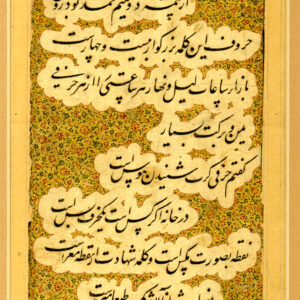
Dhūfan, Muhammad-Taqī, a prominent contemporary shrine builder and a master metal engraver (1900–1978 / 1279–1357).1
He was born in Isfahan in 1900/1279. After receiving an education in a traditional elementary school (maktab-khāne), he began learning the art of metal engraving (qalam-zanī) at the age of twelve under the supervision of his uncle, Ḥājj Hasan-Ali Qalam-zan. In parallel, he also studied traditional Persian design2. Alongside this training, he also studied traditional Persian design. Through years of dedicated practice, Dhūfan attained mastery in both design and engraving. Among his earliest projects was the design and embellishment of metal elements in major Safavid monuments such as the ‛Ālī Qāpū* Palace, the Masjed-e Shāh* (since 1979 Emām Mosque), and the Sheikh Luṭfullāh Mosque* in Isfahan. He engraved the illustrated motifs of Reza ‛Abbāsī* onto copper, brass, and silver surfaces. Dhūfan regarded his use of these miniature-inspired images as the most significant factor behind the success and popularity of his work. Dhūfan also revived outstanding specimens of Iranian historical metalwork with exceptional fidelity and artistry— such as the works he masterfully revived were golden rhyta—ceremonial drinking vessels shaped like various animals, especially lions, and emblematic of royal power in the Achaemenes period—as well as hunting-scene plates from the Sasanian era.3 In an effort to preserve the art of metal engraving, Dhūfan prioritized teaching, converting his home into a training workshop.4 His designs were so well regarded that carpet weavers, tile-makers, and textile printers in Isfahan frequently commissioned their most valuable patterns from him. He was also known as one of the most accomplished shrine builders of Isfahan.
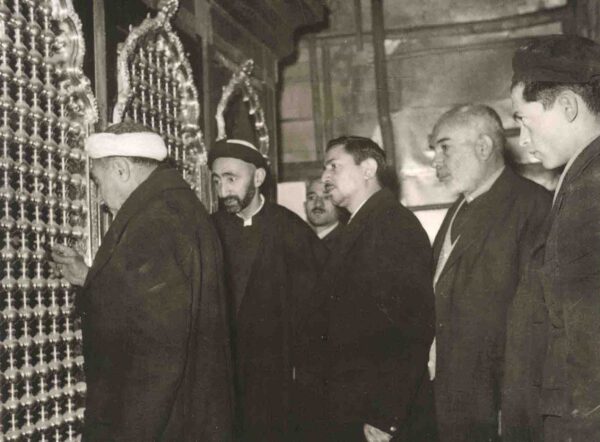
The most renowned example of Dhūfan’s design and metal engraving is the previous shrine enclosure (ḍarīḥ) of the tomb of Imam Reza. He constructed it with the assistance of his most accomplished students—such as Āqā Reza Kumeylī, Hasan Gulbīdī, Bāqer Jahānbakhsh, and ‛Aṭāʾullāh A‛ẓamī—alongside master craftsmen from other artistic disciplines. This new enclosure was built to replace the older steel shrine enclosure that had dated back to the reign of Fatḥ-Ali Shāh Qājār. Sayyid Abū al-Ḥasan Ḥāfeẓīyān (d. 1981/1360), a spiritual figure in Mashhad during that time, initiated this project of building new enclosure with support from the people of Pakistan and the Āstān-e Quds-e Raḍavī. He commissioned Dhūfan to undertake the construction. Dhūfan, in turn, committed himself to producing a shrine superior to all those that had been made before it.5 To design and prepare this shrine enclosure, Dhūfan was tasked with traveling to the sacred sites in Iraq to gather the necessary information.6 The construction of this shrine—commonly known by names such as the gold-and-silver shrine, the gilded shrine (mulamma‛), or the Shīr va Shekar motif shrine—began in 1957/1336. Hundreds of kilograms of gold and silver, along with thousands of kilograms of bronze, iron, and walnut wood, were used in its construction. The completed structure weighed more than seven thousand kilograms. Measuring 3.90 meters in height, 4.05 meters in length, and 3.06 meters in width, the shrine was finished and installed in Mashhad after two and a half years of work, in 1959/1338.7 Dhūfan himself engraved all the silver panels, columns, and inscriptions of the shrine. He oversaw and designed what became the largest and most valuable artwork of his time. As part of the project, he incorporated dozens of gold and silver inscriptions extolling the virtues of pilgrimage to Imam Reza, rendered in the calligraphy of Aḥmad Najafī Zanjānī, Ḥabībullāh Faḍāʾelī*, and Muhammad Reḍvān. He also adorned the structure with intricate motifs of grape clusters, leaves, and gold vases, all embellished with fine enamelwork (minākārī).8 In 2001/1380, due to the wear of its gold and silver surfaces and the decline in structural integrity, the shrine was removed and transferred to the museum of the Āstān-e Quds-e Raḍavī following the installation of a new one.9
Dhūfan’s name as the maker of the shrine is engraved on a silver inscription located at the base of the shrine. In recognition of his artistic achievement, he was granted the honorary title of “servant of the shrine” and was awarded the gold medal of the Āstān-e Quds-e Raḍavī.10 The most prominent engraved designs on the shrine include zoomorphic motifs, scenes of combat and hunting, alongside various painted designs in the Eslīmī and Khatāʾī styles—the latter attributed to the people of Khatā in China, Shah-‛Abbāsī flowers, and Gul-va-Murgh (floral-and-bird compositions). It is worth noting that Dhūfan also undertook the metal engraving for the shrine of Lady Ruqayya in Damascus, as well as the doors of the shrines in Najaf and in the sanctuary of Imam Reza.
Muḥammad-Taqī Dhūfan passed away in February 1979 (Bahman 1357) and was buried in Isfahan. He was among the few artists entrusted with the creation and engraving of many official emblems, ceremonial awards, and commemorative gifts for national celebrations and events. Some of these works are now held in private collections in Europe and the United States. Dhūfan had four sons, among whom Mahdi followed in his father’s profession.11 Over the course of his career, Dhūfan trained numerous students, including Murtaḍā Sarāʾīyān, Mīrzā Asadullāh, ‛Abbās Nezhād-Tabrīzīyān, and Hussein Teymūrī.
/Muhammad Afrūgh and ‛Abd al-Karīm ‛Aṭṭārzāde/
Bibliography
‛Uṭāredī Qūchānī, ‛Azīzullāh, Tārīkh-e Āstān-e Quds-e Raḍavī, vol. 1, Tehran: Vezārat-e Farhang va Ershād-e Eslāmī, Sāzmān Chāp va Enteshārāt, 1992/1371.
Dehnavī, Maḥmūd, Qalamzanī be revāyat-e Maḥmūd Dehnavī, Tehran: Khāne-ye Farhang va Hunar-e Gūyā, 2001/1380.
Dhūfan, Muhammad-Taqī, “Guftugū-ī bā Muhammad-Taqī Dhūfan ustād-e qalamzanī,” Hunar va Mardum, no. 126, Farvardīn 1352/March 1973.
Farmānīkīyā, Ma‛ṣūme, “Chand revāyat az yek ḍarīḥ,” Quds, 14 Esfand 1387/March 4, 2009.
Ḥāfeẓīyān, Abū al-Hasan, Sharḥ va tafsīr-e Lūḥ-e Maḥfūẓ, Tehran: Vezārat-e Farhang va Ershād-e Eslāmī, Sāzmān Chāp va Enteshārāt, 2007/1386.
Mashhadī-Muhammad, ‛Abbās (Ḥamīd), Mashhad al-Reza, Tehran: ‛Abbās (Ḥamīd) Mashhadī-Muhammad, 2004/1383.
Mehrān, Muhammad, “ḍarīḥ-e jadīd,” Nāme-ye Āstān-e Quds, no. 1, Tīr 1339/ June–July 1960.
Mu‛taman, Ali, Rāhnamā, yā Tārīkh va tuṣīf-e darbār-e velāyatmadār-e Raḍavī, Mashhad: Āstān-e Quds-e Raḍavī, 1969/1348.
- This article was previously printed in The Encyclopaedia of the World of Islam, vol. 19, pp. 14-15, and has been published in The Encyclopaedia Isfahanica with slight modifications.[↩]
- See: Dhūfan, pp. 95–96.[↩]
- Ibid., p. 97 and illustration on pp. 98–99.[↩]
- Ibid., p. 99.[↩]
- See: ‛Uṭāredī Qūchānī, vol. 1, pp. 75–81; Mehrān, p. 13; Ḥāfeẓīyān, introduction by Muhammad-Reza Ḥakīmī, pp. 15–16.[↩]
- Mehrān, p. 4.[↩]
- See: Mu‛taman, pp. 96–97; ‛Uṭāredī Qūchānī, vol. 1, pp. 81, 85–86; Mehrān, p. 8.[↩]
- See: Mu‛taman, pp. 98–100.[↩]
- See: Mashhadī-Muhammad, p. 154; Farmānīkīyā, p. 4.[↩]
- Mehrān, pp. 13, 17.[↩]
- Dehnavī, p. 12.[↩]