
The Quran of Keshvād b. Amlās, the oldest known dated copy of the Quran on paper in the world, was copied in Isfahan (in June–July 939/Ramadan 327).1
This manuscript, which was originally prepared in fourteen volumes, is now preserved in only three volumes in the library of the Āstān Quds Raḍavī. The codex is known as the Quran of Keshvād b. Amlās after the name of the donor who endowed it to the sanctuary of Imam Reza. Two volumes were discovered in 1969/1348 during restoration work in the sacred shrine of Imam Reza, when workers, between the double ceiling of the Dār al-Salām portico—a Timurid structure in the south-eastern part of the sanctuary—came across some bags filled with numerous Quranic fragments. Apparently, these bags had been transferred to this place five years earlier, in 1964/1343, from the space between the ceilings of the old library, which was located in the southern section of the sanctuary.2 This practice, namely burying or concealing fragments and folios of sacred texts within parts of sacred buildings (known as jenīza), has been an age-old tradition in the Islamic world.3
The most historically significant aspect of this manuscript is a note written in the early Kufic script on its first three folios, which records part of the concluding section of the endowment deed, the date of copying (939/327), and the place of copying, namely “Eṣbahān,” together a text that, in accordance with the Iranian tradition of Quranic codicology, lists the number of sūra (chapters), words, and letters of the Quran (Ms. no. 3013, fols. 1r–3r). The first folio of this manuscript is missing or appears to have been deliberately removed. For this reason, it seems that this Quran was endowed twice, although neither the first donor nor the original place of endowment is known.
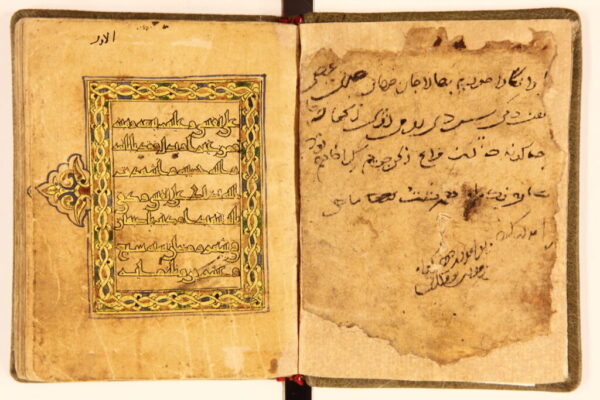
According to this note, the significance of the Quran of Keshvād lies in two main aspects: this manuscript is more than thirty years older than the Quran that had previously been regarded as the oldest known dated Quran on paper, namely the Quran copied by Ali b. Shādhān Rāzī in 971/361.4 This discovery demonstrates that the use of paper for copying the Quran goes back at least to 939/327 in Isfahan, whereas it had earlier been assumed that such a practice began several decades later.5
Another important point is the recording of the place of copying, for, on the basis of this note, this is the oldest known Quranic manuscript in which the place of copying has been explicitly stated. At present, there are folios from six other Quran manuscripts whose script displays entirely identical features with that of the Quran of Keshvād. This indicates that the style in question was not an individual manner of scripting, but rather a widespread and well-established style in fourth/tenth-century Isfahan.6 This, in turn, pushes back the evidence for the existence of a coherent regional style in the history of Islamic calligraphy in Iran to at least the fourth century.7 It is therefore plausible to assume that the so-called “Eṣfahānī script” mentioned by Ebn al-Nadīm in al-fehrest, among fifteen other scripts used for making a copy of the Quran,8 may in fact refer to this very particular style employed in the Quran of Keshvād.
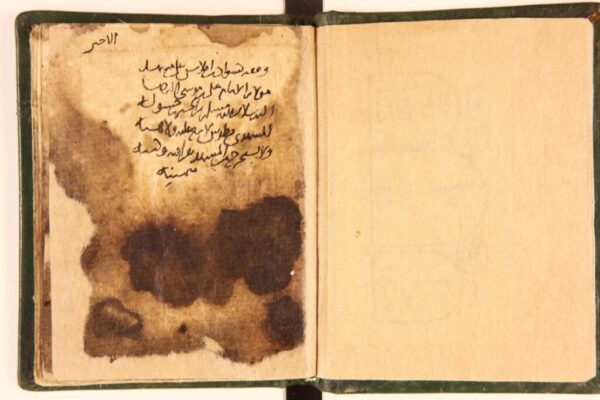
It is worth noting that two marginal notes serve as documentary evidence for the endowment of the Quran of Keshvād to the shrine of Imam Reza. The first, written in ruqā‛ script in black ink on the first folio of the eighth volume, reads: “waqafahū Keshvād b. Amlās ʽalā Mashhad al-Reza be Ṭūs, elayh-e al-salām [Sic.] katabahū be-yamīnehī” [وقفه کشواد بن املاس املاس علی مشهد الرضا الیه السلام بطوس کتبه بیمینه] (no. 3015, fol. 1r). This note identifies the secondary donor who endowed the manuscript to the shrine of Imam Reza. However, no further information about him is available. All that is known is that Ebn Shahr-āshūb, in his description of poets devoted to the Ahl al-Bayt, mentions an individual named Keshvād b. Īlās Sarvajī among the “extremist” (mujāherūn) poets who openly propagated Shiism.9 In view of the endowment of this manuscript to the shrine of Imam Reza, it is plausible to consider him as the donor of this Quran, and to attribute the slight difference in the rendering of the name (“Elyās” / “Īlās”) to scribal corruption or misreading in the transmission of the text.
Another note, written by a different hand in the fourteenth volume, repeats the name of the donor and mentions a certain Muslem b. al-Hussein b. Ḥasūle as the person to whom the manuscript had been entrusted (no. 3014, fol. 1r). The Shiite Ḥasūle family from Hamadan played a role in the administrative apparatus of the Buyid, Ghaznavid, and Seljuq*. The most renowned member of this family was Abul-‛Alāʾ Muhammad b. Ali b. Hasan b. Ḥasūle, who became known as “the vizier of the two courts” (wazīr Ṣafī al-Ḥaḍratayn).10 His father, Abul-Qāsem Ali b. Hasan b. Ḥasūle, served as secretary to Ṣāḥeb b. ‛Abbād* and, in 1030/421, mediated the endowment of a thirty-volume Quran to the shrine of Imam Reza.11 Since Muslim was probably the cousin of Abul-‛Alāʾ, and the latter died before 1058/450, the endowment of this Quran was most likely carried out in the early fifth/eleventh century, at least a century after it had been copied.
No. 3013 (76 folios): from the beginning of Sūrat al-Fāteḥa to the end of verse 2:269 of Sūrat al-Baqara (volume 1);
No. 3015 (78 folios): from the beginning of verse 18:75 of Sūrat al-Kahf to the end of verse 23:55 of Sūrat al-Muʾmenūn (volume 8);
No. 3014 (84 folios): from the beginning of Sūrat al-Ṭalāq to the end of Sūrat al-Nās (volume 14).12
This division, known as nīm-sub‛ (“half of a seventh”), is one of the methods of dividing the Quranic text and is attested in early Islamic Qurans produced in Iran.13 The Quran of Keshvād measures 11 × 9 cm, with eleven lines on each page. The text area in most folios is 6.5 × 5 cm, although the final folios of each volume are slightly smaller. The Quran is copied in a vertical (upright) format, which differs from the prevailing tradition of Abbasid-period Kufic Qurans, since until the early fourth/tenth century Qurans were usually copied in a horizontal (bayāḍī) format.14
The paper of this manuscript is relatively thick and compact, indicating the density and compression of its fibers. Its color is a dark, matte cream, which is most probably the result of three factors: the density of the fibers, the thickness of the paper, and the limited amount of starch used in its composition. In certain areas, small specks can be seen, left by impurities in the paper pulp. Moreover, in places where the smooth surface of the paper has worn away, the structural weakness caused by the shortage of starch is clearly visible.15 These features correspond closely to the characteristics of Iranian papers from the early twelfth/sixth century.16 Accordingly, in light of the date of the Quran of Keshvād, the emergence of this type of paper may be traced back to the fourth/tenth century.
The main text of the Quran is written in Eastern Kufic. The script is characterized by a rigorous application of geometric construction, carefully proportioned letter bodies, and a pronounced contrast between thick and thin strokes. The pen’s maximum stroke thickness measures approximately 0.75 mm, while the average line height is about 4.3 mm. Despite the small format, the script is highly disciplined, regular, and clearly governed by a defined set of calligraphic rules. The isolated alef terminates in a distinct horizontal tail; jīm is executed with a pronounced, heavy diagonal movement; ṭāʾ consists of two parallel horizontal strokes combined with a slightly oblique vertical stem tipped with an inverted head; ‘ayn displays a wide, diagonally opened aperture; mīm is rendered in a lozenge-shaped form with an extended, freely flowing tail; and nūn and yāʾ are written with comparatively rounded, bowl-like terminals. Another defining characteristic of this style is the presence of angular, heptagon-like ligatures—usually formed with a thin connective stroke—created from the intersection of two oblique structural cores of adjacent letters17 (fig. 3).
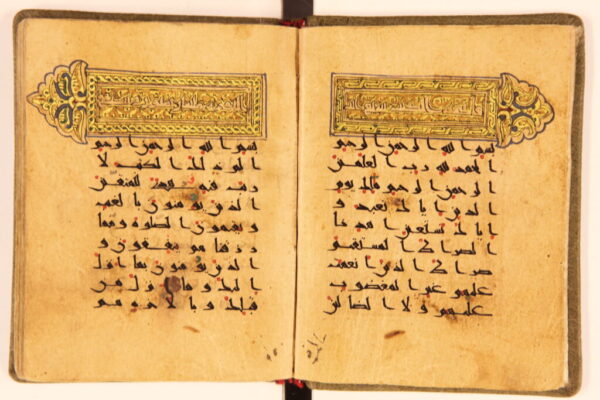
One of the defining characteristics of this manuscript is the remarkably wide spacing between letters within individual words—a feature associated with what is known as continuous copying (scriptio continua), inherited from the early Kufic Qurans.18 In Qurans exhibiting this feature, it is normally common for words at the end of a line to be divided, with the remaining part copied at the beginning of the next line. In the Quran of Keshvād, however, the scribe has successfully avoided splitting words across lines, consistently ending each line with a complete word. To achieve this, he employed two techniques: elongating letter strokes at the end of lines and compressing the final words when necessary. In the second and sixth lines of the first page of the text in the opening volume, the extended forms of the words al-‛ālamīn, al-mustaqīm, and ‛alayhem, together with the unusually wide spacing between the final words of the lines, were deliberately used to visually justify and fill out the lines.
The sūra-headings and the endowment note are written in early Kufic script in gold ink, outlined in brown or black. In this handwriting, the returning stroke of the lower part of the isolated alef is long and pointed; jīm rests directly on the baseline; ‛ayn displays a wide, generally circular aperture; and mīm has a short horizontal stroke lying on the baseline. These features represent a combination of characteristics associated with styles D.I and D.V.c in François Déroche’s classification of early Abbasid Quranic Kufic scripts. While Déroche maintains that it is not possible to determine with certainty the geographical origins or centers of diffusion of the early Kufic styles,19 the Quran of Keshvād clearly indicates that at least styles D.I and D.V.c were current and practiced in Isfahan.
In the Quran of Keshvād, vocalization is carried out with small circular red dots: a dot placed above the letter indicates fatḥa, a dot below indicates kasra, and a dot to the left marks ḍamma. This system is traditionally attributed to Abul-Aswad al-Duʾelī.20 Inflection is applied primarily to the final letters of words, since in most cases the vowel on the final consonant determines the grammatical function of the word within the sentence.21 Consonantal dotting (e‛jām) is executed with black, oval-shaped dots of varying size and form. Certain signs—such as sukūn (vowelless mark), shedda (gemination sign), and madd (prolongation)—have been added in green ink and are disproportionately large, suggesting that they were added later. The sukūn sign is crescent-shaped, corresponding to what is known in the Maghrebī tradition as khafīf.22 The pause mark (waqf) is written with a red letter qāf placed above the word, and the same form is employed for all types of pauses.
The rasm al-muṣḥaf (the orthographic system of the Quranic text) in the Quran of Keshvād tends towards an orthographic or analogical system, as it reflects a combination of writing conventions adopted according to scribal necessity. For example, alef is generally written in most words, except in cases where a shortage of space at the end of a line has required its omission. The naming of the sūra likewise reflects an older practice different from the modern convention, with titles such as “Nūn wa-l-Qalam” (68), “‛Amma Yatasāʾalūn” (78), “Alam Nashraḥ” (94), and “al-Qalam” (96), which are not used in contemporary muṣḥaf.23
It is worth noting that throughout the text various diacritical and inflection signs have been added, reflecting other recitations were current in the fourth/tenth century. The cinnabar-red dots largely correspond to the readings of Abū ‛Amr and Ya‛qūb, while the green dots are almost entirely consistent with the reading of Nāfe‛. With regard to the ‛add al-āy (verse enumeration), although the verse endings are not explicitly marked within the text, the presence of the ‛ashr sign (marking every ten verses) in the margins indicates that the scribe adhered to the Basra system of verse numbering.24
The first three folios of the first volume, containing the endowment deed, along with the date and place of copying, are illuminated. On these pages, the text is set within decorative gold panels with an ochre ground and a thick lapis-blue border. In the margins of these folios, a sunburst medallion (shamse) composed of gilt leaves appears. The first two folios of the fourteenth volume contain a vertical illuminated page with a lattice-pattern background and a large shamse, both enclosed within a chain-like gold frame. The opening pages of the main text are without colored ruling, although the impressions of the ruling frame (mesṭara) are clearly visible in the form of horizontal and vertical ruling lines. The sūra-headings on the illuminated incipit pages are placed at the top of the page; inside them, the title of the sūra and the number of its verses are written in early Kufic script. In the side margin beside the sūra frame, a shamse similar to those found on the other decorated pages is placed, ornamented with lapis-blue and ochre, bordered in blue, and filled with symmetrically arranged gilt leaves.
Of the original binding, only the cover of the first volume has survived. It is made of a single piece of solid black leather, although its edges are worn. The surface of the cover bears a large geometric interlace design, stamped in relief using the mushtī (hot-tooling technique). This method—known in Iran as mushtī, kūbīde, or mangane—consisted of carving the design onto metal dies and then striking the heated die onto moistened leather, thereby impressing the pattern.25
/Mahdi Sahrā-gard/
Bibliography
Blair, Sheila S. Islamic calligraphy, Edinburgh: Edinburgh University Press, 2008a.
Blair, Sheila S., “Transcribing God’s word: Qur’an codices in context”, Journal of Qur’anic studies, vol.10, no. 1 (2008b).
Bloom, Jonathan M., “Silk Road or paper road?”, The Silk Road, vol.3, no. 2 (2005). Retrieved Dec.12,2025, from www.silkroadfoundation.org/newsletter/vol3num2/5_bloom.php
Dānī, ‛Uthmān b. Sa‛īd, al-muḥkam fī nuqaṭ al-maṣāḥef, ed. ‛Azze Hasan, Beirut: Dār al-Fekr al-Mu‛āṣer, 1997/1418.
Déroche, François, The Abbasid tradition: Qur’ans of the 8th to the 10th centuries AD, in The Nasser D. Khalili Collection of Islamic Art, vol.1, ed. Julian Raby, London: The Nour Foundation, 1992.
Ebn Nadīm, ketāb al-fehrest, tr. Muhammad-Reza Tajaddud, Tehran: Chāpkhāna-ye Bānk-e Bāzargānī-ye Iran, 1967/1346.
Ebn Shahr-āshūb, ma‛ālem al-‛ulamāʾ, Najaf: Manshūrāt al-Maṭba‛a al-Ḥeydarīyye, 1961/1380.
Ebn Shāker Kutubī, fawāt al-wafayāt, ed. Eḥsān ‛Abbās, Beirut: Dār Ṣāder, 1973–1974.
Gulchīn-Ma‛ānī, Aḥmad, “shāhkārhā-ye hunarī-ye shegeft-angīzī az qarn-e panjum hejrī va sarguzasht-e heyrat-āvar-e ān,” hunar va mardum, no. 157 (1975/Ābān 1354).
Gulchīn-Ma‛ānī, Aḥmad, rāhnamā-ye ganjīne-ye Quran, Mashhad: Āstān-e Quds-e Raḍavī, 1968/1347.
Ḥamad, Ghānem Qudūrī, rasm al-khaṭṭ al-muṣḥaf, tr. Ya‛qūb Ja‛farī, Tehran: Usve, 1997/1376.
Karīmī-nīyā, Murtaḍā, Quran-hā-ye kūfī dar Iran va dīgar pāre-hā-ye ān dar jahān: sade-ye nakhust tā panjum, Tehran: Markaz-e Ṭab‛ va Nashr-e Quran-e Jumhūrī-ye Eslāmī-ye Iran, 2022/1401.
Loveday, Helen, Islamic paper: a study of the ancient craft, London: Archetype Publications, 2001.
Māyel Heravī, Najīb, ketāb-ārāʾī dar tamaddun-e Eslāmī, Mashhad: Bunyād-e Pazhūhesh-hā-ye Eslāmī, 1993/1372.
Qalqashandī, Aḥmad b. Ali, ṣubḥ al-a‛shā fī ṣanā‛at al-enshāʾ, Cairo: Wezārat al-theqāfa wa al-Ershād al-Qawmī, 1910–1920, offset print 1963/1383.
Sahrā-gard, Mahdi, “Revived leaves: The Qur’an endowed by Kishvād b. Amlās, the oldest known Qur’an manuscript on paper (327/939)”, Journal of Islamic manuscripts, vol.14, no.2-4 (Aug. 2023).
Ṣaḥrā-gard, Mahdi, “sabk-shenāsī-ye manṭaqeʾī-ye kūfī-ye sharqī: barresī-ye ṣefāt-e qalam-e kūfī dar Quran-e Isfahan (maḥfūẓ dar ketābkhāna-ye Āstān-e Quds-e Raḍavī),” nāme-ye hunarhā-ye tajassumī va karburdī, vol. 13, no. 28 (2020/1399a).
Ṣaḥrā-gard, Mahdi, saṭr-e mastūr: tārīkh va sabk-shenāsī-ye kūfī-ye sharqī, Mashhad: Bunyād-e Beyn-al-melalī-ye Farhangī Hunarī-ye Imam Reza, 2020/1399b.
- Ṣaḥrā-gard, 2020/1399b, p. 128.[↩]
- Gulchīn-Ma‛ānī, 1975/Ābān 1354, p. 48.[↩]
- Déroche, p. 13.[↩]
- Blair, 2008a, p. 152.[↩]
- Bloom, 2005.[↩]
- Ṣaḥrā-gard, 2020/1399a, pp. 25–29.[↩]
- Ṣaḥrā-gard, 2023, pp. 214–215.[↩]
- Ebn Nadīm, p. 9.[↩]
- Ebn Shahr-āshūb, p. 149.[↩]
- Ebn Shāker Kutubī, vol. 3, p. 430.[↩]
- Gulchīn-Ma‛ānī, 1968/1347, p. 36.[↩]
- Ṣaḥrā-gard, 2020/1399b, p. 128.[↩]
- idem, p. 111.[↩]
- Déroche, p. 17.[↩]
- Loveday, pp. 59–60.[↩]
- Loveday, p. 60.[↩]
- Ṣaḥrā-gard, 2020/1399b, pp. 69–70.[↩]
- Blair, 2008b, p. 78.[↩]
- Déroche, p. 14.[↩]
- Qalqashandī, vol. 3, p. 156.[↩]
- Ḥamad, p. 463.[↩]
- Dānī, p. 52.[↩]
- Karīmī-nīyā, 2022/1401, pp. 397–398.[↩]
- idem, pp. 407–408.[↩]
- Māyel Heravī, p. 611.[↩]
