
Ṣāʾeb, Mausoleum, a garden and funerary complex situated adjacent to the Nīyāṣarm Canal (mādī), belonging to Mīrzā Muhammad-Ali Beyg Tabrīzī Esfahānī, known by his poetic epithet Ṣāʾeb (ca. 1591/1000– 1675–1676/1086–1087), the celebrated poet of the Safavid period.
The garden lies to the south of Ṣāʾeb Avenue (formerly called Ṣafā Avenue). In various sources, this precinct has been referred to by several names, including Bāgh-e Tekye1, Tekye Darvīsh2, Bāgh-e Mīrzā3, Tekye Mīrzā Ṣāʾeb4, and Qabr-e Āqā.5
The location of the garden during the lifetime of Ṣāʾeb formed part of the newly established quarter of ‛Abbās-ābād, which was among the largest and most flourishing quarters of Isfahan and regarded as the residence of the city’s notable figures.6 It is said that the family of Ṣāʾeb, after migrating from Tabrīz to Isfahan, settled in this very quarter. Ṣāʾeb himself, after a period of absence, returned to Isfahan around the age of forty and lived in this quarter until the end of his life.7 Malīḥā-ye Samarqandī (alive in 1692/1104)8, writing in 1679/1090, shortly after the death of Ṣāʾeb, described the house or “Dawlat-khāne-ye Mīrzā Ṣāʾeb” as one of the most elevated and spacious residences of the ‛Abbās-ābād quarter*.9 According to certain sources, the burial place of Ṣāʾeb was located either in the Garden of Ṣāʾeb or at his own residence.10 Humāyī (d. 1980/1359) states that, after his death, Ṣāʾeb was buried in a small garden belonging to himself;11 but according to the account of Malīḥā-ye Samarqandī—who had seen both the house and the mausoleum—Ṣāʾeb was buried, in accordance with his will, in the “Tekye Darvīsh Ṣāleḥ, whom he revered, near the Mārvīyān Bridge and facing the Chahārsūq-e Darūn, situated along the margin of the Zendehrūd”.12 It has been reported that Darvīsh Ṣāleḥ (d. 1663/1073) was a renowned mystic in Isfahan, followed by many of the city’s ulema and dignitaries,13 and that Shah ‛Abbās II* built for him a pleasant tekye (Sufi lodge) along the canal known as the Ṭāq-namā,14 and he was buried in that same tekye. Three years after the death of Ṣāʾeb, Malīḥā described this tekye as a delightful garden, within which there existed a domed shrine over the grave of Darvīsh Ṣāleḥ, and a grapevine growing over the grave of Ṣāʾeb, while in the ṭāq of the mausoleum of Darvīsh Ṣāleḥ a quatrain had been inscribed:
On the day that they unrolled the scroll of our sorrow-letter
They took it to the scale of deeds and weighed it
They saw that our guilt exceeded all others,
They pardoned us for the sake of our love for Ali15
Ān rūz ke ghamm-nāme-ye mā pīchīdand
burdand be mīzān-e ‛amal sanjīdand
dīdand ke būd jurm-e mā az hame bīsh
mā rā be muhabbat-e Ali bakhshīdand
According to Khushgū (d. 1756/1170) and Sarkhush (d. 1715/1127), both poets of the late Safavid period, it has also been recorded regarding two verses inscribed on the grave of Ṣāʾeb that “a master of eloquence reached that place and wrote this verse upon his grave:
‘O morning breeze, tread gently upon the leaves of the buds
the flowers stand as guardians, for Ṣāʾeb is asleep’16
Ey ṣabā āheste pā bar barg-hā-ye ghunche neh
Pāsbānānand gul-hā, Ṣāʾebā khābīde ast
This verse was probably an inscription on the tombstone that gradually disappeared over time.
According to Humāyī (d. 1980/1359), Ṣāʾeb passed away in late 1676/1086, and his tombstone was made and set upon his grave in early 1677/1087, and installed over his grave in the garden of the mausoleum.17 The funerary garden, which had gradually become known as “Tekye-ye Mīrzā Ṣāʾeb,” fell into oblivion after the Safavid period and the decline of Isfahan.
Before the rediscovery of the tomb of Ṣāʾeb in the past century, this place was known among the inhabitants of the Lunbān quarter as “Qabr-e Āqā,” [mausoleum of the master] and its visitation was customary among women on Thursday nights and other blessed nights.18 Several accounts exist regarding the rediscovery of the burial site and the person who located it. According to Humāyī, “In October 1922/Mehr 1301, while I was engaged in research among the cemeteries of Isfahan, I encountered historical indications leading me to this place […]. With the assistance of the gardener of the Ṣāʾeb estate, I carried out an excavation in a corner and brought forth the tombstone of the great poet from beneath layers of soil.”19 On the other hand, Ebrāhīm Ṣafāʾī (d. 2007/1386), the journalist and historian, has written that in 1938/1317, during a journey to Isfahan, he located the tomb of Ṣāʾeb—along with two other gravestones—outside the city, at the far end of a quince orchard near Shāhpūr Avenue (present-day Shahīd Beheshtī Street), guided by Ulfat Esfahānī* (d. 1964/1343), an Esfahānī poet.20 A further account is provided by Mīrzā Faḍlullāh Khan E‛temādī Khūʾī (d. 1948/1327), an Esfahānī poet known by the pen name Burnā*, who stated that he knew the location of Ṣāʾeb’s grave and that through his efforts, correspondence, and mobilization of support from several inhabitants of Isfahan, the garden was removed from private ownership so that a mausoleum could be erected over Ṣāʾeb’s resting place.21
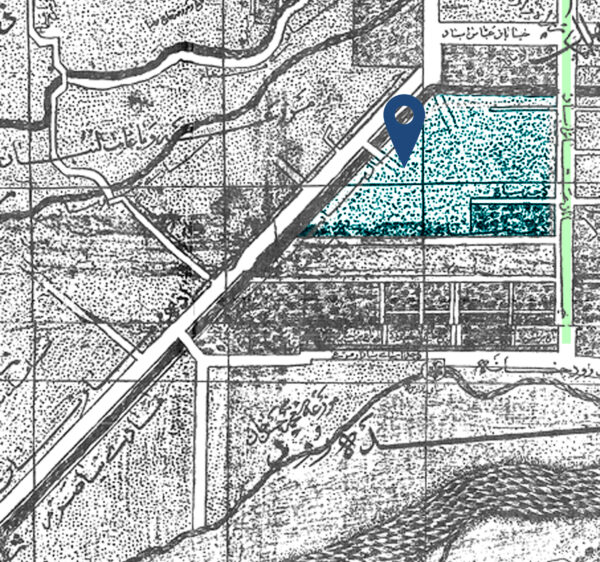
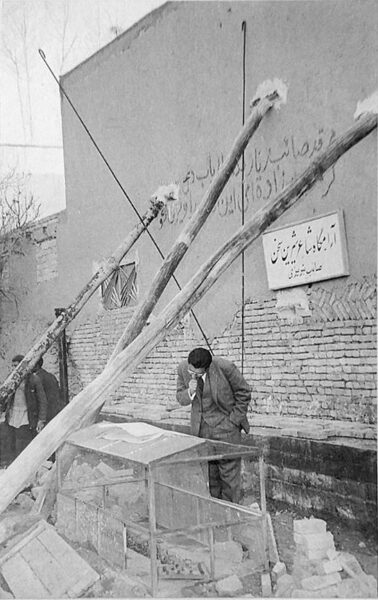
According to various accounts, the mausoleum garden was originally much larger.22 In Sulṭān Sayyed-Reza Khan’s map as well, the location of the tomb corresponds to a garden that extended eastward as far as the present-day Urdībehesht Street (fig. 1).23 In 1930/1309, the garden was registered among the endowments of the Lunbān Mosque*, whose praying leader, bearing the family name Khuldī-Nasab, served as its administrator. The garden had been divided into two parts, and one section had been leased out. In 1963/1342, the Archaeology Department leased the garden from the Awqāf Administration, reunified the two sections into a single parcel, and then, in a formal ceremony, arranged for the governor, members of the council, and the public to visit the site. At the time when Ṣāʾeb’s grave was rediscovered, no trace remained of the building of the tekye of Darvīsh Ṣāleḥ (fig. 2).24
The new structure of the mausoleum of Ṣāʾeb is among the memorials constructed by the Anjuman-e Āthār-e Mellī (National Monuments Council).25 Prior to this, the Council had erected commemorative monuments for poets and cultural figures such as Ferdavsī, Sa‛dī, Khayyām, and Abū Ali Sīnā. These memorials were generally built with public contributions, designed by Iranian architects, and inspired by the architectural traditions of earlier Iranian periods. In the construction of Ṣāʾeb’s mausoleum as well, part of the expenses was provided by the people of Isfahan, while the remainder was financed by the National Monuments Council.26 At the request of the Council members, the mausoleum was designed as a simple and tall vaulted porch “in the architectural style of the Safavid period.”27 The preliminary elevation design was produced by Mohsen Furūghī (d. 1983/1362),28 after which Hussein Ma‛ārefī* (d. 1975/1354) prepared the architectural drawings based on that design. The plan was finalized in 1963/1342 with the supervision of Furūghī. The project executor was Aḥmad-Ali Beshārat (d. 2012/1391), deputy of the Archaeology Department of Isfahan, while Hussein Ma‛ārefī oversaw the technical aspects of the construction. Construction of the mausoleum began on 27 September 1963/5 Mehr 1342 and was completed in 1967/1346; after a delay of several months, the building was inaugurated on 8 October 1968/16 Mehr 1347.29 The inauguration of the mausoleum of Ṣāʾeb was a cultural event. The ceremony was held with the participation of cultural figures and literary men of the time, along with several members of the Parliament and directors of governmental organizations.30 Some poets, such as Karīm Amīrī Fīrūzkūhī (d. 1984/1363) and Majīd Avḥadī (d. 1976/1355), composed poems for the inauguration of the mausoleum.31 Simultaneously with the opening of the building, an edition of the divan of Ṣāʾeb was also published.32
Beginning around the 1950s/1330s, several literary societies bearing the name of Ṣāʾeb gradually became active in Isfahan, holding periodic gatherings at his mausoleum. The first literary society named after Ṣāʾeb—out of which the initial nucleus of Jung-e Isfahan* later emerged—was founded through the efforts of Nāṣer Muṭī‛ī (d. 2017/1396) in 1957/1336. Meetings of this society were held in Bāgh-e Ṣāʾeb from 1960 to 1961/1339 to 1340. During this period, public commemorative ceremonies marking the anniversaries of the deaths of Malek al-Shu‛arā Bahār (d. 1951/1330), Ṣādeq Hedāyat (d. 1951/1330), and Ali-Akbar Dehkhudā (d. 1955/1334) were also held at this location.33
Another society, named the Ṣāʾeb Literary Society, was founded in 1959/1338 through the efforts of Khalīl Sāmānī (d. 1981/1360), who was known by the pen name mavj ]the Wave[. This society published, from 1959 to 1979/1338 to 1358, a periodical entitled The Garden of Ṣāʾeb; A Gift from the Ṣāʾeb Society (Bāgh-e Ṣāʾeb; Hadīyye-ye Anjuman-e Adabī-ye Ṣāʾeb), edited by Sāmānī.34
From 1965/1344, Muhammad Bīrīyā Gīlānī (d. 1994/1373) founded the Ṣāʾeb School Literary Society, whose sessions were presided over by Muhammad-Hussein Ṣaghīr Esfahānī* (d. 1970/1349) and attended by a group of Esfahānī poets, held in the Garden of Ṣāʾeb. During its first year, the society met every Friday morning beneath the shade of the garden’s trees. After a few months’ interruption, beginning in June 1966/Khurdād 1345, a room within the mausoleum complex was allocated for the society’s gatherings.35 This society, which promoted the Ṣāʾeb style in ghazal composition, continued its activities in the same location for many years.36 After the transfer of Bīrīyā Gīlānī to Tehran in 1973/1352, the leadership of the Ṣāʾeb School Literary Society was assumed by Muhammad-Ali Ṣāʿed37 (d. 2021/1400). Among the members of this society, Muhammad-Ali Ṣāʿed and Ṣaghīr Esfahānī played an important role in pursuing the construction of the mausoleum building.38
In 2013/1392, the Supreme Council of Public Culture of Iran designated the tenth of Tīr as “Ṣāʾeb Tabrīzī Day.”39 On this occasion, a commemorative ceremony for Ṣāʾeb is held annually at his mausoleum.
The garden of the mausoleum of Ṣāʾeb is situated adjacent to the Mādī-ye Nīyāṣarm*, and the entrance to the garden is marked by a prominent pedestal bearing a bust of Ṣāʾeb. The garden contains an elongated pool along its central axis, aligned with both the entrance to the garden and the opening of the īvān of the mausoleum structure. Two garden avenues, located on either side of the pool, are lined with four rows of cypress trees. At the far end of each of these two avenues, the mausoleum building becomes visible. The longitudinal axis of the garden extends from north (the garden entrance) to south (the mausoleum structure), and its length is approximately twice its width.
The mausoleum structure consists of a broad, columned vaulted porch set upon a ṣuffe (raised platform) approached by ten steps. The īvān is open on three sides. The slender columns of the vaulted porch are made of marble, and above them rise pointed arches executed in mosaic tilework (fig. 3).
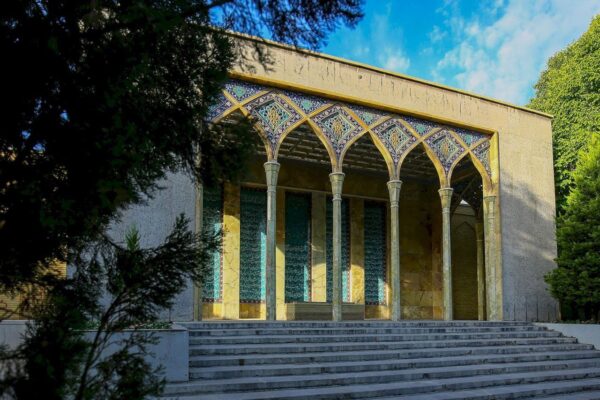
The southern wall of the vaulted porch is faced with marble, and five verticals, recessed concave panels executed in mosaic tilework are set into it, aligned with the five openings of the northern façade. The inscriptions are written in white nasta‛līq script against a turquoise ground. The tilework design was created by Amir Hūshang Jazīzāde* (d. 2026), while the calligraphy was executed by Ḥabībullāh Faḍāʾelī* (d. 1997/1376), and the tilework was carried out by master craftsmen including Hussein Muṣaddeqzāde* (d. 2025/1404) and Ḥabībullāh Muṣaddeq (d. 2014/1393).40 The central inscription introduces the building, the poet, and the patrons, while the eastern inscription consists of a poetic composition by Jalāl al-Dīn Humāyī* that includes the chronogram41 for the construction of the monument. The remaining inscriptions contain selected verses from the divan of Ṣāʾeb.42 The ceiling of the mausoleum is covered with refined mirrorwork, arranged in a pattern of latticed rectangles, and encircled by a frame of turquoise mosaic tilework decorated with geometric knot motifs (gereye-chīnī) in the form of a shamsa. The reflection of the interior space upon the ceiling creates the perception of an expanded, upward-opening spatial field, at the center of which stands the cenotaph of Ṣāʾeb (fig. 4).
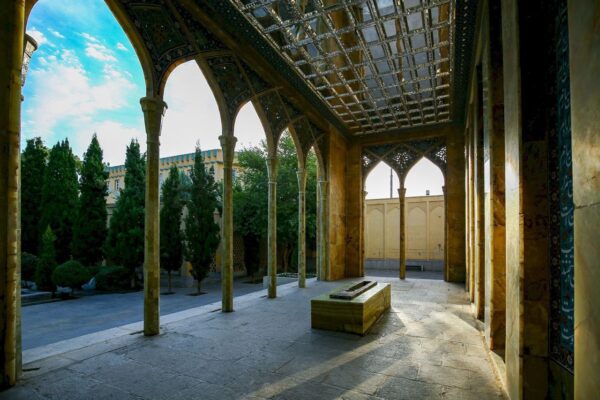
The stone cenotaph is positioned at the center of the vaulted porch, aligned with its longitudinal axis, and is made of marble from Yazd. Along its edge, a bold nasta‛līq inscription reads: “Ṣāʾeb’s chest is a place of pilgrimage for the companion of heart.” (sīne-ye Ṣāʾeb zīyāratgāh-e arbāb-e del ast). Placed atop it is Ṣāʾeb’s original tombstone, a single-piece black stone of pebble stone. According to its inscription, the tombstone dates to 1676–1677/1087. Apart from the date and the calligrapher’s signature, the remaining inscriptions on the tombstone are in verse and are by Ṣāʾeb himself. At the center of the stone, a finely carved basin resembling old wooden spouts is formed, typically filled with fresh flowers set in water (fig. 4). According to Humāyī, this motif was common in the Safavid* period and was known as the “mercy spout” (nāvdān-e raḥmat).43 Inscribed above the stone is the opening couplet: “Never will the traces of my being fade from the pages of hearts; I am that very delight discovered in my words.” Along the margins of the stone, five couplets from another celebrated ghazal by Ṣāʾeb44 are inscribed. The inscriptions are executed in elegant nasta‛līq by Muhammad-Ṣāleḥ Esfahānī*45 (d. 1717/1130),46 and at the lower inscription the following is written: “taḥrīran shahr-e Jumādī al-Awwal sana 1087 faqīr Muhammad-Ṣāleḥ” [“Written in Jumādī al-Awwal, year 1676–1677/1087, by the humble Muhammad-Ṣāleḥ.”].47 Besides Ṣāʾeb, two of his sons, Mīrzā Abū al-Qāsem (d. 1727/1140) and Mīrzā Muhammad Muḥsenā (d. 1736/1149), as well as one of his relatives named Mīrzā Muhammad-Ali, son of Mīrzā Raḥīm Ṣāʾeb (d. 1728/1141), are buried, and their gravestones are still preserved today in the vaulted porch of the mausoleum.48
A portion of the mausoleum garden is separated on its eastern side by a perforated brick arcade. In 1979/1358, a public library named after Ṣāʾeb was established in this section and remained active for several decades. Later, in 2007/1386, a three-story building known as the Ṣāʾeb Cultural and Artistic Complex was constructed in the same location, replacing the earlier structure. This building, which houses a public library, is also used as the new venue for meetings of the Ṣāʾeb Literary Society.49 Despite the proximity of the new building to the mausoleum, its architecture bears no stylistic relationship to the mausoleum. The garden of the mausoleum also extends westward into a wooded area adjacent to the Mādī-ye Nīyāṣarm.
On 18 August 2025/27 Murdād 1404, Maḥmūd Farshchīyān*, the renowned Iranian master painter, was buried—according to his will—in the western section of the garden of the mausoleum of Ṣāʾeb (fig.).50
The garden and mausoleum of Ṣāʾeb were registered on the National Heritage List of Iran on 9 February 1977/20 Bahman 1355, under registration no. 1332.51
/Sara Bemanian/
Bibliography
“ārāmgāh-e Ṣāʾeb [registration file],” pazhūheshgāh-e mīrāth-e farhangī va gardeshgarī, 2025/1404.
Retrieved Nov. 19, 2025, from https://library.richt.ir/site/catalogue/180179.
Amīrī Fīrūzkūhī, Karīm, “ārāmgāh-e Ṣāʾeb,” Vaḥīd, no. 58, Mehr 1968/1347.
Amīrī Fīrūzkūhī, Karīm, “maḥall-e qabr-e Ṣāʾeb va chegūnegī-ye peydāyesh-e ān; naql-e qawl-e Amīrī Fīrūzkūhī az Jalāl al-Dīn Humāyī,” Farhang-e Isfahan, no. 25–26, Autumn–Winter 2002/1381.
Baḥr alʽUlūmī, Hussein, kārnāme anjuman āthāre melli, Tehran: anjuman āthāre melli, 2535/1977.
Beshārat, Aḥmad-Ali, mīrāth-e farhangī-ye Isfahan be revāyat-e Sayyed Aḥmad-Ali Beshārat, ed. Mas‛ūd Sayyed Bunakdār, Isfahan: Naqsh-e Mānā, 2022/1401.
Chardin, Jean, safarnāma-ye Chardin, tr. Eqbāl Yaghmāʾī, Tehran: Ṭūs, 1993–1996/1372–1375.
Dūstkhāh, Jalīl, “yādī az kūsheshī farhangī dar sāl-hā-ye khafqān: panjāhumīn sāl-e bunyādguzārī-ye Jung-e Isfahan,” Bukhārā, no. 93, Khurdād–Tīr 2013/1392.
Humāyī, Jalāl al-Dīn, “[she‛r],” Vaḥīd, year 1, no. 1, Dey 1964/1342.
Humāyī, Jalāl al-Dīn, tārīkh-e Isfahan: rejāl va dāneshmandān, ed. Māh-Dukht Bānū Humāyī, Tehran: Pazhūheshgāh-e ‛Ulūm-e Ensānī va Muṭāle‛āt-e Farhangī, 2017/1396.
Hunarfar, Luṭfullāh, ganjīne-ye āthār-e tārīkhī-ye Isfahan, Isfahan: Thaqafī, 1971/1350.
Isfahan Emrūz News Agency, 2017/1396.
Retrieved Dec. 10, 2025, from https://esfahanemrooz.ir/fa/tiny/news-17836
Islamic Republic News Agency, 2007/1386.
Retrieved Nov. 17, 2025, from https://www.irna.ir/news/4919277
Khushgū, Bendrā Ban-Dās, safīna-ye khushgū, part 2, ed. Kalīm Aṣghar, Tehran: Ketābkhāne, Mūze va Markaz-e Asnād-e Majles-e Shūrā-ye Eslāmī, 2010/1389.
Kīyānī Falāvarjānī, Ali, “Ṣaghīr Esfahānī, Muhammad-Hussein,” in dāneshnāma-ye jahān-e Eslām, vol. 29, Tehran: Bunyād-e Dāʾerat al-Ma‛āref-e Eslāmī, 2021/1400.
Losensky, Paul E., “Ṣāʾeb Tabrīzī,” in Encyclopædia Iranica [online].
Retrieved Nov. 17, 2025, from https://www.iranicaonline.org/articles/saeb-tabrizi
Mahdavī, Muṣleḥ al-Dīn, a‛lām-e Isfahan, ed. Ghulām-Reza Naṣrullāhī, Isfahan: Sāzmān-e Farhangī Tafrīḥī-ye Shahrdārī, 2007/1386–.
Mahdavī, Muṣleḥ al-Dīn, mazārāt-e Isfahan: az qarn-e sevvum-e hejri tā zamān-e ḥāẓer, ed. Aṣghar Muntaẓem al-Qāʾem, Isfahan: University of Isfahan, 2003/1382.
Malīḥā Samarqandī, Muhammad-Badī‛ b. Muhammad Sharīf, mudhakker al-aṣḥāb, ed. Muhammad Taqavī, Tehran: Ketābkhāne, Mūze va Markaz-e Asnād-e Majles-e Shūrā-ye Eslāmī, 2011/1390.
Mehr News Agency, 2013/1392.
Retrieved Dec. 10, 2025, from http://mehrnews.com/xnT98
Mehr News Agency, 2025/1404.
Retrieved Nov. 17, 2025, from https://www.mehrnews.com/photo/6564494
Muṣaffā, Maẓāher, “ārāmgāh-e Ṣāʾeb dar Isfahan,” Yaghmā, no. 241, Mehr 1968/1347.
Naṣr-ābādī, Muhammad-Ṭāher, tadhkere-ye naṣr-ābādī, ed. Hasan Vaḥīd Dastgerdī, Tehran: Ketābfurūshī-ye Ebn Sīnā, 1938/1317.
Panāhī Semnānī, Muhammad, “mīrāth-e adabī-ye Khalīl Sāmānī (Mavj),” in yādnāma-ye Khalīl Sāmānī (Mavj), ed. Sepīdeh Sāmānī, Tehran: Tābesh, 1984/1363.
Pāzūkī Ṭarūdī, Nāṣer and Shādmehr, ‛Abd al-Karīm, āthār-e sabt-shude-ye Iran dar fehrest-e āthār-e mellī: az 24/6/1310 tā 24/6/1384, Tehran: Sāzmān-e Mīrāth-e Farhangī-ye Keshvar, 2005/1384.
Qaṣrī, Ḥāmed, qahramānān-e tanhāyī dar yek shahr; darangī dar tajrube, andīshe va zīst-e jaryān-e Jung-e adabī-ye Isfahan (1332–1360), Tehran: Ketāb Sarzamīn, 2021/1400.
Ṣafā, Zabīḥullāh, tārīkh-e adabīyāt-e Iran, Tehran: Ferdavs, 1984–1991/1363–1370.
Ṣafāʾī, Ebrāhīm, “dīdārhā: dīdārī bā Ulfat-e Esfahānī va dāstān-e ārāmgāh-e Ṣāʾeb,” Negīn, no. 62, Tīr 1970/1349.
Sarkhush, Muhammad-Afḍal b. Muhammad-Zāhed, kalemāt al-shu‛arāʾ, ed. Ali-Reza Qazve, Tehran: Ketābkhāne, Mūze va Markaz-e Asnād-e Majles-e Shūrā-ye Eslāmī, 2010/1389.
Sulṭān Sayyed-Reḍākhān, naqshe-ye dār al-salṭana-ye Isfahan, scale 1:4000, Isfahan: Maṭba‛a-ye Mīrzā Hussein Farhang, 1923/1302.
Yektāy-e Esfahānī, Majīd, “tārīkh-e anjuman-hā-ye adabī-ye Isfahan: anjuman-e tabrīzī,” Vaḥīd, no. 43, Tīr 1967/1346.
Yektāy-e Esfahānī, Majīd, “tārīkh-e etmām-e ārāmgāh-e Ṣāʾeb dar Isfahan,” Yaghmā, no. 213, Farvardīn 1966/1345.
- Humāyī, 2017/1396, vol. 2, p. 879.[↩]
- Baḥr al-‛Ulūmī, p. 415.[↩]
- Idem.[↩]
- Khushgū, part 2, p. 378.[↩]
- Ṣafā, vol. 5, part 2, p. 1275.[↩]
- Chardin, vol. 4, p. 1547.[↩]
- Regarding whether Ṣāʾeb enjoyed the patronage of the Safavid court, contradictory accounts exist; however, it is known that he declined residence at the court. See Losensky, s.v. “Ṣāʾeb Tabrizi.”[↩]
- Humāyī, 2017/1396, vol. 2, p. 879.[↩]
- Malīḥā-ye Samarqandī, p. 505.[↩]
- According to some sources, the garden belonged to Ṣāʾeb, including Baḥr al-‛Ulūmī, p. 392; Hunarfar, p. 634; “ārāmgāh-e Ṣāʾeb [registration file],” 2025/1404. Mahdavī, in a‛lām-e Isfahan (vol. 4, p. 808), also identifies the garden as Ṣāʾeb’s place of residence, and in mazārāt-e Isfahan (p. 282) he likewise describes this site as “probably his house or garden”.[↩]
- Humāyī, 2017/1396, vol. 2, p. 875.[↩]
- Malīḥā Samarqandī, p. 506.[↩]
- Mahdavī, 2007/1386, vol. 3, p. 542.[↩]
- Naṣr-ābādī, pp. 209–210.[↩]
- Malīḥā Samarqandī, p. 507; he also described the openness and serenity of the tekye and portrayed its simplicity and unadorned character as follows: “its walls built of humility, […] its floor plain, devoid of the marks of attachment, […] a purified dwelling where every flower of its ground meets the sun eye to eye, […] a work of purity in which every brick of its paving is like jade stone.”[↩]
- Sarkhush, p. 120; Khushgū, part 2, p. 378.[↩]
- Humāyī, 2017/1396, vol. 2, p. 879.[↩]
- Amīrī Fīrūzkūhī, p. 51.[↩]
- Jalāl al-Dīn Humāyī’s speech at the inauguration ceremony of the Ṣāʾeb Mausoleum, quoted in Baḥr al-‛Ulūmī, p. 415.[↩]
- Ṣafāʾī, p. 45.[↩]
- Mahdavī, 2007/1386, vol. 4, p. 809.[↩]
- Amīrī Fīrūzkūhī, p. 52.[↩]
- In Maẓāher Muṣaffā’s report on the inauguration of the mausoleum of Ṣāʾeb, it is stated that the garden had formerly measured sixteen jerīb. On this matter, see Muṣaffā, p. 381. [↩]
- Beshārat, pp. 43–44.[↩]
- Baḥr al-‛Ulūmī, p. 415.[↩]
- Muṣaffā, p. 381; according to the same source, the total cost of constructing the building amounted to seven hundred thousand tomans.[↩]
- Baḥr al-‛Ulūmī, pp. 396–397.[↩]
- Idem.[↩]
- Humāyī, 1964/1342, p. 15; Muṣaffā, p. 381.[↩]
- For a full account of this ceremony see Baḥr al-‛Ulūmī, pp. 412–418.[↩]
- Amīrī Fīrūzkūhī, pp. 887–891; Yektāy-e Esfahānī, 1966/1345, p. 33.[↩]
- Baḥr al-‛Ulūmī, p. 418.[↩]
- Qaṣrī, pp. 47–62.[↩]
- Panāhī Semnānī, pp. 38–39.[↩]
- Yektāy-e Esfahānī, 1967/1346, pp. 635–636.[↩]
- Dūstkhāh, pp. 99–101.[↩]
- Isfahan Emrūz News Agency, 2017/1396.[↩]
- Kīyānī Falāvarjānī, p. 637.[↩]
- Mehr News Agency, 2013/1392.[↩]
- Baḥr al-‛Ulūmī, p. 414.[↩]
- Khushgū, part 2, p. 378.[↩]
- Ṣafā, vol. 5, part 2, p. 1275.[↩]
- Humāyī, 2017/1396, vol. 2, p. 879.[↩]
- Chardin, vol. 4, p. 1547.[↩]
- Regarding whether Ṣāʾeb enjoyed the patronage of the Safavid court, contradictory accounts exist; however, it is known that he declined residence at the court. See Losensky, s.v. “Ṣāʾeb Tabrizi.”[↩]
- For the complete texts of the inscriptions see Baḥr al-‛Ulūmī, p. 390.[↩]
- Hunarfar, p. 635[↩]
- Hunarfar, p. 635[↩]
- Islamic Republic News Agency, 2007/1386.[↩]
- Mehr News Agency, 2025/1404.[↩]
- [↩]
