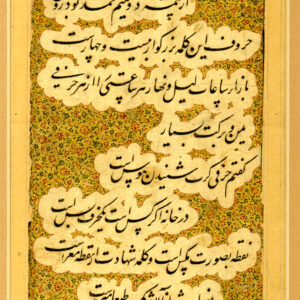
Humāyī, Jalāl al-Dīn, literary figure, poet, historian, and jurist-mystic of the 20th /14th century (1899-1980/1278-1359).
He was born on the 4th of January 1900/the first of Ramaḍān 1317 in the Pāqal‛a* quarter, southeast of Isfahan, into a learned, cultivated family with a background in poetry and literature. His father, uncles, and ancestors were scholars of Shiraz origin. Muhammad Reza-Qulī Khan Shīrāzī, Humāyī’s ancestor who used the pen name “Humā”, came to Isfahan around 1879/1258 due to his friendship with several scholars, including Sayyed Muhammad Bāqer Shaftī*, Ḥājj Mīr Ma‛ṣūm, and Mullā Muhammad Hasan Ārandī Nā’īnī, and settled in that city.1 Humāyī’s father, Mīrzā Abul-Qāsem Muhammad Naṣīr, with the pen name “Ṭarab” (1897–1951/1276–1330), was known as Humāyī-ye Shīrāzī-ye Eṣfahānī because he was born, raised, and educated in Isfahan. Mīrzā Abul-Qāsem had studied jurisprudence and legal theory with Muhammad Hāshem Chahār-Sūqī,* philosophy with Jahāngīr Khan Qashqā’ī* and Mullā Muhammad Kāshānī*, and had attended the sessions of Mīrzā Abul-Hasan Jelve.* He was also a friend of ‘Ummān Sāmānī*.2 Moreover, he was a master of calligraphy, literature, and poetry, and his collection of poems, titled dīvān-e ṭarab, was published in Tehran in 1963/1342 with an introduction and annotations by his son Jalāl al-Dīn.
Brief Biography
Jalāl al-Dīn completed his elementary education and Quranic reading with his father and mother, Bībī Khānum (d. 1957/1336).3 Around the age of seven, together with his older brother ‛Abdul-Javād, he went to the traditional school (maktab) of Mīrzā ‛Abdul-Ghaffār-e Pāqal‛a’ī*, who used the pen name “Saḥāb” (d. 1957/1336).4 From 1948/1327 onward, both brothers attended the Qudsīyye school*, one of the modern schools in the Darb-e Emām quarter, founded by Mīrzā ‛Abdul-Hussein Qudsī*, where all the teachers were from the Qudsī family.5 After a while, the scholarly and spiritual influence of Mullā ‛Abdul-Karīm-e Gazī*, Mīrzā Aḥmad Eṣfahānī, and especially Sayyed Muhammad Bāqer-e Durche’ī*, teachers at the Nīm-Āvard school*, drew Jalāl al-Dīn there 6– a stay lasting over twenty years.7 Jalāl al-Dīn lost his father at the age of thirteen and lived with his mother for a while; then he became a cloistered seminary student, going home only on weekends. Humāyī studied jurisprudence, legal theory, and theology with these three men. He studied logic, philosophy, mathematics, and some astronomy from Muhammad Khurāsānī, known as Ḥakīm, and Mullā Javād Ādīne’ī. He also studied ancient medicine from Avicenna’s qānūn with Khurāsānī. According to his own account, he learned Arabic literature from Sheikh Ali Yazdī, most of astronomy and astrology from Ḥājj Āqā Raḥīm Arbāb*, and the art of the Usturlāb, astronomical tables (zīj), and calendar computation from Mīr Sayyed Ali Jenāb*.8 From some of his teachers, Humāyī received a number of authorizations to transmit hadiths, which carried weight in the traditional educational system. However, he received authorization for ejtehād (independent legal reasoning) from Muhammad Hussein Feshārekī, Sayyed Muhammad Najaf-ābādī, and ‛Abdul-Hussein Khātūn-ābādī-e Pāqal‛e’ī.9
Alongside his studies and research, Humāyī was constantly engaged in teaching at the lower levels of the religious seminary. From 1921/1300 onward, he also taught at modern schools, especially the Ṣāremīyye high school*. Another source of income was manuscript transcription, for which he received one tūmān per thousand lines.10 From the academic year 1928–29/1307–1308, due to financial difficulties, he was employed by the Ministry of Education and taught in high schools in Tabriz and Tehran, and later at the Faculty of Law of the University of Tehran.11 In August–September 1929/Shahrīvar 1308, he voluntarily set aside his clerical attire.12 In 1933/1312, he married Ṣadrī Thaqafī, the daughter of Hussein Thaqafī, in Isfahan. From this marriage, he had three daughters—Māhdukht, Mīnūdukht, and Mehrdukht— each of whom later became cultivated and learned, well-versed in literature and the sciences.13 Until 1966/1345, when Humāyī officially retired from the Ministry of Education, he lived in Tehran but came to Isfahan in the summers and pursued his research. He never abandoned teaching or research. At the university, when he was finally granted the official title of “professor”, it was already too late, and he no longer had the energy or inclination to teach. During his service, he made two work-related trips abroad, one to Beirut and the other to Lahore.14 Among the most famous of his seminary and university students, whom Humāyī himself named, are: Murtaḍā Ardakānī, ‛Abbās-Ali Adīb Ḥabīb-ābādī*, Sayyed Abu al-Hasan Shams-ābādī*, Maḥmūd Sharī‘at Rīzī, Kamāl al-Dīn Nūrbakhsh, and Ja‛far Āl-e Ebrāhīm.15
On Saturday, 19th of July 1980/28th of Tīr 1359, Humāyī began the day appearing healthier and happier than ever, but at eight o’clock in the evening his condition suddenly changed, and he passed away an hour later.16 According to his will, he was buried in Takht-e Fūlād* cemetery in Isfahan. Poems were composed in his elegy.17 It has been said of him that he had a strong inclination toward mysticism, loved music and calligraphy, carefully observed religious rituals, and sometimes would turn to prayer and estekhāra (consultation with the Quran) for direction in important affairs.18 He had a truth-seeking spirit.19 Hence, he once said: “The main Shiite school of thought is superior and more solid than any other school of thought in the world. However, the practices and customs I see among the common people of Isfahan are completely far from the very essence of Islam, let alone being Shiite or Sunni.”20 Humāyī considered poetry, music, and dance to be inseparable companions and believed that every nation has its own distinct form of all three.21 Humāyī believed that anyone who has not read Ferdavsi’s shāhnāme will have no real grasp of their own genuine Iranian nationality.22 Humāyī loved the Persian language and script and strongly opposed the movement that proposed changing the Persian script to Latin, believing that this would make Iran modern, and called it “treason.”23 Humāyī embodied the unity of the seminary and the university in terms of method and knowledge, and a critical study of his works is instructive in this regard for finding the strengths and weaknesses of these two educational systems.
Biographies
Humāyī’s biography has been published many times: from his own autobiographical account, once in 1965/1344 in the magazine of vaḥīd,24 and again in 1973/1352 in the magazine hud-hud, to short notes and long articles by his admirers in praise of him. Perhaps Muṣleḥ al-Dīn Mahdavī* was the first to describe Humāyī in tadhkere-ye shu‛arā-ye mu‛āṣer-e Isfahan (1955/1334), emphasizing his poetic strength.25 In 1962/1341, Manūchehr Qudsī* published a short note, the first “Biography of Ustād Humāyī”.26 Qudsī republished this same note as an introduction to a book titled shu‛ūbīyya in June–July 1984, on the third anniversary of his death in Isfahan. In 1968/1347, the journal ma‛āref-e eslāmī published a short biography of Humāyī. In 1976/1355, the Association of Professors of Persian Language and Literature published Humā’ī-nāme: majmū‛e-ye maqālāt-e ‘elmī va adabī taqdīm-shuda be ustād Jalāl al-Dīn Humā’ī, edited by Muhammad Khwānsārī, which included, besides Humāyī’s autobiography in his own words, contributions from scholars such as Īraj Afshār, Muhammad Dabīr Sīyāqī, and Faḍlullāh Reza expressing their views of him. This work was twice republished by the Society for National Heritage and Cultural Honors (Anjuman-e Āthār va Mafākher-e Farhangī) under the supervision of Mahdī Muḥaqqeq, professor at the University of Tehran, with slight changes in its colophon page and introduction, in 2000/1379 and 2007/1386. In 1977/1356, short notes about Humāyī were also published, such as “zendegī-ye jāneshīn-nāpazīrhā” [the life of who had not a successor] 27and “savād ya‛nī ustad Jalāl Humā’ī” [erudition means professor Humā’ī].28
Favorable mentions of Humāyī continued after the 1978/1357 Islamic Revolution. In 1980/1359, Eḥsān Ṭabarī, a senior member of the Tudeh Party of Iran, published a piece titled “yādī az Jalāl al-Dīn Humā’ī”, [“A Remembrance of Humāyī.”].29 In 1981/1360, Abū al-Qāsem Rafī‛ī-ye Mehrābādī devoted a short note to Humāyī.30 1360, pp. 411-412.}} In June–July 1984/Tīr 1363, keyhān-e farhangī wrote a short note about Humā’ī.31 In 1988/1367, ‛Abdullāh Naṣrī, professor at ‛Allāma Ṭabāṭabā’ī University, published kār-nāma-ye Humā’ī. Four years later, ‛Abbās Khush-‛amal wrote a note on his life and critical poetry. In 1996/1375, Muhammad Hussein Rīyāḥī wrote an article on Humāyī’s life32 and repeated it with slight changes in 2001/1380.33 In 1997/1376, Humāyī’s autobiography was republished under the title “zendegī-nāme”.34 In 2000/1379, Ṣafar Ali Karamī wrote about Humāyī in the article “maḥram-e rāz-e setāre”.35 In 2002/1381, Naṣrī republished kār-nāma-ye Humāyī with slight changes under the title pāyān-e shab sukhan-sarā’ī.36 In 2007/1386, a book titled humā-ye ma‛refat was also published.37 From 2006/1385 to 2025/1404, in addition to the article “Humāyī, Jalāl al-Dīn” in the dāneshnāma-ye takht-e fūlād (2015/1394),38 short notes have been published in journals and newspapers, more or less repeating earlier material. Perhaps the common thread of all these biographies can be said to be the emphasis on Humāyī’s comprehensiveness and his mastery of various literary and Islamic sciences. In the section introducing his works in this article, we will become acquainted with his comprehensiveness. The robustness and authority of most of Humāyī’s opinions have been so strong that few have been able to find grounds for fundamental criticism of his views, and all the authors of his biographies have praised him. But a review of the more than two hundred works left by Humāyī allows us to also emphasize another aspect of his character that has perhaps received less attention: industriousness combined with patience and perseverance – qualities that are rare among academic and seminary researchers today and virtually absent among the youth, and hence Humāyī can be regarded as a “myth of hard work and patience.”
Cultural-Literary Activities
Humāyī began such activities from adolescence as a member of literary-poetry societies. He was deeply attached to poetry and never distanced himself from poetry throughout his life. He first practiced poetry under his father and then under his uncle “Suhā”, and then composed poems in which, due to his great fondness for Sanā’ī’s ḥadīqa, he used the pen name “Sanā”, which he considered his uncle Suhā’s preferred choice.39 His other cultural-literary activities include: participation in the Congress for the Commemoration of Ferdavsī (October 1934/Mehr 1313); contribution to the compilation of lughat-nāma-ye Dehkhudā for a portion of the entries under the letter “alef” (1940–42/1319–1320);40 membership in the Academy of Persian Language and Literature (Farhangestān-e Zabān va Adab-e Fārsī) under the presidency of Dhukā’ al-Mulk Furūghī (1942/1321); membership in the first Congress of Iranian Writers (June–July 1946/Tīr 1325), organized by the Society for Cultural Relations between Iran and the former Soviet Union; participation in the Congress of Avicenna on the millennium of his birth (April–May 1954/Urdībehesht 1333); and a series of lectures on the radio (1958/1337).41
Method and Thought
In most of Humāyī’s works, a “critical-historical” approach, alongside philosophy or the method now known as “critical thinking”, is evident. Humāyī had no knowledge of foreign languages; therefore, it would have been impossible for him to become acquainted with this approach and method in the works of critical philosopher-historians such as Wilhelm von Humboldt (1767-1835) and Leopold von Ranke (1795-1886). Moreover, in Humāyī’s time, insofar as is known, no Persian work like tārīkh dar tarāzū (written in 1975/1354) by ‛Abdul-Hussein Zarrīnkūb existed on the critical-historical approach. However, Humāyī, with his questioning and research-driven spirit, had managed to become more or less familiar with this approach and method and apply them in practice. For example, one of the principles of the aforementioned approach is maintaining the timeline of events and ideas. In his Ghazālī-nāme, Humāyī quotes from Qāḍī Nūrullāh Shūshtarī (d. 1610/1019) in majāles al-mu’menīn that “Ghazālī met Sayyed Murtaḍā ‛Alam al-Hudā on the road to Mecca and, through the blessing of his breath, converted from Sunnism and became a pure Shīʽa.” Humāyī names Shiite scholars such as Muhammad Bāqer Khwānsārī* (d. 1895/1313), author of rawaḍāt al-jannāt, and Muhammad b. Zayn al-‛Ābedīn Ma‛ṣūm Ali Shah (d. 1925/1344), author of ṭarā’eq al-ḥaqā’eq, who repeated this report of Shūshtarī in their works. Then, by recalling the birth and death years of Ghazālī (1058–1111/450–505/) and Sayyed Murtaḍā (966–1044/355–436), he shows that this report is fabricated due to a defect in the timeline, because Sayyed Murtaḍā had died fourteen years before Ghazālī was born.42 Shūshtarī himself had noticed this chronological flaw but tried to justify it by suggesting that the intended “Sayyed Murtaḍā” was the nephew of Sharīf Murtaḍā, interpreting Ghazālī’s emotional changes as his conversion to Shiism and adducing evidence.43 Humāyī, while pointing out the historical flaw in this report, examines and rejects the possibility that Ghazālī might have met some other Sayyed Murtaḍā, including the nephew of Sharīf Murtaḍā, and that historians might have erred in recording the name. Numerous such examples are found in Humāyī’s works, where he looks at sources, theories, and interpretations with critical thinking.
Another principle of the “critical-historical” approach is refraining from partisanship in describing the beliefs of different individuals and religious groups. Hence, the researcher tries to state what actually happened based on “realism” in the method of historiography, and, while maintaining the boundary between fact and analysis, to offer an analysis that is as close to reality as possible or completely in accordance with it.44 For example, in the introduction he wrote for Ghazālī’s naṣīḥat al-mulūk, Humāyī says: “The author’s purpose in the above exposition was only to describe the state and represent the type of thoughts and beliefs of Imam Ghazālī and his likes, without expressing any opinion on the matter or having any view – praise or blame – concerning those people…”45
Another principle of the “critical-historical” approach is that the researcher’s evidence must be “investigable”; that is, the historian of ideas does not deal with metaphysical, uninvestigable components, such as dreams, divine assistance, or God’s will, in the realization of ideas, phenomena, and things (three different existents), regardless of whether he believes in them or not. Because the historian’s job is to state objective, natural components. Humāyī also made use of this principle on occasion. For example, after recounting some marvels (karāmāt) of Ghazālī and citing the approvals of his supporters and the criticisms of his opponents, he says: “I neither consider the dreams and heartfelt inspirations of Abul-Ḥasan Shādhelī and the Ṣayyād of Yemen as signs of Ghazālī’s greatness, nor do I regard the insults of Ebn Qayyem and Ebn Ṣalāḥ as proof of his insignificance, because all these states are like dreams, and a dream has no binding force except metaphorically.”46
Source Bibliography
A review of Humāyī’s various works on diverse subjects shows how familiar he was with sources, especially primary sources, in different fields. This skill and trait stemmed from his own personal effort; otherwise, the educational system of the seminary and the university, even today with the advent of online libraries, does not provide such skill for their graduates. The variety of citations in all his works indicates his personal reference to sources, at a time when computers had not yet been born. In addition to using the libraries available to him in Tehran and Isfahan, despite financial limitations, Humāyī managed to assemble a valuable personal library. Personal libraries usually tell of the scope and diversity of knowledge, and the owner’s taste in book selection. Humāyī’s library*, in addition to printed sources, contained valuable manuscripts (some 400 items), all of which were donated to the National Library of Iran after his death.47
Works
The number of Humāyī’s works, both published and unpublished, reaches two hundred short and long pieces in the form of authorship, critical edition, glosses, notes, and writing introductions to others’ works. For a complete list of these works, one may consult some of the biographies.48 However, in this article, to become acquainted with his exceptional comprehensiveness, industriousness, and patience, only a few subjects in which Humāyī specialized – not merely had an interest – are addressed, and for each subject a few of his more important works are introduced.
A) Literature
Humāyī had planned a tārīkh-e adabīyāt-e Iran (History of Iranian Literature) in five volumes. However, only two volumes of it, covering two periods from ancient times to the fall of the Sasanians and then from the advent of Islam in Iran to the Mongol invasion, were first published in Tabriz (1929–31/1308–1309). This work has been republished many times in Tehran. In 1958/1337, Humāyī, in collaboration with several other professors, accepted responsibility for writing Persian grammar textbooks for the fifth and sixth elementary grades and a history of literature for the high school level.49 He also has notes on Persian grammar and its comparison with Arabic morphology and syntax, first published in several issues of the journal farhangestān-e zabān-e fārsī and then partly in Dehkhudā’s lughat-nāma.50 In addition, he prepared funūn-e balāghat va ṣanā‛āt-e adabī in two volumes, covering verbal rhetorical devices (ṣanāye‛-e lafẓī; date of the introduction to the first volume, 1960/1339) and semantic rhetorical devices, figures of speech, and literary borrowings (ṣanāye‛-e ma‛navī-ye badī‛ va saraqāt-e adabī; date of the introduction to the second volume, 1974/1353). Both volumes have been published together in one volume in Tehran (1984/1363). Humāyī wrote biographies of some famous poets in the introductions to their collections, evaluating and interpreting their poems, including Malek al-Shu‛arā Bahār (1951/1330), Surūsh Eṣfahānī* (1960/1339), Ḥakīm Mukhtārī Ghaznavī (1961/1340), ‘Umar Khayyām (1962–64/1341–1342), and Jalālul-Dīn Rūmī.51 Humāyī also wrote articles on Ferdavsī’s shāhnāme, the innovations of Rūdakī and Abū Reyḥān Bīrūnī, the poems of Avicenna, Ḥāfeẓ, the supplementary materials (mustadrakāt) of the dīvān-e Shams-e Tabrīzī, the poetic style of Ṣabā-ye Kāshānī, Ẓahīr Fāryābī, and Mas‛ūd Sa‛d Salmān, which Nashr-e Murvārīd published in a collection titled maḥram-e asrār in Tehran (2000/1379). Another collection of Humāyī’s literary articles (25 pieces), edited by ‛Abdullāh Naṣrī, was published in Tehran (Humā, 1990/1369), and his collection of poems titled dīvān-e sanā was published in Tehran (Humā, 1988/1367).52
B) History
Humāyī has numerous articles on the history of Iran and Islam. Some of them have been published as books, such as shu‛ūbīyye, first published in the journal mehr and then as a book, edited and introduced by Manūchehr Qudsī, in 1984/1363. The focus of Humāyī’s interpretation of the “Shu‛ūbīyye movement” is on distinguishing Arab traditions from Islamic teachings. In his view, the call to Islam does not mean becoming Arab, accepting Arab traditions, and preferring Arabs over other peoples and nations. The policy of considering Arabs superior was the policy of the Umayyad caliphs, and protest movements against this policy, in various literary and political forms, including the Shu‛ūbīyye movement, took shape from the middle of the eighth/second century and flourished during the Abbasid period. The Shu‛ūbīyye movement (shu‛ūb is the plural of sha‛b, meaning people or nation, as used in the Qur’an (49:13): “We have made you into peoples (shu‛ūban) and tribes so that you may come to know one another”)53 began with the belief in the equality of Arabs and non-Arabs and gradually led to enmity toward Arabs and everything associated with them.54 Since there was no independent book or article on the subject, Humāyī referred to historical sources from the second/sixth to the eighth/twelfth centuries and extracted and inferred material from between the lines. However, during his research, he came across two books, fajr al-eslām (Cairo, 1928/1347) and ḍuḥā al-eslām (Cairo, 1932/1351), by the Egyptian author Aḥmad Amīn, and in parts of these two found useful scholarly material on the Shu‛ūbīyye movement. He therefore decided to prepare and publish a free translation and report of the text in Persian.55 Humāyī did not simply translate the text; he referred to the authors’ sources and was critical in many instances, and at the end he also reported Ebn Qutaybe’s critique of this movement. While defending the tendency toward Iranian nationalism in Ferdavsī and toward Twelver Shiism, Humāyī considers both tendencies unrelated to the Shu‛ūbīyye movement.56
A collection of Humāyī’s lectures on the history of science, titled tārīkh-e ‛ulūm-e eslāmī, with an emphasis on astronomy and mathematics, was published in 1984/1363. According to Humāyī himself, Western books on this subject had been written, and some translated and published, but he deliberately ignored them and, focusing on Islamic sources and his own effort, organized and presented these lectures. His lectures and effort are commendable because in his time works of this kind in Persian were very few. However, the quantitative and qualitative growth of sources in this field has been so remarkable that today Humāyī’s book can only be mentioned for the history of the historiography of Islamic sciences.
C) Isfahan Studies
Humāyī’s library and field research on Isfahan, conducted without any financial support and solely out of love for Isfahan, bore fruit over a period of about fifty years. Many historical sources had not yet been published at the time of his research, and he consulted manuscript copies of these sources with a critical view.57 After his death, his daughter Māhdukht Bānū Humāyī compiled this research and published it in volumes titled tārīkh-e Isfahan*.58 Each volume has a specific subtitle, but none has a volume number. The subtitles are as follows: rejāl va dāneshmandān Isfahan (Figures and Scholars) in three volumes; hunar va hunarmandān (Art and Artists); abnīye va ‛emārāt, faṣl-e takāyā va maqāber (Buildings and Monuments, section on Takāyā and Tombs); abnīye va ‛emārāt va āthār-e bāstānī (Buildings and Monuments, and Ancient Remains); tatamme-ye abnīye va ‛emārāt (Supplement to Buildings and Monuments); jughrāfiyā-ye Isfahan (Geography of Isfahan); ḥavādeth va vaqāye‛ va ḥukkām va salāṭīn-e Isfahan (Events and Incidents, and Rulers and Sultans of Isfahan); and selsele-ye sādāt va mushajjarāt va musaṭṭaḥāt, ansāb va nasab-e emāmzādehā-ye Isfahan (The Lineage of Sayyeds, Pedigree Charts and Geometric Layouts, Genealogies of the Emāmzādas of Isfahan).59 Naturally, in an individual’s research, there are shortcomings, especially in terms of historiographical style, criteria for selecting and quoting material, bibliographic details, and references. Throughout various articles in the Encyclopaedia Isfahanica, Humāyī’s views have been cited according to each subject, and where necessary, criticism or clarification has been provided.
D) Jurisprudence
Humāyī has several works on jurisprudence. First, resāla-ye erth (a treatise on inheritance) in Persian, in which, while discussing the history of inheritance in Islam, he addressed its rules and the differences in its calculation according to Sunni and Shiite methods, but ultimately was not satisfied to publish it.60 Second, qavā‛ed va eṣṭelāḥāt-e feqh va uṣūl (Rules and Terminology of Jurisprudence and Legal Theory), which began as a Persian booklet and for a time served as a textbook for the doctoral program at the Faculty of Law at the University of Tehran. Then, over years of teaching, Humāyī added to this booklet information on the history of the periods of jurisprudence (seven distinct periods), some doctrinal issues, an introduction to hadith sources, and some of his own legal opinions (fatāwā), intending to publish it after revision. However, this did not happen, and this work remained as Humāyī’s notes and was published in 2012/1391 in 465 pages, edited by Māhdukht Bānū Humāyī, under the title qavā‛ed-e feqh, eṣṭelāḥāt va tārīkh-e feqh va qaḍā dar eslām in Tehran.
E) Astronomy, Mathematics, and Philosophy
Humāyī has several works on this subject. One is khayyāmī-nāme. According to the introduction, it was written in 1963/1342. His own purpose, he says, was not to write biographies of astronomers such as Khayyām, Ebn al-Haytham, and Khwāje Naṣīr al-Dīn Ṭūsī, but rather to analyze the scientific and literary works of Khayyām (d. ca. 1135/530). Humāyī considers Khayyām among the ranks of French philosophers René Descartes and Blaise Pascal, and believes that some, based on a collection of poems and quatrains (rubā‛īyyāt) attributed to him, have highlighted his artistic aspect,61 ascribed “strange and unbelievable” beliefs to him, and even considered him similar to Epicurus, the Greek Stoic philosopher.62 Humāyī has introduced in detail the foundations of Khayyām’s Euclidean geometry.63 Another work is the book zamīn va āsemān (Earth and Sky), in which he compiled the conditions of the planets and spheres according to both the Ptolemaic and Copernican systems, along with the expositions of Ḥājj Āqā Raḥīm Arbāb. Another of his treatises is “tarīq-e muḥāsebāt-e nujūmī” [Method of Astronomical Calculations], unpublished. Humāyī twice edited Bīrūnī’s ketāb al-tafhīm le-awā’el ṣanā‛at al-tanjīm, which Bīrūnī wrote once in Persian and once in Arabic in the year 1060/452.64 He edited it once in 1937–40/1316–1318 and again in 1973/1352.65 Both editions include a detailed introduction covering Bīrūnī’s biography, innovations, and thoughts in the mathematical and natural sciences.66 He then presented a summary of that introduction in a lecture at the Millenary Celebration of Bīrūnī (Tehran, August–September 1973/Shahrīvar 1352). This introduction was published by Humāyī himself as a small book (65 pages) titled abū reyḥān Bīrūnī: ekhtīrā‛āt va ekhteshāfāt va fann-e nujūm (Tehran: Ṭahūrī, 1974/1353).67 In the field of philosophy, Humāyī produced several critical editions, each accompanied by an introduction and glosses. These include: first, an edition of Avicenna’s me‛yār al-‛uqūl (Tehran: Anjuman-e Āthār-e mellī, 1952/1331), with an introduction and glosses; second, an edition of kunūz al-mu‛azzemīn (Tehran: Anjuman-e Āthār-e mellī, 1952/1331), a work attributed to Avicenna, also with introduction and glosses; and third, a critical edition and Persian translation of sharḥ al-eshārāt wa al-tanbīhāt (unpublished).68
F) Ethics and Mysticism
Among Humāyī’s earliest works in this field is his edition of akhlāq-e nāṣerī by Khwāje Naṣīr al-Dīn Ṭūsī. He also prepared a selection from the akhlāq-e nāṣerī for teaching at the high school level in 1941/1320, which was published by the Ministry of Culture of the time and has been republished many times. He wrote taṣavvuf dar eslām: negāhī be ‛erfān-e sheikh abū Sa‛īd Abu al-Kheyr in 1935/1314, but it was first published in 1983/1362 in Tehran. Another important work of his on this subject is Ghazālī-nāme, written based on Ghazālī’s own works and, according to Humāyī,69 the first Persian book about him. The date he began writing it was 1317/1938–39 and the date he finished it was 1342/1963–64. Faḍlullāh Reza,70 the president of Āryāmehr University (the present-day Sharif University of Technology) and later of Tehran University, greatly praised Humāyī’s work. In addition, Humāyī edited Ghazālī’s naṣīḥat al-mulūk, an early Persian text on political ethics and practical wisdom, once in 1936–39/1315–1317, and another time with glosses, commentaries, and a 196-page introduction (the introduction was written on 15 Bahman 4 February 1972/1350). At the end of the introduction, citing evidence, Humāyī says that Ghazālī’s tomb surely is located in Ṭūs, in his khāneqāh, near the tomb of Ferdavsī. Humāyī also edited meṣbāḥ al-hedāya wa meftāḥ al-kefāya, by ‛Ezz al-Dīn Maḥmūd b. Ali Kāshānī (d. 1334/735), and published it with an introduction and commentaries in 1944/1323. This book has an ethical content and expounds the conditions of spiritual path (sulūk).
G) Glosses on Books
One of Humāyī’s admirable traditions was writing glosses in his personal books. None of these have been published so far, and it is said that they are preserved in the National Library of Iran. Perhaps the most important of them are the glosses he wrote on Rūmī’s masthnavī-ye ma‛navī. Some of his other glosses are on the following books: annīs al-tā’ebīn by Sheikh Aḥmad Jām (d. 1141/536); tadhkeret al-qubūr by Mullā ‛Abdul-Karīm Gazī; khulāṣat al-hekma by Mīr Muhammad Hussein Khan Bahādur; ‛abbās-nāme or tārīkh-e jahān-ārā-ye ‛Abbāsī by Mīrzā Ṭāher Vaḥīd; kefāyat al-ta‛līm fī ṣanā‛at al-tanjīm by Muhammad b. Mas‛ūd Ghaznavī; kullīyāt of kamāl al-Dīn Ismā‛īl Eṣfahānī*; gulshan-e rāz by Maḥmūd Shabestarī, in the hand of ‛Abdul-Ghaffār Pāqal‛a’ī; and tārīkh-e sīstān by Malek al-Shu‛arā Bahār.
/Muhsen Muhammadi Fesharaki and Saeid Edalatnejad/
Bibliography
Abū Reyḥān Bīrūnī. ketāb al-tafhīm le-awā’el ṣanā‛at al-tanjīm, ed. Jalāl al-Dīn Humā’ī, Tehran: Bābak, 1983/1362.
Ghazālī, Muhammad b. Muhammad. naṣīḥat al-mulūk, ed. Jalāl al-Dīn Humā’ī, Tehran: Bābak, 1982/1361.
Humāyī, Jalāl al-Dīn. “zendegī-nāma-ye Humā’ī be zabān-e khudash”, ed. Muhammad Khwānsārī, in Humā’ī-nāme: majmū‛e-ye maqālāt-e ‛elmī va adabī taqdīm-shude be ustād Jalāl al-Dīn Humā’ī, ed. Mahdī Muḥaqqeq, Tehran: Society for National Heritage and Cultural Honors, 2000/1379.
Humāyī, Jalāl al-Dīn. “zendegī-nāma-ye Humā’ī be zabān-e khudash”, ed. Muhammad Khwānsārī, in Humā’ī-nāme: majmū‛e-ye maqālāt-e ‛elmī va adabī taqdīm-shude be ustād Jalāl al-Dīn Humā’ī, ed. Mahdī Muḥaqqeq, Tehran: Society for National Heritage and Cultural Honors, 2007/1386.
Humāyī, Jalāl al-Dīn. ghazālī-nāme: sharḥ-e ḥāl va āthār va ‛aqā‛ed va afkār-e adabī va madhhabī va falsafī va ‛erfānī-e emām Abū Ḥāmed Muhammad b. Muhammad b. Aḥmad Ghazālī Ṭūsī, Tehran: Zavvār, 2018/1397.
Humāyī, Jalāl al-Dīn. khayyāmī-nāme, vol. 1, Tehran: Anjuman-e Āthār-e Mellī, 1967/1346.
Humāyī, Jalāl al-Dīn. maqālāt-e adabī, vol. 1, Tehran: Humā, 1990/1369.
Humāyī, Jalāl al-Dīn. mukhtārī-nāme: muqaddeme-ye dīvān-e ‘uthmān mukhtārī, Tehran: ‛elmī va Farhangī, 1982/1361.
Humāyī, Jalāl al-Dīn. Shu‛ūbīyye, ed. Manūchehr Qudsī, Isfahan: Ṣā’eb Bookshop, 1984/1363.
Humā’ī-nāme: majmū‛e-ye maqālāt-e ‛elmī va adabī taqdīm-shude be ustād Jalāl al-Dīn Humā’ī, ed. Mahdī Muḥaqqeq, Tehran: Society for National Heritage and Cultural Honors, 2007/1386.
Jahānbakhsh, Jūyā. “darbāre-ye dīvān-e sanā”, Āyene-ye Pazhūhesh, vol. 10, 1999/1378.
Karamī, Ṣafar Ali. “maḥram-e rāz-e setāre: guzar va naẓarī bar zendegī-ye ustād Jalāl al-Dīn Humā’ī”, Farhang-e Iṣfahān, no. 16, Summer 2000/1379.
Mahdavī, Muṣleḥ al-Dīn. tadhkere-ye shu‛arā-ye mu‛āṣer-e Isfahan, Isfahan: Ta’yīd Bookshop, 1955/1334.
Muhammadī Feshārkī, Muḥsen. “Humā’ī, Jalāl al-Dīn”, in dāneshnāma-ye takht-e fūlād, ed. Aṣghar Muntaẓer al-Qā’em, vol. 4, Isfahan: Cultural and Recreational Organization of the Municipality, 2015/1394.
Naṣrī, ‛Abdullāh. kār-nāme-ye Humā’ī, Tehran: ‛Allāme Ṭabāṭabā’ī University, 1988/1367.
Reza, Faḍlullāh. mahjūrī va mushtāqī: maqālāt-e farhangī va adabī, Tehran: Institute for Humanities and Cultural Studies, 1996/1375.
Sepantā, Sāsān. “majmū‛e-ye āthār-e nafīs-e khāne-ye ustād Jalāl al-Dīn Humā’ī”, Vaqf: Mīrāth-e Jāvīdān, vol. 10, no. 2, Summer 2002/1381.
Shūshtarī, Nūrullāh b. Sharīf al-Dīn. majāles al-mu’menīn, ed. Ebrāhīm ‛Arab-pūr et al., Mashhad: Islamic Research Foundation, 2013–15/1392–1393.
Ṭarab Eṣfahānī, Abul-Qāsem b. Reza-qulī. dīvān-e ṭarab, with introduction and annotations by Jalāl al-Dīn Humāyī, Tehran: Furūghī, 1963–65/1342–1343.
- Humāyī, 2007/1386, pp. 5-7.[↩]
- Ṭarab Eṣfahānī, vol. 1, Humāyī’s introduction, pp. 5, 37-38, 63, 71.[↩]
- On Jalāl al-Dīn Humāyī’s mother, see: ibid., vol. 1, Humāyī’s introduction, pp. 146-151.[↩]
- Ibid., vol. 1, Humāyī’s introduction, pp. 60, 63, 148; Humāyī, 2007/1386, p. 9.[↩]
- Ṭarab Eṣfahānī, vol. 1, Humāyī’s introduction, p. 8, fn. 1.[↩]
- Ibid., Humāyī’s introduction, pp. 13-15; see also: Humāyī, 2007/1386, p. 13.[↩]
- Humāyī-nāma, foreword by Mahdī Muḥaqqeq, p. 11; see also: Humāyī, 2007/1386, p. 16. For his difficult economic circumstances during these twenty years, see: ibid., pp. 25-26.[↩]
- See: Abū Reyḥān Bīrūnī, Humāyī’s introduction, pp. 3-4, fn. 1; Humāyī, 2007/1386, pp. 19-24; Humāyī also respectfully mentions Sayyed Mahdī Dūrcha’ī, the brother of Sayyed Muḥammad Bāqir, as his teacher of legal theory (2007/1386, p. 20). For other names, see: Naṣrī, p. 57.[↩]
- See: Humāyī, 2007/1386, pp. 24-25.[↩]
- Ibid., p. 26.[↩]
- See: ibid., pp. 28-29.[↩]
- Ibid., p. 30. For a photograph of him in clerical attire (February-March 1928/Isfand 1306), see: Humāyī, 2000/1379, p. 98, which is essentially the same as the 1976/1355 edition with slight changes. In the 2007/1386 edition, this photograph has been removed.[↩]
- See: Humāyī, 2007/1386, p. 32; see also: Naṣrī, p. 22.[↩]
- See: Humāyī, 2007/1386, pp. 30-32; for more detail, see: Naṣrī, p. 66; Humāyī, 1984/1363, Qudsī’s introduction, p. 92.[↩]
- See: Humāyī, 2007/1386, p. 28. Humāyī’s biographers have added many names to this list; for example, Naṣrī (p. 19) lists the following as famous students of Humāyī: Muhammad Mu‘īn, Zabīḥullāh Ṣafā, Nāṣer al-Dīn Shah Ḥusaynī, Mahdī Muḥaqqeq, Muḥammad Khwānsārī, Jamāl Reḍā’ī, Khusru Farshīdvard, Amīr Hussein Yazdgerdī, Muhammad Reza Shafī‘ī Kadkanī, and Fīrūz Ḥarīrchī.[↩]
- Humāyī, 1982/1361, Mīnūdukht Humāyī’s introduction, pp. 5-6.[↩]
- For examples, see: Humāyī-nāme, pp. 20-21, poems by Amīrī Fīrūzkūhī and Jamāl Reḍā’ī.[↩]
- Humāyī, 1984/1363, Qudsī’s introduction, pp. 10, 25.[↩]
- Humāyī (2018/1397, p. 456) says: “They say that Ghazālī became disturbed due to thought and severe austerities. If that disturbance which Ghazālī had is what it means to be disturbed, I would buy that disturbance with my soul”.[↩]
- For Humāyī’s meaning of “the manner and custom of the common people of Isfahan,” see: Humāyī, 2018/1397, p. 437.[↩]
- See: Humāyī, 1990/1369, vol. 1, pp. 38-40. Humāyī was fond of authentic, serious Persian music and held singers such as Tāj Eṣfahānī* and Adīb Khwānsārī in high esteem and respect. The sound of Hasan Kasā’ī’s* flute moved him in an indescribable way (Humāyī, 1984/1363, Qudsī’s introduction, pp. 25-26).[↩]
- Humāyī, 1990/1369, vol. 1, pp. 158-159. In his view, the Shāhnāme is not only a Persian work but the greatest precious legacy of humanity, and one should strive to preserve it and transmit it to the next generation. In the words of Ferdavsī himself: “I have erected a lofty palace of poetry/ that will not be harmed by wind or rain.” Humāyī (1984/1363, Qudsī’s introduction, p. 36) considered Sa‛dī’s kullīyāt the ornament of Persia (‘ajam) but he read no book as much as Rūmī’s masthnavī-ye ma‛navī; he may have completed it ten times. He loved Kamāl al-Dīn Ismā‘īl.[↩]
- Humāyī, 1984/1363, Qudsī’s introduction, p. 29. Humāyī used to say: do not joke with three things: knowledge, love, and mysticism (ibid., p. 23).[↩]
- Jalāl al-Dīn Humāyī, “Sharḥ-e ḥāl-e ustād Jalāl al-Dīn Humāyī be qalam-e khud-e īshān”, Vaḥīd, vol. 2, no. 7, July 1965/Tīr 1344, pp. 13-17.[↩]
- Mahdavī, pp. 247-250.[↩]
- khabarhā-ye rūz-e Isfahan, vol. 5, July 16, 1962/25 Tīr 1341.[↩]
- Leylā Gulzār, “zendegī-ye jānshīn-e nāpazīrhā”, Bunyād, vol. 1, no. 1, 1977/1356, pp. 30-31.[↩]
- Ebrāhīm Zālzāde, “Savād yanī ustād Jalāl Humāyī”, rastākhīz, no. 640, June 14, 1977/24 Khurdād 1356, p. 15.[↩]
- Eḥsān Ṭabarī, “Yādī az Jalāl al-Dīn Humāyī”, duniyā, vol. 4, no. 5, 1980/1359, pp. 161-163.[↩]
- Abū al-Qāsem Rafī‘ī-ye Mehr-ābādī, “Darbāre-ye Humāyī”, āyande, vol. 7, no. 5, August 1981/Murdād{{‘Abbās Khūsh-‘amal, “Shāhed-e khalvatgāh-e ghayb: negāhī be zendegī va ash‘ār-e enteqādī-ye ustād Jalāl Humāyī“, Adabestān-e farhang va hunar, no. 28, April 1992/Farvardīn 1371, pp. 36-40.[↩]
- keyhān-e farhangī, no. 4, July 1984/Tīr 1363, pp. 38-39.[↩]
- Muhammad Hussein Rīyāḥī, “Humāy-e adab: guzarī bar ḥayāt-e ustād-e dāneshmand-e marḥūm Jalāl al-Dīn Humāyī”, farhang-e Isfahan, no. 4, Summer 1996/ 1375, pp. 26-33.[↩]
- Muhammad Hussein Rīyāḥī, “Ustād Jalāl al-Dīn Humāyī”, masjed, no. 55, April-May 2001/Farvardīn va Urdībehesht 1380, pp. 78-83.[↩]
- Jalāl al-Dīn Humāyī, “zendegī-nāme”, in Cherāgh-e tajrube: sarguzasht-e jam‘ī az mashāhīr be qalam-e khudeshān, ed. Ja‘far Pazhūm, Tehran: Nashr-e Sāleth, 1997/1376, pp. 640-676.[↩]
- Ṣafar Ali Karamī, “maḥram-e rāz-e setāre: guzar va naẓarī bar zendegī-ye ustād Jalāl al-Dīn Humāyī“, farhang-e Isfahan, no. 16, Summer 2000/1379, pp. 18-25.[↩]
- The title of the book is taken from Humāyī’s last poem, composed in November 1979/Ābān 1358. Although suffering from severe shortness of breath, he himself confirmed that it was his “last”. “At the end of the night of poetry / He spoke from the burning heart of Humāyī // Cry from this clay abode / I give my life but not my heart // Death has drawn a sword at my throat / I am drunk with air and desire // There remains a moment and the fulfillment of desire / I renew my promise of a year // Ailing body, chilled spirit / Skin stretched over bone // In my throat my breath is tight / Swollen from obesity // No strength to walk or to sleep / No mood to listen or to speak // Nothing exists but the fantasy of the impossible / I am dying but do not believe in death” (Naṣrī, p. 215).[↩]
- Mitrā Hāshemī, humā-ye ma‛refat: zendegī-nāme va āthār-e ustād Jalāl al-Dīn Humāyī, Isfahan: Cultural and Recreational Organization of the Municipality, 2007/1386.[↩]
- See: Muhammadī Feshārekī, vol. 4, pp. 653-693.[↩]
- See: Humāyī, 1984/1363, Qudsī’s introduction, pp. 32, 35; Karamī, p. 19.[↩]
- Naṣrī, p. 62.[↩]
- Ibid., pp. 63-65, 69.[↩]
- Humāyī, 2018/1397, pp. 327-329. The date Humāyī began writing Ghazālī-nāma was 1938/1317 and the date he finished it was 1963/1342.[↩]
- Shūshtarī, vol. 4, pp. 485-503.[↩]
- Assuming, of course, that such a goal can be achieved.[↩]
- Ghazālī, Humāyī’s introduction, p. 77.[↩]
- Humāyī, 2018/1397, p. 455.[↩]
- For the variety of his personal books and a list of Humāyī’s manuscripts, see: Humāyī, personal library*; see also: Sepantā, pp. 81-86.[↩]
- For example, see: Humāyī, 2007/1386, pp. 32-37; for a complete list, see: Muhammadī Feshārekī, vol. 4, pp. 668-690.[↩]
- Humāyī, 2007/1386, p. 34.[↩]
- Ibid., p. 33.[↩]
- Jalāl al-Dīn Humāyī, taafsīr-e mas̱navī-ye mavlāvī, Tehran: Humā, 2006/1385; idem, mavlāvī-nāme: mavlāvī che mīgūyad? Tehran: Humā, 1987/1366.[↩]
- On dīvān-e sanā, see: Jahānbakhsh, pp. 110-112.[↩]
- Qur’an, 49:13; see also: Humāyī, 1984/1363, pp. 70-73.[↩]
- Ibid., p. 99.[↩]
- Ibid., pp. 3-6, see also: pp. 25-27, 68, 74.[↩]
- Ibid., pp. 102, 124, 132.[↩]
- Humāyī (2018/1397, p. 225) has emphasized that “the writer of these lines, Jalāl al-Dīn Humāyī … has exerted the utmost effort to examine the writings of historians with a critical and contemplative eye and to record the matters, not only in this regard but in other places in his book, according to the most correct historical sources”.[↩]
- Humāyī (2018/1397, p. 396, fn. 1) says that his collection of notes on the history of Isfahan will probably reach ten volumes, and he hopes that they will be published after him.[↩]
- For a comprehensive description of all volumes of the book, see: tārīkh-e Isfahan*.[↩]
- Humāyī, 1984/1363, Qudsī’s introduction, p. 69.[↩]
- Humāyī, 1967/1346, vol. 1, pp. 3-4.[↩]
- Ibid., p. 5.[↩]
- Humāyī uses the term “muṣāderāt” for Euclidean geometry. In the tradition of Islamic mathematicians and logicians, the preliminary discussions and conceptual and affirmative principles, including axioms and common notions (al-‛ulūm al-muta‛ārefa), are called muṣādarāt.[↩]
- See: Abū Reyḥān Bīrūnī, Humāyī’s introduction, p. 105.[↩]
- Ibid., p. 135.[↩]
- Humāyī mentions the few who appreciated this difficult task and thanked him: Muhammad Ali Furūghī, Muhammad Qazvīnī, and Sayyed Hasan Taqīzāde. Humāyī considers these to be scholars and men of letters after whose passing “the community of science and literature has been orphaned, and the mother of time has been rendered barren of producing their likes and counterparts” (see: Abū Reyḥān Bīrūnī, Humāyī’s introduction, pp. 13-14).[↩]
- See: ibid., pp. 19-20.[↩]
- Avicenna’s al-eshārāt wa al-tanbīhāt and Naṣīr al-Dīn Ṭūsī’s sharḥ al-eshārāt wa al-tanbīhāt; see: Humāyī, 1984/1363, Qudsī’s introduction, p. 70.[↩]
- Humāyī, 2018/1397, pp. 3-4, 459.[↩]
- Reza, pp. 57, 63.[↩]