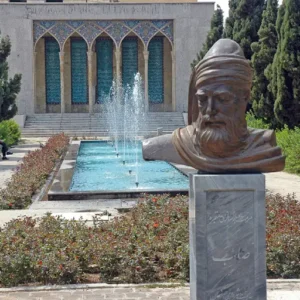
Darb-e Emām, a mausoleum, a shrine located in the Sunbulestān quarter of Isfahan.
The shrine is situated in south of Ebn Sīnā Street, belonged to one of the earliest urban quarters known as Chumlān, which appears in sources under variant forms such as Sunbulān, Chunbulān, Jamīlān, and Sunbulestān*.1 Chumlān was among the earliest districts contributing to the formation of the city of Isfahan and possessed its own cemetery, whose origins go back to the pre-Islamic period.2 The mausoleum of Darb-e Emām stands in the southeastern corner of this cemetery, and today it remains the only surviving element of that burial ground.3 The architectural complex of Dar-e Emām consists of a central mausoleum containing a wooden cenotaph, two domes (one large and one small), two portals on the northern side, a portico and a number of chambers on the eastern side, as well as three courtyards on the northern, eastern, and western sides of the shrine.4
In documentary sources of the 15th century/9th century and in most Safavid texts, Darb-e Emām is recorded under the name Emāmzāde Zayn al-‛Ābedīn, whereas the designation Darb-e Emām came into use only in later periods.5 It appears that, due to the similarity of the name of the person buried here—Zayn al-‛Ābedīn—with that of Imam Zayn al-‛Ābedīn, the honorific of the fourth Shiite Imam, the shrine was gradually attributed to the latter and consequently became known as Darb-e Emām.6 In the 15th-century/9th-century inscription of the building, the epithet Zayn al-‛Ebād is applied to the emāmzāde, which in the same era was also an honorific of Imam al-Sajjād, Zayn al-‛Ābedīn.7 Likewise, a Safavid inscription refers to the mausoleum as “the mausoleum ascribed to our master, the lord of those who prostrate” (al-buq‛a al-mansūba elā mawlānā sayyed al-sājedīn).
The oldest part of the structure is a small mosque located on the western side of the northern courtyard, known as the Mosque of Sa‛īd b. Jubayr, which is counted among the earliest mosques of Isfahan.8 It is reported that Sa‛īd b. Jubayr (d. 713/94), a hadith transmitter of the tābe‛īn (Successors) generation in the early Islam, came to Isfahan in 700/81 and resided for some time in the Sunbulān quarter, where he is said to have performed his prayers at this site.9 The northern courtyard is the oldest courtyard of the mausoleum, while the other two courtyards were added to the complex at a later stage.10 Excavations carried out in this courtyard have revealed remains dating to the Seljuq period.11 The two principal burials within the mausoleum are, first, the tomb of Ebrāhīm b. Muhammad Baṭḥānī b. Qāsem b. Hasan b. Imam Hasan Mujtabā (d. mid-9th century/3rd century), and second, that of Emāmzāde Zayn al-‛Ābedīn, a descendant of Ali ‛Urayḍī b. Imam Ja‛far Ṣādeq (d. 12th century/6th century).12 Both figures are regarded among the most highly esteemed emāmzādes of Isfahan and considered to be of authentic lineage.13 According to a 11th-century/5th-century text, Hasan b. Ebrāhīm Baṭḥānī was also buried beside his father in this mausoleum.14 It is further related that Emāmzāde Zayn al-‛Ābedīn used to worship during his lifetime in the Mosque of Sa‛īd b. Jubayr, and for this reason, after his death, he was interred adjacent to that mosque.15
According to the inscription on the northern portal, the construction of the main structure of the mausoleum was completed during the reign of Jahānshāh Qarā Quyunlū (r. 1436–1467/839–872) under the governorship of Abul-Mufaṭṭaḥ Muhammadī. The complex consisted of a domed mausoleum for the two emāmzādes, an antechamber or hall known as the Jahānshāhī Hall, and a northern portal.16 Although the final part of the portal inscription, which contained the date, has been lost, a poetic inscription in the Jahānshāhī Hall records the year 1453/857. The identity of Abul-Mufaṭṭaḥ Muhammadī has been debated. Some, such as the French architect and archaeologist André Godard*, identified him as Sulṭān Muhammad b. Bāysunghur (d. 1451/855), the grandson of Shāhrukh Teymūrī (r. 1405–1447/807–850), who governed Isfahan between 1446 and 1451/850–855. Others, such as Jalāl al-Dīn Humāyī* and Luṭfullāh Hunarfar*, considered him to be Shāhzāde Muhammadī-Mīrzā (d. ca. 1467/872), the youngest son of Jahānshāh.17 The latter view is generally regarded as more convincing, since, on the one hand, Sulṭān Muhammad was killed two years before the completion of the building in 1451/855, and on the other, following Jahānshāh’s conquest of Isfahan in 1452/856, the city’s governorship was entrusted to Shāhzāde Muhammadī-Mīrzā.18 According to the portal inscription, the patron of these constructions was Jalāl al-Dīn Ṣafarshāh, the steward of Muhammadī-Mīrzā,19 who in contemporary chronicles is mentioned under the titles nurse (lale in Isfahan dialect and lala in standard Persian) of Ṣafarshāh or Ṣafarshāh-lale.20 After the completion of the building, Ṣafarshāh dedicated an endowment for it, the custodianship of which was assigned to Sayyed ‛Aḍud al-Dīn b. Yaḥyā—descendant of Emāmzāde Zayn al-‛Ābedīn (of the Sādāt-e Emāmī) and to his descendants.21 It seems, however, that even before this date the site of the mausoleum had been one of the city’s important pilgrimage centers and already possessed its own endowments.22
In the poetic inscription of the hall, mention is made of a certain Shams al-Dīn Muhammad, who had passed away before the completion of the building.23 This individual may have been the brother of Ṣafarshāh, who held the office of the prefect (dārūghe) of Isfahan. He was killed in 1452/856 during a period of unrest and popular revolt in the city.24 In the sources, he is referred to as Lale-Muhammad.25 According to a historical document, he too had dedicated an endowment to the shrine during his lifetime.26
The portal dated 1453/857 is entirely decorated with mosaic faience (mu‛arraq), seven-color tiles (haft-rang), and lusterware (la‛ābparān) tiles, accompanied by symmetrical frames of arabesques and vase motifs.27 This portal has been regarded, both in its proportions and in the design of its patterns and colors, as well as in the delicacy of its craftsmanship, as the finest example—or at least one of the masterpieces—of Iranian architecture.28 The dado of the hall is covered with green hexagonal tiles, ornamented with delicate gilded and glazed decorations, much of which has now disappeared. The walls and the ceiling of the main chamber of the shrine are adorned with floral paintings. Although none of the inscriptions mention it, it is said that the reason for the construction of the building was to bury Jahānshāh’s mother beside Emāmzāde Zayn al-‛Ābedīn.29 The location of this burial is indicated as the Jahānshāhī Hall.30 Jāberī Anṣārī* refers to a tomb in this place that was distinguished by tile and stucco ornamentation of exceptional quality.31
“During the reign of Shah ‛Abbās I* (r. 1588–1629/996–1038), the tiled covering of the dome was renewed and repaired. According to the dome’s inscription, the patron of this restoration was Ghīyāth al-Dīn Maḥmūd al-Ḥusaynī al-Mustawfī,32 and it was probably carried out in 1601–02/1010.33 After the constructions of Jahānshāh’s era, numerous burials gradually took place within the mausoleum, so that the hall and vestibule became covered with gravestones. For this reason, during the reign of Shah Sulaymān* (r. 1666–94/1077–1105), the main entrance was blocked and replaced with a window. At the same time, a small dome was built above the vestibule, which was annexed to the prayer hall of the Imāmzāde.34 The inscription of this small dome, executed in the hand of Muhammad Reza Emāmī*, bears the date 1670/1081. Its interior decoration consists of gilded layering over muqarnas and geometric stucco work.35 Since the blocking of the portal left only a side entrance on the south, 36during the reign of Shah Sulṭān Hussein* (r. 1694–1722/1105–1135), by his order a new portal was erected to the east of the former entrance, together with a portico and several chambers along the eastern side of the mausoleum. Based on two inscriptions of the new portal, dated 1715/1127 and 1717/1129, penned respectively by Ali Naqī b. Muhammad Muḥsen al-Emāmī and ‛Abd al-Raḥīm, these structures were executed by Muhammad b. Muhammad Ghadīr ājur tarāsh(master brick-carver) over the course of about three years.37 The geometric design used in the lattice pattern of the portal’s tympanum (a quasi-crystalline motif) has been regarded as the result of advanced mathematical knowledge.38 The new portal became known as the Ṭahmāsebī portal, and the portico behind it as the Ṭahmāsebī hall.39 It is likely that the two southern rooms of the mausoleum and the enlarged eastern courtyard, which is wider than the other courtyards, also date to this phase40. In the same period, repairs were carried out in the Masjed-e Sa‛īd b. Jubayr. According to the inscription inside the mosque’s prayer niche (mehrab), these restorations date to 1711/1123, and the limited tile decorations of the mosque belong to this renovation.”
The western courtyard, which is the smallest of the courtyards, has undergone considerable changes over time and is today connected to the surrounding houses. The western façade of the mausoleum in this courtyard consists of three porticos adorned with muqarnas and geometric ribbed vaulting. Formerly, the central portico of the courtyard contained three highly elaborate plaster windows with delicate stucco patterns and stained glass.41 Some scholars have attributed these porticos and their plaster windows to the Safavid* period, while others have suggested a 15th/ 9th -century date.42 It is not known when two of the three windows disappeared. The only surviving window was repaired in 1941/1320 and subsequently transferred, by order of Majdzāde Ṣahbā*, then head of the Department of Antiquities of Isfahan, to the Chehel Sutūn* Palace, where it was installed.43
Humāyī has suggested that the historical structure known as Qaṣr-e Chumlān, located near the mausoleum and functioning as a caravanserai and lodging place for pilgrims and strangers—whose origins are attributed to the Safavid period—may have belonged to the Darb-e Emām complex, built on the site of the old castle of Jamīlān.44 Adjacent to the mausoleum there is also a stone water basin (sangāb) which, according to its inscription, was endowed in 1705/1117 by the owners of a neighboring house who identified themselves as the descendants of Ḥājī Ḥeydar.45 Another well-known endowed object of the monument is a bronze chain hanging from the entrance door of the main mausoleum, which, according to its inscription, was donated on 26 Jamāde al-Ūlā 1270/1854 by Āqā Muhammad-Hasan, a merchant from Hamadan, to the Eāmzāde Zayn al-‛Ābedīn.46”
During the 15th–18th 9th 12th centuries, on several occasions rulers or other benefactors added new endowments to the monument.47 It seems that throughout this period, the custodianship of the mausoleum was always held by the Emāmī sayyed family, descendants of Emāmzāda Zayn al-‛Ābedīn.48 In the Safavid period, due to the considerable revenues of the mausoleum, the office of custodian of the Darb-e Emām gained key importance in the city,49 and some of the custodians themselves were recognized for their scholarly and mystical standing. Some of them also held important offices such as neqābat (headship normally chosen of the Prophet’s descendants), amīr al-ḥājj (commander of the pilgrimage caravan), and mustawfī50 of Isfahan’s public endowments.51 It is said that one of the custodians in the 15th/ 9th century, named Neẓām al-Dīn Ḥeydar (or Mīr Shah Ḥeydar), was the spiritual pole (quṭb) of a dervish order.52
Due to the strong devotion of the general public to the sanctuary and the high esteem it enjoyed, the monument served over the centuries as either a temporary or permanent burial place for notable figures. Humāyī has stated that some princes of the Muẓaffarīd dynasty* were buried in the crypt of this monument.53 As mentioned above, according to the common view, the mother of Jahānshāh was also interred here. In 1596/1005, the remains of Shah Ṭahmāsb I Safavī were brought from Mashhad to Isfahan and, before their transfer to the Iraq holy shrines, were temporarily placed in this mausoleum for the people to pay their respects.54 In 1622/1031, the body of Sheikh Bahāʾī* was likewise held here before being taken to Mashhad.55 Among the eminent figures buried in this mausoleum are: Esḥāq Beg ‛Uẓrī (d. 1771/1185), poet and man of letters; Mahdī Beg Shaqāqī (d. 1799/1214), poet of the era of Ṣadr Eṣfahānī*’s rule; and possibly Mīrzā Aḥmad Nayrīzī*, one of the most renowned calligraphers of the first half of the 18th/12th century.56
Among the well-known popular beliefs concerning the Darb-e Emām—especially among women—was the vow of offering bread and yogurt in order to obtain favors from the Emāmzāde. According to Humāyī, this belief led to a flourishing trade for the yogurt sellers around the monument.57 In the northern courtyard, in front of the Jahānshāh portal, there is a stone lion which probably once belonged to the gravestone of a local champion.58 It seems that this stone lion too was regarded by some pilgrims as endowed a sacred power.
The Darb-e Emām mausoleum was registered as a national monument on 13 December 1934/1313. under number 217.59 In the contemporary period, the building has undergone multiple restorations.60 It seems that a large portion of the present tiles of the main dome belong to these modern restorations61. One of the dome’s inscriptions records the date 1946/1325 for the restoration of the monument.
/Nazanin Shahidi Marnani/
Bibliography
Abū Nu‛aym Eṣbahānī, dhekr akhbār Eṣbahān, trans. Nūrullāh Kasāʾī, Tehran: Surūsh, 1998/1377.
Afandī, ‛Abdullāh b. ‛Īsā, rīāḍ al-‛ulamāʾ wa ḥayāḍ al-fuḍalāʾ, trans. Muhammad-Bāqer Sā‛edī, vols. 4 & 6, Mashhad: Bunyād-e Pajuheshhā-ye Eslāmī, 2010/1389.
Aḥmadī, ‛Abbās-Ali, “Darb-e Emām,” in dāʾerat al-ma‛āref-e buzurg-e eslāmī, ed. Kāẓem Mūsavī Bujnūrdī, vol. 23, Tehran: Markaz-e Dāʾerat al-Ma‛āref-e Buzurg-e Eslāmī, 2017/1396.
Aḥmadī-Nezhād, Hasan, “Sīmā-ye Sa‛īd b. Jubayr,” Farhang-e Kawthar, no. 56, Winter 2004/1382.
Budāq Munshī Qazvīnī, javāher al-akhbār: bakhsh-e tārīkh-e Iran az Qaraquyunlu tā sāl 984 H.Q., ed. Muhsen Bahrām-Nezhād, Tehran: Mīrāth-e Maktūb, 1999/1378.
Chahārsūqī, Muhammad-Hāshem b. Zayn al-‛Ābedīn, mīzān al-ansāb: dar sharḥ hāl-e emāmzāde-hā-ye mu‛tabar-e shahr-e Isfahan, with introduction. and notes by Aḥmad Rawḍātī Chahārsūqī, Qum: Chāpkhāne-ye Ḥekmat, 1953/1332.
Ebn Ṭabāṭabā ‛Alavī Eṣfahānī, montaqelat al-ṭālebīyya, ed. Muhammad-Mahdi Kharsān, Qum: al-Maktaba al-Ḥeydarīyya, 1998/1377.
“Emāmzāde Darb-e Emām Isfahan [registration file],” Pajuheshgāh-e Mīrāth-e Farhangī va Gardeshgarī, 2025/1404. Retrieved Aug. 18, 2025, from https://library.richt.ir/faces/search/bibliographic/biblioFullView.jspx?__afPfm=-g8hi0ae8r
Eskandar Munshī, tārīkh-e ‛ālam-ārā-ye ‛Abbāsī, ed. Īraj Afshār, Tehran: Amīr-Kabīr, 2003/1382.
Godard, André, “Isfahan,” in āthār-e Iran, by André Godard et al., trans. Abul-Hasan Sarv-e Qad-e Muqaddam, vol. 4, Mashhad: Bunyād-e Pajuhesh-hā-ye Eslāmī, 2005/1384.
Golombek, Lisa and Wilber, Donald Newton, The Timurid architecture of Iran and Turan, Princeton: Princeton University Press, 1988.
“Guzaresh-e ta‛mīrāt-e majmu‛a-ye Darb-e Emām dar sāl 1354,” Pajūheshgāh-e Mīrāth-e Farhangī va Gardeshgarī, 2025/1404. Retrieved Aug. 18, 2025, from https://library.richt.ir/site/catalogue/142731
Hasan Kāshī, tārīkh-e muḥammadī, yā, tārīkh-e davāzdah emām – tārīkh-e rashīdī – tārīkh al-awlād al-ḥaḍrat al-muṣṭafawī – a‛emme-nāme, be-ḍamīme-ye ma‛refat-nāme va haft band, ed. Rasūl Ja‛farīyān, Qum: Ketābkhāne-ye Takhaṣṣuṣī-ye Tārīkh-e Eslām va Iran, 1998/1377.
Humāyī, Jalāl al-Dīn, tārīkh-e Isfahan: abnīye va ‛emārāt (tatemme), Tehran: Pajūheshgāh-e ‛Ulūm-e Ensānī va Muṭāle‛āt-e Farhangī, 2011/1390a.
Humāyī, Jalāl al-Dīn, tārīkh-e Isfahan: jughrāfiyā-ye Isfahan, ed. Māhdukht-Bānū Humāyī, Tehran: Pajūheshgāh-e ‛Ulūm-e Ensānī va Muṭāle‛āt-e Farhangī, 2019/1398.
Humāyī, Jalāl al-Dīn, tārīkh-e Isfahan: selsela-ye sādāt va mushajjarāt va masaṭṭaḥāt, ansāb va nasab-e emāmzāde-hā-ye Isfahan, ed. Māhdukht-Bānū Humāyī, Tehran: Pajūheshgāh-e ‛Ulūm-e Ensānī va Muṭāle‛āt-e Farhangī, 2011/1390b.
Hunarfar, Luṭfullāh, ganjīne-ye āthār-e tārīkhī-ye Isfahan, Isfahan: Thaqafī, 1971/1350.
Ḥusaynī Emāmī, Bāqer, emāmzādegān-e Darb-e Emām-e Isfahan va Emāmzāde Ali b. Ja‛far, ed. Muhammad-Reza Zādhush, in vaqf: mīrāth-e jāvīdān, no. 53, Spring 2006/1385.
Jabal-‛Āmelī, ‛Abdullāh, “guzaresh-e māhīyāne-ye fa‛ālīyat-hā-ye daftar-e fannī-ye Isfahan, Esfand māh va Farvardīn [1362],” Pajūheshgāh-e Mīrāth-e Farhangī va Gardeshgarī, 2025/1404c. Retrieved Aug. 18, 2025, from https://library.richt.ir/site/catalogue/146758
Jabal-‛Āmelī, ‛Abdullāh, “guzaresh-e Shahrīvar va Mehr-e ‛amalīyāt-e anjām-shude va pīshraft-e marammat-e banā-ye tārīkhī-ye buq‛a-ye Darb-e Emām [1362],” Pajūheshgāh-e Mīrāth-e Farhangī va Gardeshgarī, 2025/1404b.
Jabal-‛Āmelī, ‛Abdullāh, “guzaresh-e shesh māhe-ye avval-e ‛amalīyāt-e anjām-shude va pīshraft-e marammat-e banā-ye tārīkhī-ye Darb-e Emām-e Isfahan dar sāl 1362,” Pajūheshgāh-e Mīrāth-e Farhangī va Gardeshgarī, 2025/1404a. Retrieved Aug. 18, 2025, from https://library.richt.ir/site/catalogue/146756
Jāberī Anṣārī, Hasan, tārīkh-e Isfahan, ed. Jamshīd Maẓāherī, Isfahan: Mash‛al, 1999/1378.
Jenāb Eṣfahānī, ‛Alī, āthār va abnīye-ye tārīkhī-ye Isfahan, ed. Reḍvān Pur‛aṣṣār, Isfahan: Sāzmān-e Farhangī Tafrīḥī-ye Shahrdārī, 2007/1386.
Lauwers, L. “Darb-e Imam tessellations: a mistake of 250 years”, Nexus network journal, vol. 20, no.2, Jul. 2018.
Lu, Peter J. and Steinhardt, Paul J., “Decagonal and quasi-crystalline tilings in medieval Islamic architecture”. Science, vol. 315, 23 Feb. 2007.
Mahdavī, Muṣleḥ al-Dīn, tadhkerat al-qubūr, yā, dāneshmandān va buzurgan-e Isfahan, Isfahan: Thaqafī, 1969/1348.
Nīkzād Amīr-Husaynī, Karīm, tārīkhche va rāhnamā-ye abnīye-ye tārīkhī-ye Isfahan, [Tehran]: Chāp Parvīn, 1959/1338.
Nūr Ṣādeqī, Hussein, Isfahan, Tehran: Sherkat-e Maṭbū‛āt, 1937/1316.
Rafī‛ī Mehrābādī, Abul-Qāsem, āthār-e mellī-ye Isfahan, Tehran: Anjuman-e Āthār-e Mellī, 1973/1352. Retrieved Aug. 18, 2025, from https://library.richt.ir/site/catalogue/142730
Rumlū, Hasan, aḥsan al-tavārīkh, ed. ‛Abd al-Hussein Navāʾī, Tehran: Bunyād-e Tarjume va Nashr-e Ketāb, 1970/1349.
Ṣāleḥī, Aḥmad, “Darb-e Emām,” in dāneshnāme-ye jahān-e eslām, ed. Ghulām-Ali Ḥaddād ‛Ādel, vol. 17, Tehran: Bunyād-e Dāʾerat al-Ma‛āref-e Eslāmī, 2012/1391.
Shāh Ne‛matullāh Valī, dīvān, Kerman: Khadmāt-e Farhangī-ye Kerman, 2001/1380.
Shahidi Marnani, Nazanin, “khānesh-e enteqādī-ye buqā‛-e Isfahan dar sadde-ye 9 H. az manẓar-e tāb-āvarī,” PhD diss., Dāneshgāh-e Hunar-e Isfahan, 2024/1403.
Sulṭān Seyyed-Reza Khān, naqshe-ye dār al-salṭane-ye Isfahan, scale 1:4000, Isfahan: Maṭba‛a-ye Mīrzā-Hussein Farhang, 1923/1302.
Ṭehrānī, Abū Bakr, ketāb-e dīyār bakrīyya, ed. Nejātī Lūghāl and Fārūq Ṣūmer, Ankara 1962–1964, offset repr. Tehran: Ṭahūrī, 1977/1356.
Varjāvand, Parvīz, “Darb-e Emam”, in Encyclopaedia Iranica, ed. Ehsan Yarshater, vol. 7, Costa Mesa: Mazda,1996.
- Humāyī, 2011/1390a, p. 107.[↩]
- Jāberī Anṣārī, p. 169.[↩]
- Sulṭān Sayyed-Reza Khān, 1923/1302.[↩]
- Nūr Ṣādeqī, p. 147. [↩]
- Shahidi Marnani, p. 98.[↩]
- Humāyī, 2011/1390b, p. 177.[↩]
- Shāh Ne‛matullāh Valī, p. 1046; Hasan Kāshī, p. 159.[↩]
- Humāyī, 2011/1390a, p. 108; Jāberī Anṣārī, p. 123.[↩]
- Abū Nu‛aym Eṣbahānī, p. 381; cf. Aḥmadī-Nezhād, pp. 125–132.[↩]
- Humāyī, 2011/1390a, p. 119.[↩]
- Golombek and Wilber, vol. 1, p. 384.11.[↩]
- Humāyī, 2019/1398, p. 233; idem, 2011/1390a, p. 117.[↩]
- Chahārsūqī, p. 46; Humāyī, 2011/1390b, pp. 44, 166; ibid, 2011/1390a, pp. 109–112.[↩]
- Ebn Ṭabāṭabā ‛Alavī Eṣfahānī, p. 21.[↩]
- Ḥusaynī Emāmī, p. 53.[↩]
- Humāyī, 2011/1390a, p. 118.[↩]
- Godard, p. 239; Humāyī, 2011/1390a, pp. 117–118; Hunarfar, pp. 349–350.[↩]
- Rumlū, p. 325.[↩]
- For the text of the building’s inscriptions, see: Hunarfar, pp. 343–353.[↩]
- Ṭehrānī, vol. 2, pp. 329, 366; Budāq Munshī Qazvīnī, p. 66.[↩]
- Shahīdī Mārnānī, p. 94.[↩]
- Humāyī, 2011/1390a, p. 114.[↩]
- Hunarfar, p. 350.[↩]
- Rumlū, p. 325.[↩]
- idem[↩]
- Shahidi Marnani, p. 94.[↩]
- Ṣāleḥī, p. 467.[↩]
- Godard, p. 237.[↩]
- Hunarfar, p. 349; Humāyī, 2011/1390a, p. 119; Jenāb Eṣfahānī, p. 97; Mahdavī, p. 318.[↩]
- Humāyī, 2011/1390a, p. 118.[↩]
- Jāberī Anṣārī, p. 124.[↩]
- Hunarfar, p. 346.[↩]
- Idem, p. 346, n.[↩]
- Godard, pp. 235–237.[↩]
- Ṣāleḥī, p. 468.[↩]
- Varjavand, pp. 11–13.[↩]
- Nīkzād Amīr-Husaynī, p. 200.[↩]
- Lu and Steinhardt, pp. 1106–1110; Lauwers, pp. 321–329.[↩]
- Humāyī, 2011/1390a, p. 119.[↩]
- Idem.[↩]
- Aḥmadī, p. 579.[↩]
- Humāyī, 2011/1390a, p. 120.[↩]
- Nīkzād Amīr-Husaynī, p. 202.[↩]
- Humāyī, 2011/1390a, p. 108, n.[↩]
- Rafī‛ī Mehrābādī, p. 772.[↩]
- Idem, p. 769.[↩]
- Ḥusaynī Emāmī, p. 58; Humāyī, 2011/1390a, p. 114; Shahidi Marnani, p. 94.[↩]
- Ḥusaynī Emāmī, p. 56.[↩]
- Humāyī, 2011/1390a, p. 113.[↩]
- One who receives taxes and rents. [↩]
- Afandī, vol. 4, pp. 233, 436, n.; vol. 6, p. 93; Ḥusaynī Emāmī, pp. 56–57.[↩]
- Ḥusaynī Emāmī, p. 57. [↩]
- Humāyī, 2011/1390a, p. 120.[↩]
- Eskandar Munshī, vol. 2, p. 527.[↩]
- Idem, vol. 3, p. 968.[↩]
- Humāyī, 2011/1390a, pp. 125–126.[↩]
- Idem, p. 109.[↩]
- Idem, p. 126.[↩]
- “Emāmzāde Darb-e Emām Isfahan,” 2025/1404.[↩]
- Nīkzād Amīr-Husaynī, p. 202; “Guzaresh-e ta‛mīrāt-e majmu‛a-ye Darb-e Emām dar sāl 1354,” 2025/1404; Jabal-‛Āmelī, 2025/1404a; ibid, 2025/1404b; ibid, 2025/1404c.[↩]
- Ṣāleḥī, p. 468.[↩]