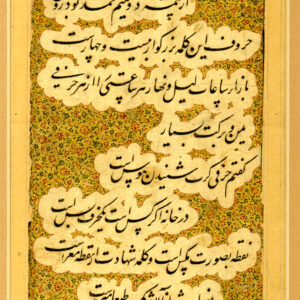
Eṣfahānī, Muhammad-Ṣāleḥ, calligrapher and inscriptionist of the 18th/12th century (d. ca. 1730/1130). He was the son of Mīrzā Abū Turāb Eṣfahānī*, known as Turābā, one of Isfahan’s celebrated nasta‛līq calligraphers and a distinguished student of Mīr ‛Emād*. Muhammad-Ṣāleḥ and his brother Nūr-al-Dīn Muhammad, known as Nūrā, started learning calligraphy under their father. Although both1 became among the foremost nasta‛līq script masters of their time (the latter half of the 17th/11th and the first half of the 18th/12th century),2 they continued to sign their works by placing their father’s name before their own.3
Muhammad-Ṣāleḥ was among the distinguished masters of the Isfahan school of calligraphy during the reigns of Shah Suleymān (r. 1666–1694/1077–1105) and Shah Sulṭān-Hussein Ṣafavī (r. 1694–1722/1105–1135). However, the existence of several calligraphers bearing the same name during the Safavid period has sometimes led to the confusion of their biographies under that of Muhammad-Ṣāleḥ Eṣfahānī. For instance, some sources report that “after the murder of Mīr ‛Emād, Shah ‛Abbās sent him to India to bring Rashīdā* back to Iran.”4 This statement is clearly incorrect, since Muhammad-Ṣāleḥ lived until about 1730/1130, more than a century after Mīr ‛Emād’s death in 1615/1024. Given that several nasta‛līq calligraphers named Muhammad-Ṣāleḥ were active in that period, it is probable that Shah ‛Abbās had actually dispatched Muhammad-Ṣāleḥ Khātūnābādī to India.
Muhammad-Ṣāleḥ authored a brief treatise entitled tadhkerat al-khaṭṭāṭīn, a biographical account of calligraphers active in the late Safavid period. In this work, he regarded Muhammad-Ṣāleḥ Khātūn-ābādī as one of Mīr ‛Emād’s students and praised his handwriting.5 According to this treatise, Khātūn-ābādī first studied calligraphy under his father but gained little renown during his father’s lifetime; only after his father’s death did he begin teaching the nasta‛līq script.6
In addition to this treatise, several calligraphic panels and specimens bearing Muhammad-Ṣāleḥ’s signature have survived, some of which are described in aḥvāl va āthār-e khush-nevīsān [the biography and works of calligraphers]. The inscription “be-baldat Ḥalab al-shahbā fī sana 1107”7 appearing on one of his pieces indicates that he apparently travelled to Asia Minor in the early years of the 18th/12th century.
Bayānī and Fīrūzbakhsh have given the year of Muhammad-Ṣāleḥ’s death as 1714/1126,8 whereas Humāyī records it as 1730/1130.9 Mīrzā Sanglākh also noted that his grave is located in the Lunbān Mosque* of Isfahan, beside the tomb of his father.10
Works
In calligraphy, Muhammad-Ṣāleḥ followed the style of Mīr ‛Emād. A copy of his transcription of one of Mīr ‛Emād’s chalīpās beginning with the verse “peyvaste umīdam be-khudā-ye mut‛āl” [My hope is always in God] is preserved in the Mīr ‛Emād Museum at the Sa‛d-ābād Palace, bearing the signature “al-‛abd Muhammad-Ṣāleḥ ghafara dhanbah.” Among his few dated chalīpās is a specimen in the Malek National Museum, inscribed “aḥqar al-‛ebād Muhammad-Ṣāleḥ ghafara dhanbah 1109/ [1697].”
In addition to his numerous chalīpās and scribal transcriptions, the extant architectural inscriptions of Isfahan attest that Muhammad-Ṣāleḥ, with ten nasta‛līq inscriptions, was the most prolific nasta‛līq inscriptionist of the Safavid period.11 On the tombstone of Ṣāʾeb Tabrizī*, the renowned poet of the Indian style, appears the signature “faqīr Muhammad-Ṣāleḥ.” The text of this inscription comprises five verses from Ṣāʾeb’s celebrated lyric poem beginning:
There is no veil without the echo of Your voice;
The world is filled with You, yet empty of Your place.
Dar hīch parde nīst nabāshad navā-ye tu //
‛ālam pur ast az tu va khālī ast jā-ye tu
and an additional separate verse:
How could the traces of my being be erased from the tablets of hearts?
I am that very delight they find within my speech.
maḥv key az ṣafḥe-ye delhā shavad āthār //
man hamān dhuqam ke mī-yāband az guftār-e man
The text of these verses is carved in twelve panels on a single monolithic stone. At the bottom of the slab, within a separate frame, the following inscription appears: “taḥrīran shahr-e Jamādī al-Awwal faqīr Muhammad-Ṣāleḥ sanah 1087 [1676].” The date shows that the performance of the tomb inscription took place one year after Ṣāʾeb’s death. In the garden where Ṣāʾeb’s mausoleum stands, a stone panel on the eastern wall bears six verses concerning the reconstruction of the Rūydashtīn dam, and between the two hemistiches of the final verse is inscribed: “Rāqamahū Muhammad-Ṣāleḥ 1100.”
The inscription in the entrance corridor (dehlīz) of the Imāmzāde Esmā‛īl* in Isfahan is also among the works of Muhammad-Ṣāleḥ. Executed in raised nasta‛līq script, it is rendered in gold on a lapis-blue background using the stucco-carving technique. The four hemistiches of the inscription include a chronogram indicating the year of execution, 1699/1111. After the first verse, and above the doorway, appears the signature: “Written by Muhammad-Ṣāleḥ al-Eṣfahānī” (katabahū Muhammad-Ṣāleḥ al-Eṣfahānī.)12
The inscriptions of the Chahār-Bāgh madrasa* in Isfahan, counted among Muhammad-Ṣāleḥ’s most celebrated works, were executed between 1706 and 1708/1118–1120. This madrasa —also known as the Madrase-ye Mādar Shāh (“the Queen Mother’s Madrasa”)—is the most magnificent royal monument of the reign of Shah Sulṭān-Hussein Ṣafavī,13 notable for the remarkable diversity of its tile decoration. The uppermost inscription above its entrance concludes with the following chronogrammatic verse:
Azharī took up the pen and wrote its date:
“By the name of the royal madrasa, perfection was attained.”
qalam gereft va nevesht Azharī be tārīkhash //
be nām-e madrese-ye shah shud az Kamāl-ābād
The chronogram of this inscription corresponds to the year 1706/1118, and at its end appears the signature “Written by Muhammad-Ṣāleḥ” (Katabahū Muhammad-Ṣāleḥ). This wooden inscription, executed in the overlay technique14, is written in white on a black background across the delicate parapets of the six alcoves surrounding the school’s vestibule. It contains fifteen verses composed by a poet named “Azharī.”
Another of Muhammad-Ṣāleḥ’s outstanding works is the inscription on the two silver leaves of the entrance door of the Chahār-Bāgh-e madrasa 15which concludes with the following chronogrammatic verse:
The wondrous pen inscribed for its date:
“God opened in Isfahan the gate of the city of knowledge.”
negāsht kelek-e badī‛ az barā-ye tārīkh-ash //
“gushād Haqq be Sefāhān dar-e madīna-ye ‛elm”
This poem, consisting of sixteen verses, is engraved in separate panels—eight on the right leaf and eight on the left. At the end, between the last two verses on the left leaf, appears the calligrapher’s signature: “kāteb al-ḥurūf Muhammad-Ṣāleḥ ghafara dhanbah.” The chronogram in the final hemistich corresponds to the year 1708/1120. The upper inscription above the vestibule of the madrasa’s entrance is likewise signed by Muhammad-Ṣāleḥ. It is written in twenty-two consecutive panels, in white script on a lapis-tiled background, and its closing verse also contains a chronogram for the year 1708/1120:
Out of yearning for the completion of this lofty edifice he said:
“The madras of the servant of Ali, and the king of faith is Sulṭān Hussein.”
az pey-e etmām-e īn ‛ālī banā az shuq guft //
madrase kalb-e Ali va shah-e dīn Sulṭān Hussein
Between the eleventh and twelfth hemistiches appears the signature “Written by Muhammad-Ṣāleḥ.” The inscription on the northern vestibule of the Chahār-Bāgh madrasa, executed in white on a lapis-tiled background, is also his work. It concludes with the following chronogrammatic verse:
The mosque of the just king, the moon of the two Easts;
The noble madras of the king of faith, Sulṭān Hussein.
masjed-e Sulṭān-e ‛ādel, māh-e awj-e mashreqayn //
madrase ‛ālī-jenāb shah-e dīn Sulṭān Hussein
The final hemistich of these panels bears the dates 1706–1707/1118–1119, and between the two lines appears the inscription “Written by Muhammad-Ṣāleḥ.” In the entrance inscription of the ‛Alīqulī Āqā Mosque* as well, the chronogram reads: “God’s mercy was the dedication of this mosque,” (raḥmat-e ḥaqq vaqf-e īn masjed buvad) indicating the year 1710/1122. The name “Muhammad-Ṣāleḥ” is also inscribed there. The technique used for this inscription is white mosaic tilework* (mu‛arraq) on a lapis-blue background, framed with turquoise borders. The ‛Alīqulī Āqā Mosque and its adjoining bathhouse were built in 1710/1122 by one of the royal eunuchs of Shah Sulṭān Hussein.16
Mahdi Bayānī, in his aḥvāl va āthār-e khush-nevīsān, attributed the stucco inscription on the entrance vaulted portico of the Chehel Sutūn* Palace to Muhammad-Ṣāleḥ Eṣfahānī,17 whereas Humāyī, the author of tārīkh-e Isfahan, credited the work to Muhammad-Ṣāleḥ Khātūn-ābādī.18 Since Muhammad-Ṣāleḥ Khātūn-ābādī lived in the 17th/11th century and was a direct student of Mīr ‛Emād,19 and given the chronogram of the inscription—“May blessed be the lofty hall of Jamshīd’s pavilion” (mubārak bād tālār-e buland eyvān-e Jam-jāhī) —which corresponds to the year 1706/1118, along with the signature “Written by Muhammad-Ṣāleḥ,” the attribution to Muhammad-Ṣāleḥ Eṣfahānī appears more plausible, as the date of execution falls ninety-four years after Mīr ‛Emād’s death. Accordingly, considering his earliest known inscriptional work (Ṣāʾeb’s tombstone, 1676/1087) and his latest (the ‛Alīqulī Āqā Mosque, 1710/1122), it may be inferred that he was active in monumental inscription work for at least thirty-five years.
/Farhad Khosravi Bizhaem/
Bibliography
Bayānī, Mahdi. aḥvāl va āthār-e khushnevīsān, Tehran: ‛Elmī, 1984/1363.
Eṣfahānī, Muhammad-Ṣāleḥ b. Abū-Turāb. tadhkerat al-khaṭṭāṭīn, ed. Pejmān Fīrūzbakhsh, Nāmeh-ye Bahārestān, 6–7/1–2 (2005–2006/1384–1385).
Godard, André. “Isfahan,” in āthār-e Iran, by André Godard et al., tr. Abū al-Hasan Sarvaqad Muqaddam, vol. 4, Mashhad: Bunyād-e Pazhūhesh-hā-ye Eslāmī, 2005/1384.
Humāyī, Jalāl-al-Dīn. tārīkh-e Isfahan: mujled-e hunar va hunarmandān, ed. Māhdukht Bānū Humāyī, Tehran: Pazhūheshgāh-e ‛Ulūm-e Ensānī va Muṭāle‛āt-e Farhangī, 1996/1375.
Hunarfar, Luṭfullāh. ganjīne-ye āthār-e tārīkhī-ye Isfahan, Isfahan: Saqafī, 1971/1350.
Khosravi Bizhaem, Farhād. “shenāsāʾī va mu‛arrefī-ye khushnevīsān-e katībe-hā-ye nasta‛līq dar banāhā-ye dure-ye Ṣafavī-ye Iran,” Negare, no. 49, Spring 2019/1398.
- Eṣfahānī, introduction by Fīrūzbakhsh, p. 13.[↩]
- Humāyī, pp. 129, 154.[↩]
- Ibid., p. 129.[↩]
- Bayānī, p. 767.[↩]
- Eṣfahānī, pp. 19–20; Bayānī, p. 774.[↩]
- Eṣfahānī, introduction by Fīrūzbakhsh, p. 13.[↩]
- Bayānī, p. 773.[↩]
- Ibid., p. 772; Eṣfahānī, introduction by Fīrūzbakhsh, p. 14.[↩]
- Humāyī, p. 129.[↩]
- Eṣfahānī, introduction by Fīrūzbakhsh, p. 14.[↩]
- Khusravi Bizhaem, p. 51.[↩]
- Godard, p. 315.[↩]
- Hunarfar, p. 685.[↩]
- Khusravi Bizhaem, p. 47.[↩]
- Humāyī, p. 129.[↩]
- Godard, p. 334.[↩]
- Bayānī, p. 772.[↩]
- Humāyī, p. 152.[↩]
- Ibid., p. 130.[↩]