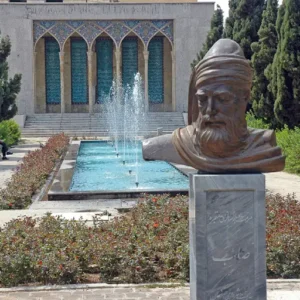
Emāmzāde Esmā‛īl, a complex consisting of the shrine of Emāmzāde Esmā‛īl, a madrasa bearing the same name, and the Isaiah mosque and mausoleum, located on Hātef Street. The Hātef quarter is one of the old districts in the eastern part of Isfahan, which in the past was known as the Khushīnān quarter* and is today also called Gulbahār*.
Each part of this complex bears an inscription*, most of which belong to the 17th/11th century. The oldest inscription of the complex is on a tombstone dated 1587/995.1 This complex is attributed to two religious figures: one is Emāmzāde Esmā‛īl, after whom the complex is named, and the other is Sha‛yā, who has been regarded as Isaiah*, one of the prophets of the Children of Israel. In Islamic and Iranian sources, the name “Esha‛yā” ]Isaiah[ is often recorded without the initial E and appears in two forms: Sha‛yā and Sha‛yāʾ.2 The longest book in the “Prophets” section of the Bible is attributed to Isaiah the Prophet. According to the Book of Isaiah, he was the son of Amoz and a contemporary of kings such as Uzziah (786–734 BC). According to the Old Testament, he presents an image of the wrathful face of Yahweh. Chapters 34 and 35 and also 40 to 46 of the Book of Isaiah differ in content and style and are probably attributed to another prophet who lived in the 6th century BC (around 540 BC) in exile in Babylon. He presents a merciful image of Yahweh and is known as “Second Isaiah.” Chapters 56 to 66 of this book are attributed to yet another prophet, who may be called “Third Isaiah.” The sayings of Third Isaiah belong to the period after the reconstruction of the Temple of Jerusalem (516 BC), and he was probably among the disciples or followers of Second Isaiah.3 The name of Isaiah the Prophet and some events of his lifetime, including reports related to his martyrdom, are mentioned in several Islamic historical and exegetical sources. Some, based on verses 4 to 8 of Sūrat al-Esrāʾ[Chapter 17], have considered Isaiah to be a prophet who was sent before Zachariah and who gave the glad tidings of the coming of the prophets after him—Jesus and Muhammad.4 However, what Muslim authors have written on this matter is based on their own understanding and interpretation, and the claim that this person came to Iran and was buried in Isfahan has no historical source or foundation. The Isaiah buried in this complex was most probably one of the sacred figures associated with the Jewish religion in this region, which was among the areas of Jewish settlement in Iran.
The other figure is Emāmzāde Esmā‛īl, whose lineage, according to the inscription on the entrance portal of the courtyard of the shrine, is introduced as “Esmā‛īl b. Hasan b. Zayd b. Hasan b. Ali b. Abī Ṭāleb”, and according to the inscription on the wooden lattice of the building, as “Esmā‛īl b. Zayd b. Hasan b. Ali b. Abī Ṭāleb.” Some have regarded him as Esmā‛īl Dībāj, the son of Ebrāhīm al-Ghamr, or Esmā‛īl b. Ebrāhīm Ṭabāṭabā. Nevertheless, according to genealogical sources, the existence of the tomb of Esmā‛īl Dībāj in Isfahan is not acceptable.5
The architecture of this complex is such that on the northern side of the courtyard lie the madrasa and its chambers, while on the southern side are located the mosque, the mausoleum of Sha‛yā [Isaiah], and the shrine of Emāmzāde Esmā‛īl.6 Regarding the construction history of this complex, there are certain ambiguities. According to André Godard,7 this complex was built on the site of an old mosque dating back to the early period of the advent of Islam in Iran, and today the oldest remaining part of the building is an incomplete minaret belonging to the Seljuq period, or to the time of Alp Arslan (d. 1072/465). Myron Bement Smith8 regarded this minaret as belonging to the 12th/6th century.
The entrance to the Emāmzāde Esmā‛īl complex is through a domed chahārsū [domed crossway], to the west of which lie Hātef Street* and the bazaar. This chahārsū opens into the courtyard. In fact, the central core of this complex is the building of Emāmzāde Esmā‛īl, consisting of the domed chamber and its portal. Formerly, one of the passageways of the chahārsū passed to the south of the shrine, where the portal was located. At the time of Shah Sulṭān-Hussein* Ṣafavī, a madrasa was annexed to this building, and the portal of the shrine took the form of an vaulted porch on the southern front of the madrasa.9 According to the existing inscriptions, the construction of the building of Emāmzāde Esmā‛īl began during the reign of Shah ‛Abbās* (1588–1629/996–1038) and was completed in the reign of Shah Ṣafī (1629–1642/1038–1052).
This building is adorned with tilework, stucco decoration*, and painting*. In addition to the spandrels of the entrance portal (pusht-baghal, the triangular fields between the entrance arch and its rectangular frame), which are decorated with seven-color glazed square tiles, the interior of the shrine features decorations including raised gilded hexagonal tiles applied to the dado panels. The upper parts of the dado panels and the surface of the dome are also covered with raised gilded stucco decorations. Three tombstones can be seen in the domed chamber, dated 1633/1043, 1637/1047, and 1781/1196, the last of which belongs to Zīnat-al-Nesāʾ Beygum, the daughter of Shah Esmāʿīl III.10
The exterior dome of Emāmzāde Esmā‛īl retains tilework dating from the period of Shah ‛Abbās I* (1588–1629/996–1038). Around the drum of the dome runs an inscription executed in simple bannāʾī script, bearing Sūrat al-Tawḥīd and verse 127 of Sūrat al-Baqara. The neck (drum) of the dome is also covered with bannāʾī inscriptions in cobalt-blue, repeatedly reading “Yā Subḥān” and “Yā Sulṭān,” set against a brick background.11
Among the noteworthy features of Emāmzāde Esmā‛īl are the Persian poetic inscriptions in the portico, two sangāb (stone water basins) in the courtyard bearing invocations (ṣalawāt) upon the Fourteen Infallibles, and Persian verses inscribed on their panels. The content of one inscription, dated 1703/1115, refers to the exemption of the inhabitants of that district from performing yarāq-pūshī (ritual symbolic arming in Muharram processions) and nakhl-bastan (decorating the ceremonial mourning bier “Nakhl”) during the days of ‛Āshūrā.; however, understanding the exact historical and social context of this exemption requires further research. The precious shrine grille, which is a combination of metal and finely carved wood, is—compared with similar works—remarkably refined and distinguished.12
Emāmzāde Esmā‛īl is connected to the mausoleum of Sha‛yā [Isaiah] by a vestibule whose precious carved wooden door dates from the period of Sulṭān Maḥmūd of the Muzaffarids (1358–1374/759–776).13 This door, in terms of woodcarving*, is counted among the most exquisite historical doors of Isfahan; in addition to sacred invocations around both wings, prayers (ṣalawāt) upon the Fourteen Infallibles are also carved upon it. According to Hunarfar*,14 the structure of Sha‛yā’s mausoleum is not of great antiquity. The interior space of the mausoleum is polygonal, plain, and plastered. The mausoleum has a precious wooden grille, covered with glass, and on the southern and western sides of the sanctuary there are handwritten inscriptions in Hebrew, probably carved in the past by Jewish pilgrims. Above the northern entrance of Sha‛yā’s mausoleum is a raised nasta‛līq inscription from the time of Shah Sulṭān-Hussein Ṣafavī, which reads as follows:
Wajadnā fī ketāb Aṣfā anna awwala masjeden kabīren bunīya be-Isfahan masjedu Sha‘yā, wa banāhu Abū al-‛Abbās al-Muftī fī zamān Ali ṣalawātullāh ‛alayh, wa ‛ammara-hu Alp Arslān ba‛da nayyefen wa khamsameʾa ba‛da mā ghalabahā bi-quwwaten, wa qad amara bi-‛emāratehā fī ‛ām aḥad ‛ashara wa meʾa wa alf; wa be-‛ebāraten ukhrā heya marqadu Sha‛yā al-nabī ‛alayhe al-salām. Ali Naqī al-Emāmī, 1112.15
[We found in the Book of Asfā that the first great mosque built in Isfahan was the Mosque of Sha‘yā; it was built by Abū ‛Abbās the Mufti in the time of Ali and Alp Arslān restored it after more than five hundred years, after conquering it by force, and he ordered its reconstruction in the year 1111. In other words, this is the tomb of the Prophet Sha‘yā. Ali Naqī al-Emāmī, 1112 [1700 CE].]
Next to the mausoleum lies the Sha‛yā [Isaiah] Mosque, which is reputed to be the oldest mosque in Isfahan. In the past, this mosque was known as Khushīnān.16
According to Jāberī Anṣārī*,17 the Qajar-period historian, the mausoleum of Emāmzāde Esmā‛īl is an annexed structure that was added later to the complex. According to Abū Nu‛aym Esfahānī*,18 the 11th/ 5th-century historian, the Khushīnān Mosque was the first mosque of Isfahan, and it was built by Abū Khannās during the caliphate of Imam Ali (656–661/35–40). The author of mujmal al-tavārīkh wa al-qaṣaṣ,19 from the 12th/6th century, confirms this report. Nīkzād Amīr-Ḥusaynī20 has also suggested the possibility that the Sha‛yā Mosque may have been built in place of a former synagogue. According to the inscription of the Sha‛yā Mosque, this mosque is introduced as the first great mosque in Isfahan, the patron of which was Abū al-‛Abbās al-Mufti, governor of Isfahan during the time of Imam Ali, and it was later restored by Alp Arslān (d. 1072/465). The “Abul-‛Abbās” mentioned in this inscription is probably the same person as “Abū Khannās” introduced by Abū Nu‛aym. Moreover, the expression “ketāb asfā” is most likely a reference to al-aṣfā fī tafsīr al-Qurʾān, the work of Mullā Muḥsen Feyḍ Kāshānī*.21
Some of the other inscriptions of the mosque, written by Muhammad-Reza Emāmī, include the inscription on the northern portal in seven-color tiles* bearing verses 18 and 19 of Sūrat al-Tawba [Chapter Nine] (1700/1112); the inscription around the prayer niche bearing the same verses (1689/1100); and the inscription inside the prayer niche containing verse 144 of Sūrat al-Baqara [Chapter Two] (1689/1100). The prayer hall, located on the eastern side of the mosque, also contains two inscriptions written by ‛Abd al-Ḥamīd Adhamī.22
Jāberī Anṣārī reports, regarding the prosperity of this sanctuary, that there were houses around it in which wax candles were produced, and on Thursday nights two wax candles were lit in golden candlesticks. The candles were so tall that a ladder had to be used in order to light them.23
The Emāmzāde Esmā‛īl complex, under the title “Sha‛yā Mosque and Emāmzāde Esmā‛īl”, was inscribed on the National Heritage List of Iran on 5 January 1932/15 Dey 1310, under registration no. 112.24
/Yasamin Ghani & Akram Arjah/
Bibliography
Abū Nu‛aym Eṣfahānī, Aḥmad b. ‛Abdullāh, ketābu dhekr akhbār Eṣbahān, Cairo: Dār al-Ketāb al-Eslāmī, [n.d.].
Dehkhudā, Ali-Akbar, lughat-nāme, under the supervision of Muhammad Mu‛īn and Ja‛far Shahīdī, Tehrān: University of Tehran, 1998/1377.
Ebn Athīr, al-kāmel fi al-tārīkh, Beirut: Dār Ṣāder, 1965/1385.
Ebn Qutayba, al-ma‛āref, ed. Tharvat ‛Ukāshe, Cairo: Dār al-Ma‛āref, [1969].
Faqīh Īmānī, Mahdi, tārīkh-e tashayyu‛-e Isfahan az dahe-ye sevvum-e qarn-e avval tā pāyān-e qarn-e dahum, [Tehran]: Mahdi Faqīh Īmānī, 1995/1374.
ganj-nāme: farhang-e āthār-e me‛mārī-ye eslāmī-ye Iran, under the supervision of Kāmbīz Ḥājī-Qāsemī, daftar 11: emāmzāde-hā va maqāber, Tehrān: University of Shahīd Beheshtī, 2010/1389.
Gitay, Yehoshua, “Isaiah,” in the Encyclopedia of Religion, ed. Mircea Elide, vol. 7, New York: Collier Macmillan Publishers, 1987.
Godard, André, “Isfahan,” in āthār-e īrān, by André Godard et al., tr. Abul-Hasan Sarvaqad Muqaddam, vol. 4, Mashhad: Bunyād-e Pazhūhesh-hā-ye Eslāmī, 1989/1368.
Hunarfar, Luṭfullāh, ganjīne-ye āthār-e tārīkhī-ye Isfahan, Isfahan: Thaqafī, 1971/1350.
Jāberī Anṣārī, Muhammad-Hasan, tārīkh-e Isfahan va rey va hame-ye jahān, Isfahan: Hussein ‛Emādzāde, [1943/1322].
Mahdavī, Muṣleḥ al-Dīn, mazārāt-e Isfahan az qarn-e sevvum-e hejri tā zamān-e ḥāḍer, ed. Aṣghar Muntaẓer al-Qā’em, Isfahan: University of Isfahan, 2003/1382.
mujmal al-tavārīḵ va al-qaṣaṣ, ed. Muhammad-Taqī Bahār, Tehran: Kalāle-ye Khāvar, 1939/1318.
Nīkzād Amīr-Hussaynī, Karīm, tārīkhche-ye abnīye-ye tārīkhī-ye Isfahan, Isfahan: Chāpkhāne-ye Dād, 1956/1335.
Pāzūkī Ṭarūdī, Nāṣer va Shādmehr, ‛Abd al-Karīm, āthār-e sabt-shude-ye Iran dar fehrest-e āthār-e mellī az 15/09/1931 / 24/06/1310 — 15/09/2005 / 24/06/1384, Tehrān: Sāzmān-e Mīrāth-e Farhangī-ye Keshvar, 2005/1384.
Rafī‛ī Mehr-ābādī, Abul-Qāsem, āthār-e mellī-ye Isfahan, Tehran: Anjuman-e Āthār-e Mellī, 1973/1352.
Smith, Myron Bement, “manārehā-ye Isfahan,” in āthār-e Iran, by André Godard et al., tr. Abul-Hasan Sarvaqad Muqaddam, vol. 4, Mashhad: Bunyād-e Pazhūhesh-hā-ye Eslāmī, 1989/1368.
Ṭabresī, Faḍl b. Hasan, majma‛ al-bayān fī tafsīr al-quran, [Beirut]: Dār al-‛Ulūm, 2005/1426.
- ganj-nāme, vol. 11, p. 82.[↩]
- for example, see: Ebn Qutaybe, p. 50; Dehkhudā, under “Ash‛īyā”.[↩]
- See: Gitay, pp. 289–295.[↩]
- Ṭabresī, vol. 6, p. 170; Ebn Athīr, vol. 1, p. 255.[↩]
- Faqīh Īmānī, pp. 384–385.[↩]
- ganj-nāme, vol. 11, p. 85, map.[↩]
- Godard, p. 309.[↩]
- Smith, pp. 148 and 150, image 218.[↩]
- ganj-nāme, vol. 11, p. 83.[↩]
- Hunarfar, pp. 524–528.[↩]
- Ibid., pp. 537–538.[↩]
- Rafī‛ī Mehr-ābādī, pp. 753–755, 760–761.[↩]
- Hunarfar, pp. 529–530.[↩]
- Ibid., p. 521.[↩]
- Ibid., p. 522; for the English translation of the inscription text, see below.[↩]
- Hunarfar, p. 521.[↩]
- Jāberī Anṣārī, p. 185.[↩]
- Abū Nu‛aym Eṣfahānī, vol. 1, p. 17.[↩]
- mujmal al-tavārīḵ wa al-qaṣaṣ, p. 524.[↩]
- Nīkzād Amīr-Hussaynī, p. 126.[↩]
- Hunarfar, p. 522; Mahdavī, p. 102.[↩]
- Hunarfar, pp. 531, 533.[↩]
- Jāberī Anṣārī, pp. 189–190.[↩]
- Pāzūkī Ṭarūdī and Shādmehr, p. 69.[↩]