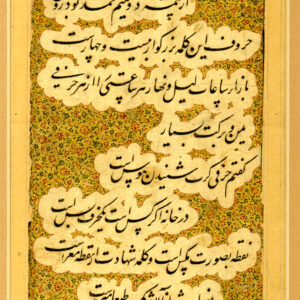
‛Emrānī, a Jewish poet and writer from Isfahan in the 15th–16th/9th–10th centuries, (1454/858–alive in 1536/943).
He was born in Isfahan. His personal name is unknown, and “‛Emrānī” was most likely his pen name. ‛Emrān (in the Bible: Amram) was the name of the father of Moses, and by choosing this pen name the poet associated his thought and orientation with the prophetic lineage of Moses and the leadership of the people of Israel. Some scribes have also placed the titles “Mullā” and “Mavlānā” before his pen name. There is no document introducing ‛Emrānī, and he himself has not provided much information about his personal life in his numerous works.1 Nevertheless, from scattered verses in the prefaces and the texts of some of his poems, certain details about his life can be inferred.
At the age of twenty, ‛Emrānī attracted the attention of a rabbi in Isfahan by the name (or title) of Amīn al-Dawla, who, recognizing his poetic talent, encouraged him to continue the work of Shāhīn Shīrāzī. Shāhīn Shīrāzī, in the 14th/8th century, was the most distinguished Jewish poet of Iran, who versified the five books of the Torah together with several other treatises from the Bible in his three major works.2 ‛Emrānī, who was deeply influenced by Shāhīn and looked with admiration upon his works, accepted the rabbi’s suggestion. He named his own book fatḥ-nāme and eagerly began it by versifying the Book of Joshua from the section of the Prophets in the Bible, continuing his work until Amīn al-Dawla passed away. The death of Amīn al-Dawla affected the young ‛Emrānī so profoundly that he abandoned the composition of the fatḥ-nāme. It is not clear how many months after this event another rabbi, named Rabbi Yehuda from the family of Rabbi Isḥāq, met ‛Emrānī and encouraged him to continue his work.3
After that, in the midst of composing the fatḥ-nāme, ‛Emrānī was compelled, despite his inner reluctance, to leave Isfahan forever. No precise information is available regarding the reasons for this decision, but in his works he lamented the lack of support, envy, obstruction, and mockery he had endured, and even years after those events he complained about the malice and intrigues that had been directed against him in Isfahan. In the closing verses of the entekhāb-e nakhlestān, in a chapter praising wisdom, old age, and the qualities of leadership in the Jewish community, he states that as a result of the wickedness of three men he left Isfahan for Kashan so that he would no longer be forced to see them.4
Regarding the reason for choosing Kashan as his place of migration, in addition to its proximity and shared cultural ties, it should be noted that Kashan at that time was one of the most populous Jewish* centers in Iran. The presence of an old Jewish community and the cultural and religious vitality of this city helped ‛Emrānī in the flourishing of his talent and the enrichment of his later works; as he himself acknowledged in the Thirteen Principles of Faith (vājebāt va arkān-e sīzdahgāne-ye īmān-e Īsrāʾīl/Isrāʾīl, the precise formulation of the philosophical system of Judaism and its poetic expression was in part indebted to his day-and-night studies in the Jewish religious schools (Bet Ha-Midrash) of Kashan.5
Little else is known about the personal life of ‛Emrānī, except that in the ganj-nāme he once mentioned his son by the name Mullā Jalāl al-Dīn. Some scholars have questioned the appropriateness of this naming for a Jewish individual and have suggested that he may have converted to Islam.6 Nevertheless, in the ganj-nāme ‛Emrānī addressed Jalāl al-Dīn together with “all the children of Israel,” and, as is clear from the content of the text, he expressed pride in this son and boasted of his upbringing.7
The date of ‛Emrānī’s death is also unknown. His last work, the ganj-nāme, was completed in 1536/943 in Kashan. A verse by Bābāʾī b. Luṭf, a Jewish poet and historian from Kashan in the 17th/11th century, in the anūsī has led some scholars to suppose that ‛Emrānī may have died in Shiraz. In describing the events relating to the Jews of each city, Bābāʾī b. Luṭf, in an entry on Shiraz, composed the following:
Now I wish to take flight from this region,
driving the steed of my speech to Shiraz.
(kunūn khāham kunam zīn ulke parvāz / berānam markab-e nuṭqam be Shīrāz)
I shall kiss with reverence the tomb of Ḥāfeẓ,
From Sheikh Sa‛dī I shall also seek spiritual resolve.
(bebūsam turbat-e Ḥāfeẓ be ‛ezat / ze Shaikh Sa‛dī bekhwāham nīz hemat)
I shall declare my love to my own masters,
I shall breathe the fragrance of the roses of Shāhīn and ‛Emrānī.”.8
(be ustādān-e khud ‛eshqī begūyam / gul Shāhīn va ‛Emrānī bebūyam)
The idea that ‛Emrānī went to Shiraz after the age of eighty and died there, though not impossible, is difficult to accept. For this reason, most scholars have regarded the verses of Bābāʾī b. Luṭf as a form of tribute and respect to two leading poets of Judeo-Persian literature, mentioned alongside Ḥāfeẓ and Sa‛dī, the two renowned poets of Persian literature.9 It thus seems that ‛Emrānī passed away in Kashan.10
There is also no substantial report regarding the social conditions of the Jews during the lifetime of ‛Emrānī. The first fifty years of his life passed in the late Timurid period, during which the situation of Isfahan changed in the wake of Teymūr’s invasion and the subsequent wars, and, as a consequence, the Jewish community of this city gradually lost its leading role.11 The later years of ‛Emrānī’s life coincided with the beginning of the Safavid* period, and although reports exist of Shah Esmā‛īl I’s aversion against the Jews, there is no evidence of persecution or conflict against them. It seems that Kashan, where ‛Emrānī resided, enjoyed considerable prosperity in economic and cultural domains during these years.
Works
Until the early 20th/14th century only two books, the fatḥ-nāme and the ganj-nāme of ‛Emrānī, introduced by Wilhelm Bacher,12 were known among scholars of Judeo-Persian texts and Orientalists.13 Afterwards, other poems and works were also mistakenly attributed to him. Amnon Netzer, a researcher of the history and culture of the Jews of Iran, in the early 1970s/1350s, through the study of manuscripts in various collections, identified and introduced ten major works of ‛Emrānī.14 After him, David Yeroushalmi, professor of Persian literature at Tel Aviv University, published a portion of the ganj-nāme and, in its introduction, examined ‛Emrānī’s works in greater detail.15 These works, in Persian verse and prose or a combination of both, were written in Hebrew script. An examination of ‛Emrānī’s poems and writings and an exploration of their content reveals his inclination to express ethical ideas in the form of counsel and advice, parables, and storytelling about the historical and didactic narratives of the Bible and other authoritative texts in Judaism, in order to apply ethical and mystical teachings to life.
fatḥ-nāme
This is ‛Emrānī’s most important and longest work, which he began composing at the age of twenty. This narrative poem, in the form of a mathnavī [a verse form of rhyming couplets] and in the meter of hazj-e musaddas maḥdhūf, comprises about ten thousand verses,16 and in it ‛Emrānī, despite his youth, demonstrated his mastery of prosodic, stylistic structures and the literary and rhetorical devices of Persian literature. The content of the fatḥ-nāme focuses on the events from the death of Moses until the enthronement of Solomon. In this work ‛Emrānī remained faithful to the general outlines of the biblical story, yet in narrating the details he did not refrain from consulting Talmudic sources and referring to legendary events found in certain Jewish exegetical texts. The language of the fatḥ-nāme is strongly influenced by Ferdavsī’s style, and ‛Emrānī took into consideration depictions of banquets and battles of the shāhnāme in his portrayals of characters and their actions. Drawing parallels between figures of the Bible and Iranian heroes and employing Qurʾānic narratives to render his accounts familiar are other features of this book.17
Vājebāt va arkān-e sīzdahgāne-ye īmān-e Īsrāʾīl/Isrāʾīl [Thirteen Principles of Faith]
Mūsā b. Maymūn, the renowned Jewish theologian, philosopher, and scholar of the 12th/6th century, formulated the principles of Jewish faith into thirteen articles on the basis of the Torah and its commentators, which after him were accepted among the Jews. In the vājebāt va arkān-e sīzdahgāne, which ‛Emrānī composed in 1508/914, he versified these principles together with their explanation and interpretation in 780 verses in the form of mathnavī. He first presented the thirteen principles in thirteen verses with a fluent translation, and then in separate chapters proceeded to give a versified commentary on each principle. Going beyond the text of Mūsā b. Maymūn, and relying on his own knowledge of Jewish exegetical writings, ‛Emrānī elaborated on each principle in detail and with comprehensiveness, choosing appropriate equivalents for philosophical and theological terms in Persian literature.18 In this book he referred to his continuous training in religious sciences and spoke of the distinguished position and reputation he had attained in the Jewish community of Kashan.19
Ḥanūkkā-nāme
This work is a heroic poetic composition in the form of mathnavī of about 1,800 verses, which ‛Emrānī composed in 1524/930. The subject of this book is the account of the struggle of a group of Jews against the forces of the Greek Empire in the 2nd century BCE. The story of this book, according to the reports found in the First Book of Maccabees from the corpus of the Deuterocanonical books, is narrated here. In this work too the influence of Ferdavsī is evident, especially in the descriptions of battle scenes and in the portrayals of the heroism of the Maccabees in warfare, which recall the imagery of the shāhnāme.20 In verses concerning the “reason for composing the book,” he stated that he named it the ẓafar-nāme:
This ancient chronicle of a new edifice,
from which the sun and moon have drawn their light,
(īn kuhan-nāma-ye ‛emārat-e nu / ke az ū yāft mehr va mah partu)
When I laid its foundation with my pen,
its true name became the ẓafar-nāme.21
(chun nahādam banāsh dar khāme / nām-e ū rāst shud ẓafar-nāme)
But since the content of the events narrated in this book is connected with the occasion of Hanukkah in Judaism, it became known as the Ḥanukkā-nāme.22
Entekhāb-e nakhlestān
This book is a didactic mathnavī of about six hundred verses, in which ‛Emrānī expounds ethical and mystical counsels. The book bears no date of composition, yet its content, in addressing young people and advising them, suggests that it must have been composed in the poet’s old age. The book consists of fourteen chapters, and its title is taken from one of the chapters, “On the Benefit of the Virtue of the Palm Grove,” in which ‛Emrānī calls upon the reader to perform deeds and actions that will preserve his name and from which people, even after his death, will benefit.23 In this book ‛Emrānī makes numerous references and allusions to the Bible and to Jewish exegetical and traditional texts, while also drawing upon the terminology and themes of Islamic mysticism. It is in this book that ‛Emrānī curses the Jews who caused his migration from Isfahan to Kashan. He also admonishes Jewish elders, sages, and leaders concerning proper conduct and correct behavior with the community.24
Ḥekāyat-e dah maqtūl-e salṭanat
This work, composed in both verse and prose and without a date of composition, concerns the aftermath of the suppression of a revolt led by a Jewish leader named Simon bar Kokhba against the forces of Hadrian, the Roman emperor (117–138 CE), in 136 CE. According to Jewish exegetical traditions, after this victory the emperor, on the pretext of the betrayal of Joseph by the ten sons of Jacob, put to death ten prominent Jewish sages. In this work ‛Emrānī narrates the general course of events in prose on the basis of Jewish narrative sources, while rendering in verse the details of the story and the manner of the torture and killing of the sages, composing elegies for each of them.25
Qeṣṣe-ye haft barādarān
This book is likewise written in both verse and prose, with the versified part comprising 600 verses. It bears no date of composition and, prior to the research of Netzer, had been attributed to one of its copyists.26 The qeṣṣe-ye haft barādarān is also known as the muṣībat-nāme, and in some manuscripts its versified part is separated and given the title ḥanā duḵtar-e Nahum. The book focuses on the story of Ḥanā and her seven sons, who, during the Maccabean struggle against the Greeks, refused to bow down before the Greek gods and were tortured and killed one by one. In this work ‛Emrānī praised the courage and heroic action of this family and, in a tone of despair, addressed the suffering and homelessness of the Jews.27
Qurbānī kardan-e Esḥāq
This book, also known by its Hebrew title, ‛aqīdat Yeyṣḥāq, has no date of composition and is entirely in prose.28 The story of Abraham and the sacrifice of his son Isaac, in the Bible, is one of the most frequently recurring themes in Jewish literary, artistic, and exegetical works, and over the centuries it has been elaborated and expanded with many additional elements. In his work ‛Emrānī drew upon these narratives and sought to present a complete course of Abraham’s story—from his childhood to his spiritual perfection—and the story of the sacrifice of his son, relying on various texts rooted in the Bible and on other legendary accounts.29 Numerous manuscripts of this book are extant, testifying to its popularity among the Jews of Iran.
Qeṣṣe-ye zanbīl-dūz
This narrative work is undated, and only 83 verses of it has survived. The story recalls the Islamic account of Joseph’s chastity in his encounter with Zulaykhā. In this tale, the sister of Nūshīrvān sees a handsome basket-weaver in the market, falls in love with him, and seeks through deceit to win his affection. One day, under the pretext of purchasing a basket, she lures the man to her palace and declares her love to him. When the man realizes that his admonitions and counsels have no effect on the woman, he throws himself from the roof of the palace in order to overcome his desire and preserve his chastity.30
Sāqī-nāme
A lyrical and mystical composition of about 190 verses, in which the influence of Ḥāfeẓ’s sāqī-nāme is evident, and which lacks nothing of the fervor and vitality of the great sāqī-nāmes of Persian literature. Its philosophical, ethical, and mystical mood accords with this genre, and its principal themes concern the instability and faithlessness of the world, the joy of the moment, and wise counsel not to set one’s heart on worldly affairs. This work was published in Selected Persian Poems from the Works of the Jews of Iran.31
Ganj-nāme
An ethical mathnavī of more than five thousand verses, it is believed to be the last work composed by ‛Emrānī, in 1536/943, in the final years of his life. The ganj-nāme is a versified translation of part of the treatise andarz-e pedarān (in Hebrew: Masekhet Avot), from the corpus of ethical texts of the Talmud, which focuses on moral anecdotes and wise sayings of rabbis and great Jewish teachers from the time of Moses to the 3rd century CE. In this work as well, ‛Emrānī did not confine himself to the original text, but confronted the reader with a wide range of themes drawn from Jewish, Iranian, and Islamic mystical and ethical sources. Scholars have considered this book to be ‛Emrānī’s most mature and eloquent work.32 Because of its engaging content and ‛Emrānī’s fluent and pleasing style, this book became his most popular work among the Jews of Iran, and many manuscripts of it are preserved in collections worldwide. A Persian prose translation of the andarz-e pedarān is also attributed to ‛Emrānī.33
The numerous works of ‛Emrānī, in both verse and prose and with their wide variety of themes, together with his taste, ability, and skill in composing poetry and embedding religious and intellectual ideas within them, have secured for him a lofty position in Judeo-Persian literature, to the extent that he has been regarded as the second greatest poet in this field after Shāhīn Shīrāzī.34 Although he was clearly a follower and continuator of Shāhīn, the influence of poets such as Ḥāfeẓ can be seen in his works, especially in the sāqī-nāme.35
‛Emrānī’s versification is at times not particularly strong, and even contains flaws of meter and rhyme,36 although some of these may have arisen in the course of transmission and re-transcription. Nevertheless, his works have been considered to possess manifold literary and historical value. In his writings, within the Persian text (in Hebrew script), he also included Hebrew and Arabic words, among which rare and obsolete terms are found, making them useful for lexicographical research. ‛Emrānī employed many mystical terms to express Jewish concepts, and even used expressions such as Allāh akbar and sayyed. His poetry contains numerous examples of literary devices such as metaphor, simile, and paronomasia. Moreover, his works contain references to historical events and the social conditions of his time, which are of great value for research in these fields.37
/Amir Ali Fallahian/
Bibliography
Asmussen, Jes P., “Judaeo-Persica I: Šāhīn-i Šīrāzī’s Ardašīr-nāmā”, Acta Orientalia, 28, 1963.
Bābāʾī b. Luṭf Kāshānī, ketāb-e anūsī, trans., ed., and study by Amir Ali Fallahian, Los Angeles, Sherkat-e Ketāb, 2021/1400.
Bacher, Wilhelm, Zwei jüdisch-persische Dichter: Schahin und Imrani, zweite Halfte, Budapest: Druck von Adolf Alkalay, 1908.
‛Emrānī, entekhāb-e nakhlestān, manuscript of the National Library of Israel, no. 1183: The National Library of Israel, Jerusalem, Israel, Ms. Heb. 1183=28.
‛Emrānī, fatḥ-nāme, manuscript of the Ben-Zvi Institute, no. 4571: The Ben-Zvi Institute, Jerusalem, Israel, Ms. 4571.
‛Emrānī, ganj-nāme, manuscript of the Hebrew Union College Library, no. 2181: Hebrew Union College Library, Cincinnati, OH, USA, Ms. 2181.
‛Emrānī, ḥanūkkā-nāme, manuscript of the National Library of Israel, no. 1183: The National Library of Israel, Jerusalem, Israel, Ms. Heb. 1183=28.
‛Emrānī, vājebāt va arkān-e sīzdahgāne-ye īmān-e Īsrāʾīl/Isrāʾīl, manuscript of the National Library of Israel, no. 1183: The National Library of Israel, Jerusalem, Israel, Ms. Heb. 1183=28.
Fischel, Walter J., “Isfahan: The story of a Jewish Community in Persia”, in Joshua Starr Memorial Volume, New York: Conference on Jewish Relations, 1953.
Moreen, Vera Basch, In Queen Esther’s Garden, New Haven: Yale University Press, 2000.
Muʾayyad, Ḥeshmat, “shā‛er-e yahūdī-ye pārsī-gū: ‛Emrānī va ganj-nāme-ye ū,” Iran-shenāsī, vol. 8, no. 4, Winter 1996/1375.
Netzer, Amnon, “seyrī dar adabīyyāt-e yahūd-e Iran,” in Pādyāvand, ed. Amnon Netzer, vol. 1, Los Angeles, Mazda, 1996.
Netzer, Amnon, muntaḵab-e ash‛ār-e fārsī az āthār-e yahudīyān-e Iran, Tehran, Farhang-e Iran-zamīn, 1973/1352.
Pīr-nazar, Nāhīd, “adabīyāt-e fārsī-hūd, mīrāth-e farhangī-ye yahudīyān-e Iran,” Iran-shenāsī, new series, vol. 14, no. 1, 2002/1381.
Yeroushalmi, David, “‛Emrānī: shā‛er-e yahūd-e Iran,” in Pādyāvand, ed. Amnon Netzer, vol. 2, Los Angeles, Mazda, 1997.
Yeroushalmi, David, The Judeo-Persian poet Emrani and his “Book of Treasure”, Leiden: Brill, 1995.
- Yeroushalmi, 1997, p. 70 and n. 18; Moreen, p. 14[↩]
- See: Netzer, 1973/1352, pp. 37–40; Moreen, pp. 12–14, 120.[↩]
- ‛Emrānī, fatḥ-nāme, fols. 7b–9a; Moreen, p. 120.[↩]
- ‛Emrānī, entekhāb-e nakhlestān, fol. 222a; Moreen, p. 120.[↩]
- ‛Emrānī, vājebāt, fol. 12b.[↩]
- See: Netzer, 1996, p. 62, n. 48. [↩]
- ‛Emrānī, ganj-nāma, fols. 3b–4a.[↩]
- Bābāʾī b. Luṭf Kāshānī, p. 205.[↩]
- See: Netzer, 1973/1352, pp. 41–42; Asmussen, p. 246.[↩]
- Yeroushalmi, 1997, pp. 69–74.[↩]
- Fischel, p. 117.[↩]
- For more information about these two works, see: Bacher, 1908.[↩]
- Yeroushalmi, 1997, p. 66.[↩]
- See: Netzer, 1973/1352, pp. 40–45.[↩]
- See: Yeroushalmi, 1995, pp. 11–41.[↩]
- Moreen, p. 121.[↩]
- Moreen, pp. 120–121.[↩]
- Yeroushalmi, 1995, pp. 38–39.[↩]
- ‛Emrānī, vājebāt, fols. 12b and 20b; Netzer, 1973/1352, p. 43; Moreen, p. 14.[↩]
- Netzer, 1973/1352, p. 43; Yeroushalmi, 1995, p. 36[↩]
- ‛Emrānī, ḥanūkkā-nāma, fol. 17a.[↩]
- Moreen, p. 122. [↩]
- ‛Emrānī, entekhāb-e nakhlestān, fols. 215b–216a.[↩]
- Yeroushalmi, 1995, pp. 39–40[↩]
- Yeroushalmi, 1995, p. 37; Moreen, p. 122.[↩]
- See: Netzer, 1973/1352, p. 44. [↩]
- Yeroushalmi, 1995, pp. 37–38.[↩]
- Moreen, p. 220. [↩]
- Yeroushalmi, 1995, p. 38.[↩]
- Yeroushalmi, 1997, pp. 103–104.[↩]
- See: Netzer, 1973/1352, pp. 251–260; Pīr-nazar, p. 134.[↩]
- Netzer, 1973/1352, p. 45; Yeroushalmi, 1997, p. 105.[↩]
- Netzer, 1973/1352, p. 44.[↩]
- Moreen, p. 122.[↩]
- Pīr-nazar, p. 134.[↩]
- Muʾayyed, p. 823.[↩]
- Pīr-nazar, pp. 130–133.[↩]