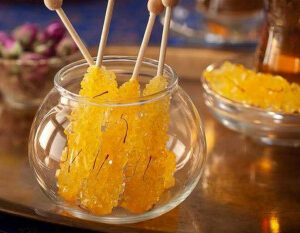
Gaz,one of the traditional nougats and souvenirs of Isfahan.
The word gaz is a simple form of the verb that stems from the verbal-noun of gazīdan (“to bite”) and refers to the sting or secretion of a certain family of the Psyllai species that feeds on the branches of the gavan shrub (milkvetch), a spiny plant with thick, tall stems that grows in the foothills.1 The principal ingredient of gaz in earlier times was gaz-angabīn—also known as the sugary exudate (shekarak) of the gaz shrub—which was collected from the milkvetch, bushes. This hardy shrubii grows wild on various foothills, notably in Gulestān-kūh near the city of Khwānsār* and around the slopes of the central Zagros Mountains—such as Kūhrang*, Zard-kūh, Bāzuft, and Chahārmahāl-e Bakhtīyārī—where it grows naturally, and it is wild. In the ancient popular belief, the gaz exudate found on the surface of some gavan and khār-shutur (camel’s-thorn) bushes was identified with the food substance manna mentioned in the Old Testament (Torah)2, the New Testament (Gospel)3, and the Qur’an,4 in the story of the Israelites. The term manna in Arabic literally means “a divine gift,” “gum,” or “hardened sap on the branches of a tree.” However, regarding its specific meaning in the scriptures—whether manna was a solid food or a liquid substance—there has been long-standing disagreement. According to some early Qur’anic commentaries, such as tafsīr al-Farrāʾ and tafsīr Muqātel, al-mann is interpreted as tarangabīn (manna, honeydew, or gaz-angabīn), and even as honey. In tafsīr al-Ṭabarī, alongside this interpretation, several other opinions are also recorded.5
There is no precise information about when gaz, in its present handmade confectionary form, first began to be produced. However, some books and reports dating back about five centuries mention the gaz shrub and tree. Jean Chardin*, the French traveler in the Safavid era, wrote during the reign of Shah ʿAbbās I about various kinds of manna (shīr-khesht) and honeydew (tarangabīn), referring specifically to gaz-angabīn, which was obtained from trees known as gavan. According to him, “People use this sugary substance as a remedy, and it is, like other types, delicious and pleasant.”6 Likewise, Eduard Polak, the German traveler, writing in the early 13th/19th century, described Iranian confections in his account of Iran and its people: “Iranian confectioners are among the foremost artisans of the world in their craft. The best sweets are made in Isfahan and Yazd… The Iranians regard gaz-angabīn as the most delicious of sweets; they mix it with almonds, pistachios, and cardamom, bake it in ovens, and after refinement, pack it in flour and export it to all countries.”7 A report preserved in the daily record of Hussein-Qulī Khan Īlkhānī, dated 1877/1294, notes: “I sent as a gift to Prince ‛Abdullāh Mīrzā some tobacco, cheese, and gaz.”8
It is said that for centuries, in mid-autumn, during the harvest of gaz-angabīn from the foothills of the Zagros Mountains, master confectioners (khalīfeh-ye qannād)iii would set up temporary clay ovens in the kitchens of wealthy households. In a hemispherical copper vessel known as a pātīl, they prepared gaz by combining the extract of gaz-angabīn with grape syrup and the kernels of pistachio or almond. These confections were molded into tablet-like forms, about five centimeters in diameter and one centimeter thick, and stored in large wooden containers dusted with wheat flour, called yakhdān. Gaz was served at formal receptions and important banquets, and being a winter delicacy of the wealthy. Among the lower-income classes, a similar nougat was made without gaz-angabīn and without pistachio or almond kernels; instead, it was prepared with the seeds of hempseed (shāhdāne), a plant resembling nettle with long leaves and bean-sized seeds. This simpler confection was known as ḥalvā-chūbe.9 In some areas of Isfahan, such an inexpensive nougat is still produced and sold, and it is commonly believed to be beneficial for treating cold temperament and for strengthening sexual vitality.
Until the early modern period, the gum-like gaz-angabīn used in gaz confectioneries was refined in the workshops through the extract of white soapwort (chūbak-e sefīd). After hours of aeration and heating until it reached the proper consistency, this syrup was mixed with various amounts of pistachio and almond kernels, molded, and finally packaged. Over time, and especially during the past hundred years, egg white replaced white soapwort, while liquid glucose or corn syrup (bādkā)—and occasionally honey—substituted for gaz-angabīn, which diminished the quality and delicacy of the original gaz. The gaz flavored with gaz-angabīn is called gaz-angabīnī, that flavored with honey, honey gaz (gaz-e ‛asalī), and that made with glucose and sugar gaz (gaz-e shekarī). The type and amount of pistachio and almond used play a significant role in the quality of the product. Today, most of the gaz available in markets is of the sugar type, made without gaz-angabīn or honey. Gaz is also classified according to its texture and consistency. One type, called gaz-e pechā, has a porous, brittle, and melt-in-the-mouth structure. Another, known as gaz-e sang-kesh, lacks the required porosity and soon becomes hard and inedible. Two methods of packaging are common. The first, called ārdī (flour-dusted), consists of shaping the gaz into forms such as squares or circles and packing them in layers of flour. The second, known as luqme’ī (bite-sized), involves cutting the gaz with special machines into uniform pieces and wrapping them in edible packaging permitted to be eaten.
The use of nutritious tree nuts and the slow-cooking method in the preparation of gaz have made this confection a wholesome and highly nutritious nougat. Moreover, since no flour, starch, or oil is used in its composition, its nutritional value is notably high. Likewise, no chemical substances are added during production to improve texture, color, flavor, aroma, or shelf life. Based on the proportion of pistachio or almond kernels, gaz is categorized into several types. The standard percentages among confectioners begin at 28 percent and may reach up to 42 percent at the customer’s request. The percentage of nuts—considered the key indicator of quality—is prominently displayed for consumer selection. Chocolate-coated gaz and gaz-suhān (a hybrid sweet combining gaz and brittle toffee) are among the innovations of Eṣfahānī confectioners, making the product more appealing to chocolate enthusiasts. Sugar-free varieties of gaz are also produced using isomalt and sorbitol, both classified as sugar-free food ingredients. Fruit-based gaz is made with dried sour fruits such as cherry, barberry, and cornelian cherry, or with fruit extracts. Today, dozens of varieties of gaz are produced under official manufacturing licenses issued by the Food and Drug Administration of Isfahan University of Medical Sciences*. The brand “Gaz, Persian Nougat, Iran-Isfahan” has been registered as a Geographical Indication (No. 161-GI, dated December 22, 2019/1 Dey 1398) by the Iranian Organization for Registration of Deeds and Properties.10
The transformation and advancement of gaz from a local traditional sweet into an industrial and internationally recognized product over the past century have been achieved by Eṣfahānī confectioners and gaz-makers, who combined artistry with craftsmanship. Today, hundreds of industrial and semi-industrial workshops in Isfahan and other Iranian cities produce and market this confection. It is noteworthy that the National Standard Organization of Iran officially registered Isfahan gaz in 1991/1370 under No. 3023 and issued standard definitions for all ingredients, types, and sizes of gaz. Based on these standards, the organization controls the quality of licensed producers. Moreover, since 2007/1386, an academic field titled Food Industries – Gaz Production (ṣanāye‛-e ghaḍāʾī – gaz-sāzī) has been established at the associate and bachelor’s levels at the University of Applied Science and Technology. One of the major challenges in today’s gaz market is its confinement to domestic distribution and the existence of unlicensed workshops, which have caused consumer mistrust. In recent decades, skilled workers and master confectioners (khalīfes) from other regions of the country have also engaged in the production and distribution of gaz. Given the long-standing history of gaz-making in Isfahan, for the past hundred years several families have adopted this craft as their principal occupation. Among the renowned families active in this field—many of whom have been gaz-makers for more than two generations—are the Shekarchīyān, Muḥsenzāde Kermānī, Kermānī Qurayshī, Sheikh Bahāʾī, Muẓaffarī, Dardashtī, Aḥmadī, Guharīyān, Sulṭānī-Nīyā, Ashrafī, Salāmatīyān, Berenjkūb, Rafī‛īyān, Mīr-Khalaf, Gulshīrāzī, Maqṣūdī, and Shams families.
It is commonly believed that consuming gaz is harmful for individuals with diabetes—particularly considering that in the past two decades, public awareness regarding the prevention of diseases such as diabetes has increased, possibly reducing the popularity of gaz. To address this concern, industrial gaz-makers have developed sugar-free and functional varieties suitable for specific dietary regimens, enabling consumers to enjoy gaz without the risk of diabetes. Furthermore, producers in the gaz industry have enriched the product with vitamins D and C and calcium, thereby transforming this potential threat into an opportunity. According to research conducted in this field, moderate consumption of sugar–free probiotic (synbiotic) gaz over a six-week period showed no direct effect on blood glucose levels or the total anti-oxidant capacity of plasma in patients with type 2 diabetes, and even demonstrated beneficial effects on serum insulin levels and total plasma glutathione.11
/Muhammad Goharian/iv
Bibliography
‘Aṣṣārī, Ne‛matullāh. “mudīr-e kārgāh-e tulīd-e gaz-angabīn dar khwānsār,” interview by Karīm Keshāvarz, March 2013/Esfand 1391.
“āthār-e maṣraf-e gaz-e synbiotic bar rū-ye muqāwemat be insulin, fāktur-e eltehābī va pārāmetrhā-ye stress oxidative dar bīmārān-e mubtalā be dīābet-e tīp 2,” by Navīd Mazrū‛ī Ārānī et al. majalle-ye ‛elmī-pazhūheshī-ye dāneshgāh-e ‛ulūm-e pezeshkī-ye arāk, vol. 16, no. 6, September 2013/Shahrīvar 1392.
Allemagne, Henri-René d. az khurāsān tā bakhtīārī, tr. Ghulām-Reza Samī‛ī. Tehran: Ṭāvūs, 1999/1378.
Chardin, Jean. safarnāme-ye Chardin, tr. Eqbāl Yag̱hmāʾī. Tehran: Ṭūs, 1993–1996/1372–1375.
Garthwaite, Garth R. khans and shahs: a history of the Bakhtiyari tribe in Iran. Cambridge: Cambridge University Press, 1983.
Polak, Jakob Eduard. safarnāme-ye polak, tr. Keykāvus Jahāndārī. Tehran: Khwārazmī, 1982/1361.
Quran (Persian translation), tr. Mahdi Elāhī Qumsheʾī. Tehran: Haft Gunbad, 2002/1381.
Quran (Persian translation), tr. Muhammad Mahdi Fūlādvand. Tehran: Dār al-Quran al-Karīm, 1997/1376.
Rūḥ al-Amīn, Hasan. “heyʾat-e mudīre-ye etteḥādīyye-ye gaz va shīrīnī-ye Isfahan,” interview by Muhammad Goharian, August 2007/Murdād 1386.
Sāzmān-e mellī-ye estandard-e Iran. 2014/1393,
Retrieved Oct. 26, 2025, from https://standard.inso.gov.ir/StandardView.aspx?Id=40969&subject
Ṭabarī, Muhammad b. Jarīr. jāme‛ al-bayān ‛an taʾwīl āy-e al-Quran, ed. Bashshār ‛Awwād Ma‛rūf and ‛Eṣām Fāres Ḥurestānī. Beirut: Muʾassasat al-Resāla, 1994/1415.
- identified scientifically as Cyamophila astragalicola.[↩]
- identified scientifically as Astragalus brachycalyx.[↩]
- Khalīfeh refers to the skilled confectioners in gaz-making workshops who supervise the other workers; all stages of gaz production are carried out by them or under their direction.[↩]
- Founder and head of the Applied Science Center of the Sekke (‛Atīq) Gaz Company.[↩]
- According to reports, due to improper extraction of gaz-angabīn and disregard for environmental considerations, the species of this insect is now at risk of extinction; see: ʿAṣṣārī, interview dated March 2013/Esfand 1391.[↩]
- Book of Exodus, 16:31; Book of Deuteronomy, 8:16.[↩]
- Gospel of John, 6:31; Revelation of John the Apostle, 2:17.[↩]
- Quran, 2:57: “And We shaded you with clouds and sent down upon you manna and salwā; eat of the good things We have provided for you.” According to some early Qurʾānic commentaries, such as those of al-Farrāʾ, Muqātil, and al-Ṭabarī, some Persian translators of the Quran—such as Muhammad Mahdi Fūlādvand—rendered this verse as: “We spread the clouds over you for shade and sent down upon you gaz-angabīn and quail.” Others, such as Mahdi Elāhī Qumshaʾī, translated “mann” as “tarangabīn” and “salwā” as “roasted fowl.”[↩]
- See: Ṭabarī, under Quran 2:57.[↩]
- Chardin, vol. 2, pp. 703–704; vol. 3, p. 1131; see also: Allemagne, vol. 1, p. 124, which paraphrases Chardin’s account with slight variation.[↩]
- Polak, p. 91.[↩]
- Garthwaite, p. 156.[↩]
- Rūḥ al-Amīn, interview dated August 2007/Murdād 1386.[↩]
- See: Sāzmān-e mellī-ye estandard-e Iran, 2014/1393.[↩]
- “as̱ar-e masraf-e gaz-e synbiotic…,” pp. 72–81.[↩]