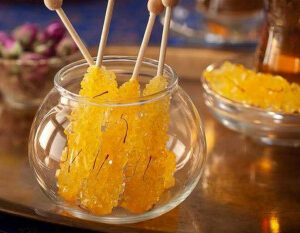
Pulaki, Sweet and Souvenir of Isfahan. Pūlakī is a type of sweet belonging to the category of hard candies, prepared in small, thin, round pieces. Because of its resemblance to a metal coin (pūl), it is called “āb-nabāt-e pūlakī” and, in short, “pūlakī”.1 The word pūlakī is a relative adjective (pūl + -k diminutive letter + -ī suffix); pūlak means “small coin” and pūlakī means “coin-like”.2
The people of Isfahan pronounce this famous sweet, a souvenir of Isfahan usually consumed with tea,3 as “pūlek” or “pūlekī”.4 Iranians typically drink tea with certain sweet (mostly solid and non-dissolving). After sugar cubes and granulated sugar, two of the most common sweets consumed with tea are nabāt* and pūlakī.5 However, for Eṣfahānīs, consuming pūlakī with tea is more common than sugar cubes, because the popular belief is that it causes less damage to teeth, is less harmful to the body due to its lower sugar content, and presumably reduces the risk of developing diabetes.6
Pūlakī is, in essence, a byproduct obtained from the excess syrup left over from nabāt production in nabāt-making workshops.7 Some workshops, however, produce pūlakī solely by mixing water and sugar.8 In nabāt-making workshops, after the nabāt has been produced and removed from the cauldron (pātīl), they use the remaining syrup to make pūlakī. The production process of pūlakī is as follows: after the nabāt has formed, a small amount of vinegar is added to the leftover syrup to prevent sedimentation and crystallization, resulting in a transparent, glassy surface.9 Then the syrup is boiled again. At this stage, saffron extract may be added, producing a thick syrup that is spread onto a large tray or a table. Before it hardens completely, it is kneaded. At this stage, ground rose petals, dried lemon, or other additives may also be incorporated. The dough is then passed through a pūlakī machine, which has two rollers, to produce small, thin, circular, or coin-shaped pieces bearing the name or symbol of the nabāt workshop. After emerging from the rollers, the pūlakī pieces are cooled with a direct fan breeze, then portioned and packaged. In the past, instead of rollers, a tool called a mushtī (literally “that which fits in the fist”) was used; it was pressed onto the pūlakī dough to flatten it and cut the pūlakī into round shapes. The mushtī was a metal tool with a narrow handle, about 15 cm long, and a broad, rounded head, about 5 cm in diameter. The surface of the mushtī also bore a mark or inscription that was impressed onto the pūlakī.10
High-quality pūlakī should be thin, crisp, and brittle, such that it fits between the thumb and forefinger, breaks at the slightest pressure, and does not stick to the teeth when chewed.11 In Isfahan’s dry climate, pūlakī pieces remain separate for a longer time and are slower to stick together in a sugar bowl or similar container, but in humid weather, their original condition quickly changes, they stick together more, and their quality effectively diminishes. For better preservation of pūlakī, according to consumer experience and producer recommendations, the sealed package of pūlakī (with its cellophane/plastic wrapping) should be placed in the refrigerator (not the freezer). Each time, only a small number should be taken out, and the package should be resealed immediately to prevent air from entering, so that the pūlakī pieces remain as separate wafers.
Pūlakī is produced in various types: 1) plain; 2) with nuts and fruits, such as pistachio, almond, sesame, lemon, barberry, and coconut; 3) with natural flavorings, such as rose, dried lemon, mint,12 ginger, and cocoa, or with essential oils, such as saffron, vanilla, or orange. In recent years, a diet (low-calorie) pūlakī has also appeared on the market.13 In some workshops, a clay-like (russī) pūlakī is also produced in coin, pellet, and slab forms.14
Various utensils and tools are used to make pūlakī, including: a stove to provide the proper heat for boiling water and sugar to produce the syrup; a large basin for pouring the prepared syrup into cauldron; a copper cauldron, the special container for boiling the syrup; a skimmer to remove impurities (scum) from the surface of the boiling syrup; a small rim (tawqche) placed on the edge of the cauldron while the syrup is boiling to prevent hot droplets from splashing around; a stirrer (āb-gardān) for stirring the syrup while boiling; a large tray or stainless steel table onto which the thick syrup is spread; and a mushtī (hand stamp) or rollers to produce the small, thin, circular or coin-shaped pieces bearing the name or symbol of the workshop on the pūlakī.15
The “Skill of Baking Pulak and Nabāt of Isfahan” was registered as an intangible cultural heritage item on the National Heritage List of Iran on January 24, 2013/4th of Bahman 1391 under registration number 767.16
/Shahin Sepanta/
Bibliography
Afqarī, Muhammad, Eṣfahānī confectioner and nabāt-maker, former head of the Union of Producers and Sellers of Sugar, Pulak, and Nabāt of Isfahan County. Interview, interviewer: Shahin Sepanta, December 2025/Āzar 1404.
Dādman, Nāṣer. dastūr-e zabān va taṭavvur va farhang-e lahje-ye Isfahan, Isfahan: Mash‛al, 1976/1355.
farāvardehā-ye qannādī – pūlakī – vīzhegīhā va raveshhā-ye āzmūn, Karaj: Institute of Standards and Industrial Research of Iran, n.d.
farhang-e buzurg-e sukhan, ed. By Hasan Anvarī, Tehran: Sukhan, 2002/1381.
fehrest-e āthār-e mellī-ye Iran: mīrāth-e farhangī-ye nāmalmūs, Tehran: Cultural Heritage, Handicrafts and Tourism Organization, Office for the Registration of Works and the Preservation and Revival of Intangible and Natural Heritage, n.d.
Matīn, Peymān, and Ebrāhīmī, Ma‛ṣūme. az jām-e peyāle tā estekān-e va na‛lbakī: chāy-nūshī be mathābey-e farhang, Tehran: Farhāme, 2015/1394.
Mīrkhalf-zāde, Mahdī, Eṣfahānī confectioner and nabāt-maker. Interview, interviewer: Shahin Sepanta, September 2012/Shahrīvar 1391.
Mu‛īn, Muhammad. farhang-e fārsī, Tehran: Amīr Kabīr, 2002/1381.
Shāyaste, Maḥmūd Reza, and Qāsemī, Manṣūr. Isfahan beheshtī kūchak ammā zamīnī, Isfahan: Naqsh-e Khurshīd, 2004/1383.
“suvqāt-e shīrīn-e ṣefāhān: mehārat-e pukht-e pulak va nabāt-e Isfahan”, Gardeshgar-e Muthbat journal, no. 4, April–May 2021/Farvardīn va Urdībihisht 1400.
‛Umrānī, Murtaḍā. dar justujū-ye huvīyyat-e shahrī Isfahan, Tehran: Ministry of Housing and Urban Development, 2005/1384.
- ‛Umrānī, p. 78.[↩]
- Mu‛īn, vol. 1, p. 842; see also: farhang-e buzurg-e sukhan, vol. 2, pp. 1456–1457.[↩]
- farhang-e buzurg-e sukhan, ibid.[↩]
- Dādman, p. 47.[↩]
- Matīn and Ebrāhīmī, p. 61.[↩]
- Shāyaste and Qāsemī, p. 372.[↩]
- Ibid., p. 373.[↩]
- Afqarī, interview, December 2025/Āzar 1404.[↩]
- Ibid.[↩]
- Mīrkhalf-zāde, interview, September 2012/Shahrīvar 1391.[↩]
- farāvardehā-ye qannādī – pūlakī – vīzhegīhā va raveshhā-ye āzmūn, pp. 6–7.[↩]
- Ibid., pp. 3–4; Shāyaste and Qāsemī, p. 373.[↩]
- “suqāt-e shīrīn-e ṣefāhān”, p. 104. In this type of pūlakī, they usually use isomalt, a sweetener extracted from sugar beet which, unlike sucrose (ordinary sugar), has very few calories; also, due to its low glycemic index, it is slowly absorbed by the body.[↩]
- Afqarī, interview, December 2025/Āzar 1404.[↩]
- Mīrkhalf-zāde, interview, September 2012/Shahrīvar 1391.[↩]
- fehrest-e āthār-e mellī Iran, p. 23.[↩]