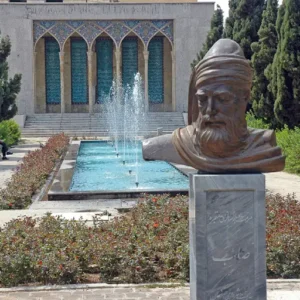

Shahshahān, mausoleum, a structure dating to the 15th/9th century in Isfahan.1
The mausoleum of Shahshahān is a husaynīyya (a congregation hall for Shiite mourning ceremonies, especially during the month of Muḥarram) and the tomb of Shāh ‛Alāʾ al-Dīn Muhammad Ḥusaynī Eṣfahānī* (d. 1446/850), known by the honorific title Shāh-e Shāhān (“King of Kings,” later contracted to Shahshahān). He was a prominent figure of the 15th/9th century and served as the (naqīb) head of the Ḥusaynīd sayyeds of Isfahan.2 The building is located in the Shahshahān* quarter, north of the Jāme‛ Mosque* of Isfahan. It was registered as a national heritage site of Iran in 1948/1327 under record number 368.3
The Shahshahān mausoleum is located to the west of a small square that bears the same name. This area was once part of the larger Dardasht* (also known as Bāb al-Dasht*) quarter. Chardin also referred to it as the ḥusaynīyya quarter, noting that on all four sides of the square stood four distinguished buildings belonging to the Shahshahānī Ḥusaynī family.4 The honorific title Shahshahān (King of Kings) given to Shāh ‛Alāʾ al-Dīn signifies his role as the naqīb al-nuqabāʾ (chief of the sayyid notables).5
The Shahshahān mausoleum was constructed during the lifetime of Shāh ‛Alāʾ al-Dīn for the mourning ceremonies of Imam Hussein and was referred to as the Ḥusaynīyya Mausoleum.6 In an inscription on one of the banners (‛alam) associated with the mausoleum, it is described as Dār al-Sīyāda al-Ḥusaynīyya (The House of Ḥusaynīd Nobility). A Qājār-era document related to the site, currently held by the caretaker, also refers to the structure as a madrasa (religious school or seminary). Shāh ‛Alāʾ al-Dīn’s support for the rebellion of Sulṭān Muhammad, son of Bāysunqur Mīrzā -himself the son of Shāhrukh of the Timurid dynasty-, who laid claim to rule over Isfahan, provoked the wrath of Shāhrukh. As a result, Shāh ‛Alāʾ al-Dīn, along with a number of scholars and notables of Isfahan, was exiled to Sāve and executed there in October–November 1446/Ramaḍān 850 by order of Guharshād Āghā-Beygum, Shāhrukh’s wife. Shortly after this event, Shāhrukh himself passed away.7 Sulṭān Muhammad, who had earlier fled Isfahan, returned and assumed control of the city. Seemingly seeking to make amends with the families of the slain, he had the body of Shāh ‛Alāʾ al-Dīn brought back to Isfahan with honor and buried beside the ḥusaynīyya, and commissioned the construction of the current mausoleum. He endowed the ḥusaynīyya and the tomb with considerable property, including two villages and one cultivated estate from his personal holdings. In the endowment deed, he assigned the custodianship of the mausoleum to Shāh Quṭb al-Dīn Muhammad, the only surviving son of Shāh ‛Alāʾ al-Dīn.8 This endowment deed is currently preserved in the Reza ‛Abbāsī* Museum.
There is no surviving dated inscription from the time of the mausoleum’s construction, but the endowment deed is dated 22 Rabīʿ al-Awwal 852/4th June 1448. Therefore, the building must have been constructed sometime between 850/1446, the year of Shah ‛Alāʾ al-Dīn’s death, and 852/1448.9 The structure contains several inscriptions*, two of which appear to date from the time of its original construction or shortly thereafter. One of these is a thuluth-script inscription encircling the shaft or cylindrical base of the dome, painted in white on a cinnabar-red background. It records the date of Shah ‛Alāʾ al-Dīn’s martyrdom, includes Arabic verses, and traces his lineage back to Imam Ali. The inscription ends with the Persian phrase ‛āqebat khayr bād (“may the end be good”), followed by katabahu al-‛abd Sayyed Maḥmūd Naqqāsh (“written by the servant Sayyed Maḥmūd the painter”). Above this band, the passages of the Quran salāmun ‛alā Āl Yāsīn and salāmun ‛alā Āl Ṭāhā are repeated in small kufic script.10 The inscription over the winter prayer hall (dār al-shetāʾ) portal of the Jāme‛ Mosque of Isfahan (dated 851/1447), and another from the Jāme‛ Mosque of Varzane (dated 848/1444), are also in the hand of Sayyed Maḥmūd Naqqāsh*,11 suggesting that the Shahshahān inscription may likewise date to around 851/1447.12 Another inscription is a small mosaic tile panel above the portal, bearing the phrase :‛amal-e mayrum Kāshītarāsh (“crafted by mayrum [a respected title for men vis-à-vis baygum for women] Kāshītarāsh) in nasta‛līq script.13 Several extant documents indicate that later rulers, such as Yā‛qūb Beg Āq Quyūnlū and Rustam Beg Āq Quyūnlū, as well as prominent figures in Isfahan, confirmed the endowments of the mausoleum.14
The Shahshahān mausoleum has undergone several restorations. One of the most significant took place in 1604/1013 during the reign of Shāh ‛Abbās I*, sponsored by a woman named Ṣāleḥa Sulṭān Khānum. The record of these repairs is inscribed in thuluth script, signed by Ṣaḥīfī-ye Fārsī, on the meḥrābe of the northern wall of the domed chamber.15 In the modern era, Hussein Shahshahānī, a descendant of Shāh ‛Alāʾ al-Dīn, undertook the repair of the partially ruined structure; he was later buried in the same mausoleum.16 In 1967/1346, a comprehensive restoration of the courtyard and surrounding structures was carried out, and a commemorative tile inscription was installed above the entrance portal. The building was also used as a clinic for the Shahshahān neighborhood for some time.17 Although it later fell into neglect, Muhammad Shahshahānī, the custodian of the shrine, took significant steps toward reviving the endowments and partially restoring the structure during the 2010s/1390s.
The structure comprises a domed chamber, a portal and vestibule, a courtyard, and several chambers. The irregularity in the overall plan suggests that the building resulted from multiple phases of construction, and it may originally have been more expanded than it is today.18 On the south and east sides of the domed chamber, facing the square, a row of chambers—clearly later additions—forms part of the exterior. At the junction between the two rows of chambers, there is a public water niche (saqqākhāneh*), dated 1100/1688, which may also indicate the construction date of these appended structures.19 Above the portal stands a small wooden minaret, likely a remnant of a mosque that once occupied this site.20 Behind the portal lies a large vestibule, with a flattened arch adorned with colorful motifs. A small corridor connects the vestibule to the southern corner of the courtyard. The courtyard is small and rectangular, with chambers on three sides. Until a few decades ago, another corridor at the northern corner of the courtyard served as a public passageway for local reside21nts. Behind one of the chambers on the southwestern side, there is a covered room containing a pool, a well, and a water reservoir. According to Chardin, the courtyard also once featured a large pool.22 On the eastern side of the courtyard is a portico with an intricately decorated muqarnas vault and colorful ornamentation. The dome of Shah ‛Alāʾ al-Dīn’s tomb lies behind a room situated at the back of this portico.23
The domed chamber is not aligned with the central axis of the courtyard and portico, suggesting that these elements were constructed in different phases. It appears that the courtyard was originally the ḥusaynīyya of Shahshahān, built during the lifetime of Shah ‛Alāʾ al-Dīn, while the domed chamber was added after his death. The chamber is square in plan, measuring approximately 5.56 meters per side, with a height of around 9 meters.24 Its dome is of the double-shell separated type. The outer shell includes iron ties, clearly indicating that the dome was completely reconstructed during a restoration phase. The grave of Shah ‛Alāʾ al-Dīn is marked by a tiled platform approximately one meter in height. Other unnamed graves also exist within the domed chamber.25 The grave adjacent to that of Shah ‛Alāʾ al-Dīn likely belongs to his son, Shah Quṭb al-Dīn.26 According to Humāʾī’s* observations in 1948/1327, the courtyard, portico, and domed chamber were filled with gravestones,27 none of which remain today. Each side of the domed chamber contains three arched niches. In the 1960s/1340s, inlaid wooden doors were installed in the central niches on the western and southern sides,28 though these no longer survive. A 17th/11th century thuluth inscription, composed in five lines, remains in the northern niche.29 The apex of the arches reaches up to the transitional zone of the dome. In the lateral niches, floral and vase motifs are painted—decorations that belong to later periods.30 The dado of the domed chamber is covered with turquoise hexagonal tiles bordered by mosaic tilework, dating to the contemporary period.31
/Nazanin Shahidi/
Bibliography
“Waqfnāme-ye Buq‛e-ye Ḥusaynīyya (Shahshahān), dated 852/1448, preserved in the archive of the Reza ‛Abbāsī Museum, no. 4621.”
Chardin, Jean, Safar-nāme-ye Chardin, trans. Eqbāl Yaḡmāʾī, Tehran: Ṭūs, 1993–1996/1372–1375.
Dawlatshāh Samarqandī, Tadhkerat al-Shu‛arāʾ, edited by Edward Browne, Leiden: Brill, 1901/1319.
Ganjnāmeh: Farhang-e Āthār-e Me‛mārī-ye Eslāmī-ye Iran, under the supervision of Kāmbīz Ḥājjī Qāsemī, vol. 11: Emāmzāde-hā va Maqāber, Tehran: Shahid Beheshti University, 2010/1389.
Golombek, Lisa and Wilber, Donald Newton, The Timurid architecture of Iran and Turan, Princeton: Princeton University Press, 1988.
Humāyī, Jalāl al-Dīn, Ketāb-e Tārīkh-e Eṣfahān: Mujallad-e Abnīyea va ‛Emārāt va Āthār-e Bāstānī, edited by Māhdukht Bānu Humāyī, Tehran: Humā, 2005/1384.
Humāyī, Jalāl al-Dīn, Tārīkh-e Eṣfahān: Selsele-ye Sādāt va Mushajarāt va Musaṭṭaḥāt, Ansāb va Nasab-e Emāmzāde-hā-ye Eṣfahān, edited by Māhdukht Bānu Humāyī, Tehran: Pazhūheshgāh-e ‛Ulūm-e Ensānī va Muṭāle‛āt-e Farhangī, 2011/1390.
Hunarfar, Luṭfullāh, Ganjīna-ye Āthār-e Tārīkhī-ye Eṣfahān, Isfahan: Saqafī, 1965/1344 Sh.
Mudarresī Ṭabāṭabāʾī, Hussein, “Chand Sanad-e Tārīkhī Marbūṭ be Eṣfahān”, Vaḥīd, no. 227, March 1978/Esfand 1356.
Nīkzād Amīr-Ḥuseynī, Karīm, Tārīkhche-ye Abnīye-ye Tārīkhī-ye Eṣfahān, Isfahan: Dād, 1956/1335.
Pāzūkī Ṭarūdī, Nāṣer and Shādmehr, ‛Abd al-Karīm, Āthār-e Sabt-Shude-ye Iran dar Fehrest-e Āthār-e Mellī: az 24/6/1310 tā 24/6/1384, Tehran: Sāzmān-e Mīrāth-e Farhangī-ye Keshvar, 2005/1384.
Rafī‛ī Mehrābādī, Abū al-Qāsem, Āthār-e Mellī-ye Eṣfahān, Tehran: Anjuman-e Āthār-e Mellī, 1973/1352.
- This article was previously printed in The Encyclopaedia of the World of Islam, vol. 28, pp. 183–185, and has been published in The Encyclopaedia Isfahanica with slight modifications.[↩]
- Humāyī, 1390, p. 351.[↩]
- Pāzūkī Ṭarūdī and Shādmehr, p. 71.[↩]
- Chardin, vol. 4, p. 1513.[↩]
- See: Humāyī, ibid.[↩]
- Hunarfar, p. 333; Humāyī, 1384 Sh., p. 25; “Waqf-nāme-ye Buq‛e-ye Ḥusaynīyye (Shahshahān), dated 852/1448,” preserved in the archive of the Reza ‛Abbāsī Museum, no. 4621.[↩]
- Dawlatshāh Samarqandī, pp. 339–340.[↩]
- Hunarfar, pp. 334–335; Humāʾī, 2005/1384, pp. 23, 27, 29.[↩]
- Hunarfar, p. 336; Humāyī, 2005/1384, p. 25.[↩]
- Rafīʿī Mehrābādī, pp. 803–804; Humāyī, 2005/1384, pp. 13, 19.[↩]
- Hunarfar, ibid.[↩]
- See: Humāyī, 1384, p. 25.[↩]
- Ibid, p. 18; CF: Hunarfar, p. 339, which mentions the phrase “Mubram Kāshītārash” instead of mayrum Kāshītārash. [↩]
- See: Mudarresī Ṭabāṭabāʾī, pp. 26–27.[↩]
- Humāyī, 1384 Sh., p. 26.[↩]
- See: Hunarfar, p. 339.[↩]
- See: Nīkzād Amīr-Ḥuseynī, p. 156.[↩]
- Humāyī, 1384, p. 24; also see: Ganjnāme, p. 106, illustrations.[↩]
- Golombek and Wilber, vol.1, p.382.[↩]
- Humāyī, 1384, p. 15.[↩]
- Ibid., pp. 15–16.[↩]
- Chardin, vol. 4, p. 1513.[↩]
- See: Ganjnāme, p. 106, illustrations.[↩]
- Humāyī, 1384, p. 16; Golombek and Wilber, vol. 1, p. 382.[↩]
- Hunarfar, p. 333.[↩]
- Humāyī, 2005/1384, ibid.[↩]
- See: Humāyī, 2005/1384, p. 17.[↩]
- See: Hunarfar, p. 339.[↩]
- Humāyī, 1384, p. 18.[↩]
- Golombek and Wilber, vol.1, p.383.[↩]
- Hunarfar, p. 336.[↩]