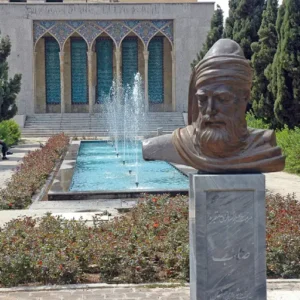
Sundial, a timekeeping device that measures time according to the apparent motion of the Sun.
This article is divided into two parts. The first outlines the general characteristics of sundials, while the second examines the sundials of the Isfahan region.
Part One:
The principle underlying the sundial is the Earth’s rotation about its axis, or its observable manifestation, namely the apparent motion of the Sun across the sky. Its principal components are a graduated dial and a gnomon. In its earliest form, time during daylight was determined from the shadow cast by a vertical rod on a flat surface. This simple arrangement was gradually refined through advances in astronomy and mathematics and eventually came to be regarded as a scientific and cultural symbol.1 In earlier times, sundials were commonly regarded as a source of pride for societies and as an indication of their scientific and cultural advancement. Today, however, in many parts of the world they serve primarily an aesthetic purpose and are regarded as tourist attractions.
A sundial is designed and calibrated according to the geographical location in which it is installed. As the Sun’s position in the sky changes, both the length and the direction of the gnomon’s shadow change accordingly, indicating the time elapsed since sunrise or the time remaining until sunset. By taking into account the equation of time and the precise longitude of the location where the sundial is situated, it is possible to determine the time with an accuracy comparable to that of a mechanical clock.2 Furthermore, by determining the length of the gnomon, the seasonal shadow length can be measured, and by plotting appropriate curves on the sundial, the seasons can also be identified.
Sundials are classified into several types according to the form of their dial and their mode of operation.i
Horizontal Sundial. This is the most common type of sundial, consisting of a horizontal dial and a shadow-casting gnomon. To indicate the time accurately, the angle of the gnomon relative to the horizontal plane must be equal to the geographical latitude of the place where the sundial is installed. As the Sun appears to move across the sky during the day, the shadow cast by the gnomon moves across the hour lines on the dial, thereby indicating the time.3
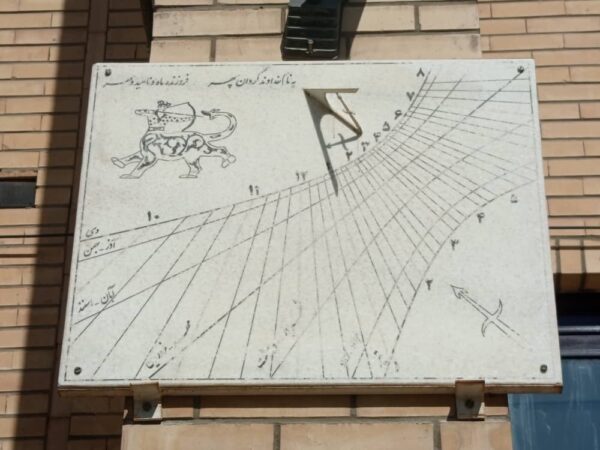
Vertical Sundial. In this type, the dial is set vertically, perpendicular to the ground, and is typically mounted on the walls of public buildings, mosques, or churches. If the dial faces exactly one of the cardinal directions (north, south, east, or west), it is known as a Direct Vertical Sundial. If, however, the wall is inclined away from the cardinal directions, it is referred to as a Declining Vertical Sundial. The inclination of the gnomon and the layout of the hour lines are calculated according to the geographical latitude of the location and the degree of the wall’s deviation from the cardinal directions.4 To avoid the complex calculations required for installing a declining vertical sundial, architects—including those in Isfahan—would construct a wall on the roof of a building in the appropriate orientation and install the sundial on it.5 Vertical sundials mounted on mosque walls were commonly used to determine local solar noon. In the Northern Hemisphere, such sundials must face south so that the movement of the gnomon’s shadow across the dial indicates the time from sunrise to sunset.
Equatorial Sundial. This type derives its name from the fact that its dial is set parallel to the Earth’s equatorial plane. Its gnomon consists of a rod mounted perpendicular to the dial and parallel to the Earth’s rotational axis. An equatorial sundial can be used at all latitudes. However, on the days of the vernal and autumnal equinoxes, when the Sun’s rays fall directly on the edge of the dial, no shadow is cast on the dial surface, making the time impossible to read.6
Polar Sundial. In this type, the dial is mounted parallel to the Earth’s rotational axis; that is, the angle between the dial and the horizontal plane is equal to the geographical latitude of the location. The hour lines on the dial are parallel to one another. Their spacing, however, is not uniform. Rather, the farther they are from the noon line, the greater the distance between them becomes, owing to calculations based on the tangent of the hour angle. The gnomon is likewise aligned parallel to these hour.7
Analemmatic Sundial. This type is designed on the basis of the Sun’s apparent path across the sky (the analemma), and its hour markers are arranged around the circumference of an ellipse. Its distinguishing feature is a movable vertical gnomon, which must be placed at a designated position according to the date. Analemmatic sundials are typically constructed on a large scale in parks, where visitors themselves act as the gnomon by standing on the point corresponding to the calendar date, allowing their shadow to indicate the time.8
Altitude Sundial. These sundials determine the time according to the Sun’s altitude above the horizon. Because the Sun’s altitude varies with the seasons, they employ different scales for the various months of the year. They were constructed in cylindrical, planar, or ring-shaped forms.9
Reclining (or Inclining) Sundial. These sundials are designed to be installed on inclined surfaces, such as the pitched roofs of houses. Their construction is based on calculations that combine the principles of horizontal and vertical sundials, with the specific design depending on the angle of inclination of the mounting surface.10
Reflected Ceiling Dial. In this type, a small mirror is placed horizontally on the sill of a south-facing window. The mirror reflects the Sun’s rays onto the ceiling of the room. Hour lines are drawn on the ceiling, and as the Sun moves, the reflected spot of light moves across them and indicates the time.11
Armillary Sphere. This instrument is a three-dimensional model of the celestial sphere, composed of intersecting rings representing the equator, the meridian, and the horizon. A rod passing through the center of these rings represents the Earth’s axis and serves as the gnomon, while its shadow on the equatorial ring indicates the time.12
Although the use of the gnomon dates back to 3500 BCE, the identity of the earliest civilization to employ it remains uncertain. Nevertheless, the origin of the sundial is generally attributed to ancient Mesopotamia, Egypt, and Greece. The oldest surviving stone sundial dates to 1500 BCE and was discovered in Egypt; it is now preserved in a museum in Berlin.13 The earliest reference to the sundial in Iran, together with a method for graduating its dial, appears in the zīj-e (astronomical tables) shahrīyār, also known as the zīj-e shah, compiled during the Sasanian period. Although the original Pahlavi text has been lost, portions of its Arabic translation have survived in the works of astronomers of the early Islamic centuries.14
The use of sundials for determining the prescribed times of Muslim prayers gave rise to a close relationship between the design of sundials and the science of mīqāt (timekeeping). The science of mīqāt, plural is mawāqīt, was a branch of astronomy in the Islamic period whose principal function was to determine the times of prayer on the basis of the Sun’s astronomical position.15 An important part of the development of sundial construction stemmed from the close association between the techniques of sundial design and the science of mīqāt.
The diversity of sundials and the treatises devoted to them in Islamic civilization reflects the considerable attention that Muslim scholars paid to both their theoretical and practical aspects. This branch of knowledge was probably of Greek origin; for example, Thābet b. Qurra adopted the analemma method from Diodorus Siculus.16 During the Islamic period, because marble (rukhām) was commonly used for the dial plate, sundials were known as rukhāma, while the discipline concerned with their design and construction was called ‛elm al-rukhāmāt. The horizontal type, owing to its flat surface, was also known as basīṭa. This simple and widely used form was the subject of most of the surviving treatises on sundial design.17
One of the achievements of Islamic astronomers was the use of an inclined gnomon instead of a vertical one. By inclining the gnomon northwards and setting its angle equal to the geographical latitude of the location, it becomes parallel to the Earth’s rotational axis and perpendicular to the Sun’s apparent path. This alignment improves the accuracy of the sundial. The earliest known example of this design is the horizontal sundial of the Umayyad Mosque in Damascus, constructed by Ibn Shāṭer al-Dameshqī in the eighth/fourteenth century.18
With the growing interest of Muslim astronomers in compiling tables of prayer times, Muhammad b. Mūsā al-Khwārazmī, as the earliest astronomer to do so, calculated in his zīj the length of the noon shadow and the beginning and end of the afternoon prayer for the latitude of Baghdad.19 Nevertheless, until before the seventh/thirteenth century, the determination of prayer times remained largely the responsibility of the muʾadhdhen (those responsible for calling Muslims to prayer(, who relied on the traditional Arab method. They determined the times of the noon and afternoon prayers from the length of the gnomon’s shadow, while the times of the dawn and sunset prayers were established on the basis of the lunar mansions.20 After the seventh/thirteenth century, the construction of sundials for religious purposes became widespread in the Ottoman Empire, although some also included hour lines for ordinary timekeeping. These sundials, which were typically installed at the base of minarets, on mosque walls, or on freestanding supports in mosque courtyards, gradually became more sophisticated, incorporating unequal and equal hour lines,ii arcs for determining the Sun’s altitude, and scales for measuring the Sun’s azimuth.21
Another relatively uncommon type of sundial in the Islamic period was a conical sundial known as the mukḥula, so called because of its resemblance to a kohl container. Although similar instruments were apparently produced by the ancient Romans in the first century BCE, the structure of this type of sundial is described briefly in a treatise attributed to al-Khwārazmī.22
The meknasa was another type of Islamic-period sundial. It consisted of two rectangular plates joined at a fixed angle, with a horizontal gnomon mounted along the line where the two plates met.23
Part Two: Sundials of Isfahan
With the advancement of astronomy and mathematics during the Islamic period, various types of sundials came into widespread use. During the Safavid period* (r. 907–1135/1501–1722), as urban development flourished and public buildings were erected in Isfahan, sundials were incorporated into the city’s architecture to determine the prescribed prayer times. In sundials with an inclined gnomon, the gnomon’s axis had to be aligned with the Earth’s rotational axis—that is, set at an angle equal to the geographical latitude of the location—to ensure accurate timekeeping. Since Isfahan is situated at approximately 32° N latitude, the gnomon of its sundials was likewise inclined at an angle of about 32° to the horizontal. Many of these sundials indicated only local solar noon, which was sufficient for determining the prescribed prayer times. Noon indicators represent the simplest form of sundial, in which the shadow cast by a rod-shaped or triangular gnomon marks the precise moment of local solar noon.
During the Safavid period, in addition to fixed sundials, qibla indicators (qeble-namā) were also produced in Isfahan, and are regarded as masterpieces of Iranian scientific and artistic craftsmanship. Among them is an example fitted with a sundial attached by a hinge to the edge of the qibla-indicator plate. These instruments, which generally combined a sundial with a qibla- indicator, were all designed for a latitude of 32°. This astronomical feature, together with their dates of manufacture or the inscriptions they bear, confirms that they were made specifically for the city of Isfahan. Examples of these instruments have been identified in European auction houses and antique shops and are now preserved in museums outside Iran.24 Three Persian couplets are engraved on the plates of three surviving examples. Besides explaining how the instruments were to be used, these verses indicate that they were produced in Isfahan during the seventeenth or eighteenth century.25 Technically, these are not inclined sundials but sundials equipped with vertical gnomons. They indicate neither equal hours nor unequal (seasonal) hours, but are designed specifically to display Babylonian hours, that is, the number of hours elapsed since sunrise. In addition, they can be used to determine the daily prayer times, particularly the time of the afternoon prayer. Their computational and astronomical design, together with the refinement of their manufacture and metalwork, attests to the innovation and astronomical expertise of the period.
The sundials currently preserved in Isfahan are as follows:
- Sundial of Jāme‛-e ‛Abbāsī Mosque
One of the best-known solar noon indicators in Isfahan is the timekeeping stone located within the complex of the Jāme‛-e ‛Abbāsī Mosque*, on the southern side of Naqsh-e Jahān Square*. This well-known indicator is installed at the base of one of the piers in the courtyard of the Sulaymānīyye madrasa, situated in the southwestern corner of the mosque and accessible through a separate entrance. The indicator stone, or noon marker, consists of two sections, one rectangular and the other triangular, which together form a right trapezoid. The triangular section was carved and fitted beside the rectangular one with such precision that, at local noon on every day of the year, the Sun’s rays fall tangentially upon its surface, leaving no shadow on the ground. The ingenuity and significance of this instrument lie in the precise calculation of the angle and dimensions of the triangular section, whose design causes the shadow cast by the rectangular section to disappear completely at noon.26 At local solar noon, or the prescribed noon prayer time, the stone functions as a noon indicator, its shadow disappearing entirely. It thus serves as a marker of local noon. This stone not only fulfilled a ritual function but also exemplifies the harmonious integration of mosque architecture with astronomical and geometrical calculations, demonstrating the application of architectural geometry to the devotional and timekeeping needs of the community. The calculation, calibration, and installation of the stone are traditionally attributed to Sheikh Bahāʾī*,27 although, like many other attributions associated with him, this attribution is most probably unsupported by documentary evidence.
- Sundials of Jāme‛-e ‛Atīq Mosque of Isfahan
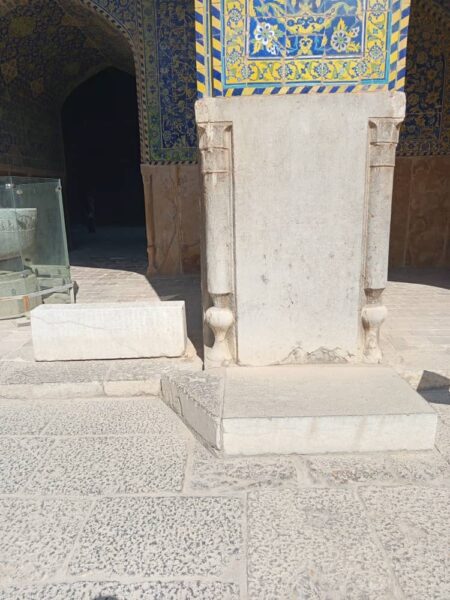
Jāme‛-e Mosque*, one of Iran’s foremost historical monuments, is the product of continuous architectural transformations carried out over successive periods, particularly under the Ilkhanids (r. 1256–1350/654–750), the Muzaffarids (r. 1318–1393/718–795), the Timurids (r. 1370–1501/771–907), the Safavids, and the Qajars (1796–1925/1210–1344/ 1925/1304). The mosque contains two sundials functioning as noon indicators. One is similar to the noon indicator at Jāme‛-e ‛Abbāsī, although on a smaller scale; the other consists of two small glazed tiles set along the edge of the upper-story iwan. The first indicator, formerly used on sunny days to determine local solar noon and the prescribed noon prayer time, is located on the ground in the eastern part of the northern iwan. It is mounted on a stone composed of a rectangular and a triangular section, which together form a right trapezoid. At local solar noon, the shadow disappears completely. The triangular stone was carved to match the dimensions of the shadow cast by the rectangular section at noon and placed beside it so that the shadow would vanish precisely at that moment. The second noon indicator consists of two small glazed tiles installed along the edge of the upper-story iwan. At the prescribed noon prayer time, the shadow cast by the front wall reaches the first marker and then the second. According to practical observation, when the shadow reaches the second mark, it is time for the noon call to prayer in Isfahan.28 The function of this indicator remains a matter of debate. Some scholars maintain that it was intended to determine the times of noon and afternoon prayers in accordance with the Sunni school of thought. Others reject this interpretation and attribute its installation to the Safavid or Qajar period. According to this latter view, the shadow reaching the first mark indicated the time of the adhān (call to prayer), whereas its arrival at the second indicated the time for commencing the congregational prayer.29
- Sundial of Ḥakīm Mosque
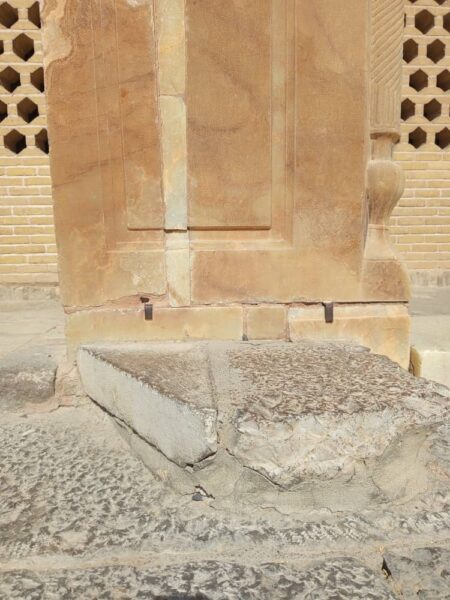
Ḥakīm Mosque*, also known as Jīrjīr, is a sample of the four-iwan mosques of the late Safavid period. Its founder, Ḥakīm Dāvūd, the personal physician of Shah ‛Abbās II (r. 1642–1666/1052–1077), built it on the remains of the Dailamite Jāme‛-e Jūrjīr mosque,30 dating to the fourth/tenth century. The mosque’s sundial is of the vertical type and is situated above its northwestern iwan, over an inscription. Its platform is constructed of brick and plaster, and its surface is plastered. At a height of one meter, a steel rod 30 centimeters long is set perpendicular to the wall. Radial lines on the plastered surface indicate the hours of the day. The central line of the dial is completely vertical, and at the prescribed noon prayer time the rod’s shadow falls precisely upon it. The mosque formerly had another sundial on the ground at the junction of the northern and western walls. Its base was made of building materials and had a right-triangular cross-section, and the sundial was fitted with a steel gnomon.31 It has now been destroyed, although traces of its structure remain visible on the stones of the wall. The dates of installation of the two sundials are unknown.
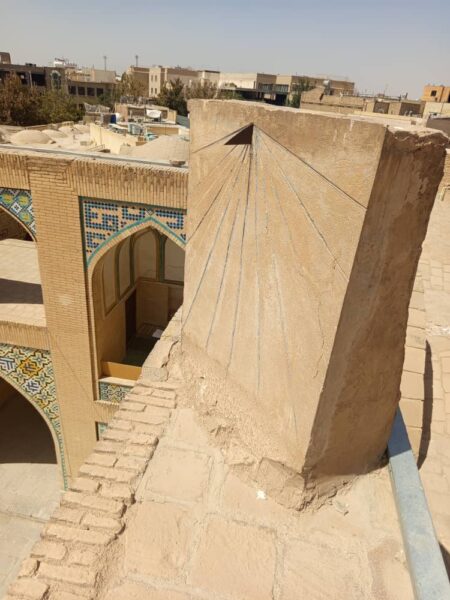
- Sundial of the Sayyed Mosque*
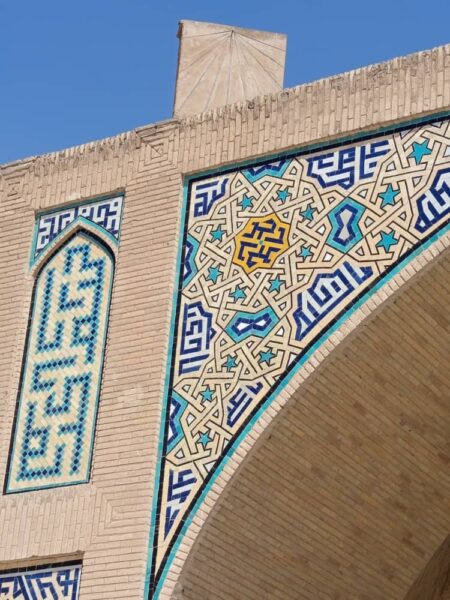
It, which is located in the Bīd-ābād quarter* of Isfahan, is named after its founder, Sayyed Muhammad-Bāqer Shaftī* (d. 1844/1260), known as “Sayyed Ḥujjat al-Esalām.” The mosque has a vertical sundial whose gnomon has now fallen away and whose hour lines have faded. It is situated on the roof of the mosque at the junction of the northern and western walls. The structure of the sundial is made of brick and plaster.
- Sundial of the Chahārbāgh madrasa
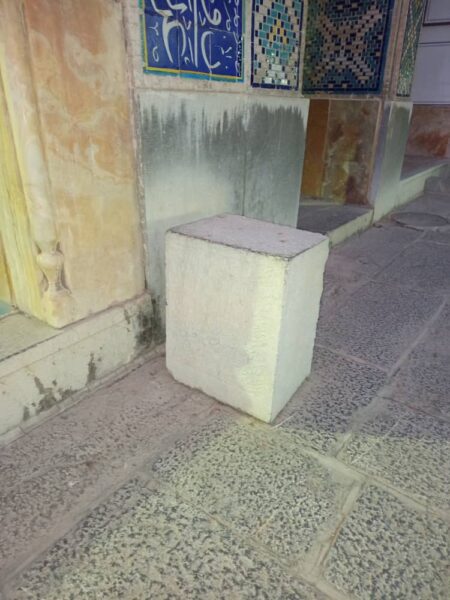
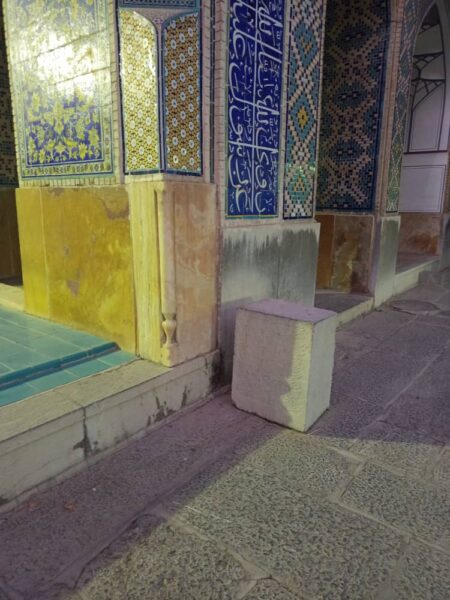
A stone noon indicator is located in the courtyard of the Chahārbāgh madrasa*. It consists of one face of a dressed stone set vertically along the north–south axis. In this type of indicator, the selected face remains in shadow throughout the morning hours, and from the moment of noon onwards it is illuminated by the Sun’s rays. Today, this indicator stone has been moved from its initial location and has consequently lost its original function. The noon indicator was calculated, designed, and installed in the courtyard of the madrasa by Sayyed Jalāl al-Dīn Ḥusaynī Ṭehrānī (d. 1987/1366.) in the form of a rectangular stone block.32 An inscription engraved on its southern and eastern faces records the astronomical calculations, the date of installation, and the method for using the indicator.33
- Sundial of the Quṭbīyye Mosque
Quṭbīyye Mosque*, situated on Ṭāleqānī Street, was built during the reign of Shah Ṭahmāsb I (r. 1524–1576/930–984). Its founder and builder was Quṭb al-Dīn Ali Bāb al-Dashtī (d. 955/1548). The mosque has a metal noon indicator mounted vertically on one of its northern walls against a tiled panel. Owing to inadequate maintenance, the sundial is now deteriorating. Its gnomon has rotated from its initial position and is no longer perpendicular to the dial face, causing it to lose its function of indicating local noon.
- Sundial of the Naw Mosque at Great Bazaar
Naw (Nu in local accent) Mosque at bazaar*, located on ‘Abd al-Razzāq Street in the Masjed-e Nu Alley, dates from the Qajar period*. On the northern wall of the mosque, a metal indicator is fixed to the stone base of one of the columns at a height of approximately one meter above the ground. It formerly served as a noon indicator. At local noon, the shadow cast by the rectangular metal indicator appears directly beneath it as a narrow line at its shortest length. Traces of restoration are now visible at the point where the indicator is attached to the column.
- Sundial of the Raḥīm Khan Mosque
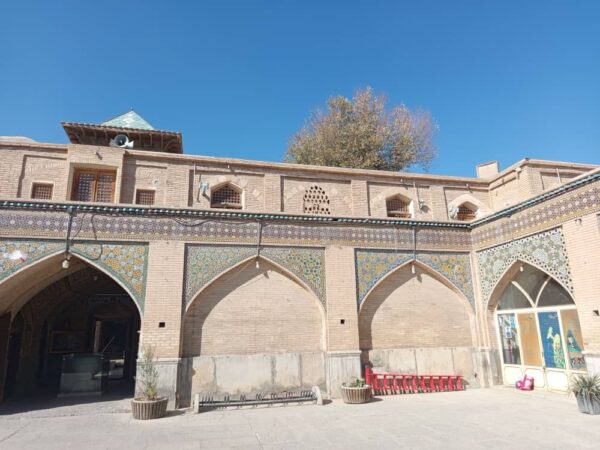
Raḥīm Khan Mosque*, located on Ṭāleqānī Street, dates from the Qajar period. On the roof of the mosque, at the junction of the northern and eastern walls, a vertical sundial constructed of brick and plaster has been installed. This sundial resembles that of Ḥakīm Mosque. At the time of writing this article (2026/1405), however, its gnomon is missing, and the graduations on the dial have faded.
- Sundial of the Ali Qulī Āqā Mosque*
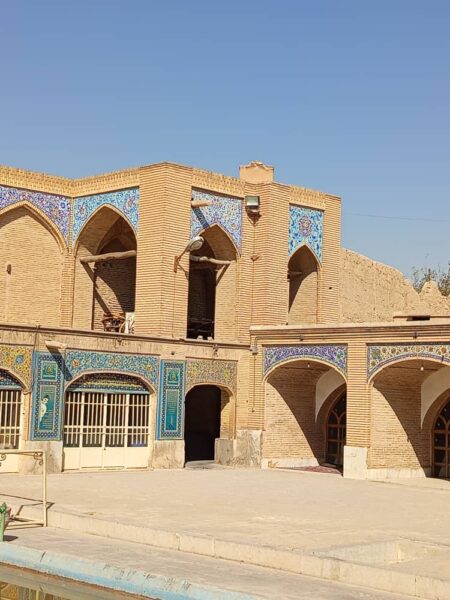
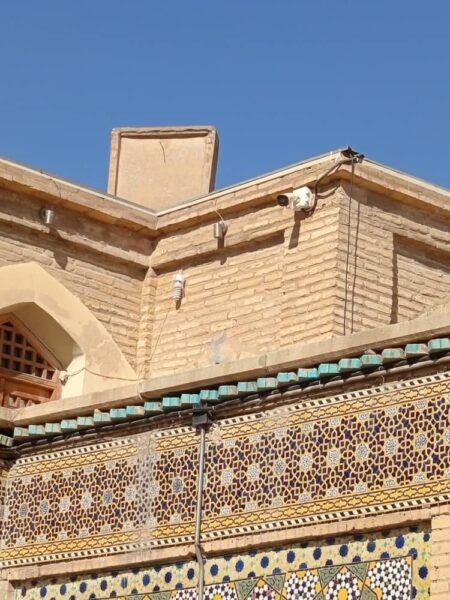
This mosque was built during the reign of Shah Sulṭān Hussein* (r. 1694–1722/1105–1135) and was enlarged during the Qajar period. Its sundial, constructed vertically at the junction of the northern and western walls, is made of brick and plaster. The sundial still retains its gnomon, although the graduations on the dial have faded.
- Sundial of the Kadkhudāʾī House
The historic house attributed to Kadkhudāʾī, located on Ebn Sīnā Street*, is one of the notable Qajar-period buildings in Isfahan. Following extensive restoration, the building was converted to a new use and now serves as the headquarters of the Isfahan Municipality Renovation and Rehabilitation Organization. After the restoration, a horizontal sundial was installed on the northern side of the building’s pool and water feature. Designed and constructed in 2006/1385 by the astronomy researcher Pāyān Amīnī, the sundial has a metal gnomon and a stone base and dial plate. In addition to indicating time, it is capable of correlating official time with astronomical (solar) time.
- Sundial of Julfā Square
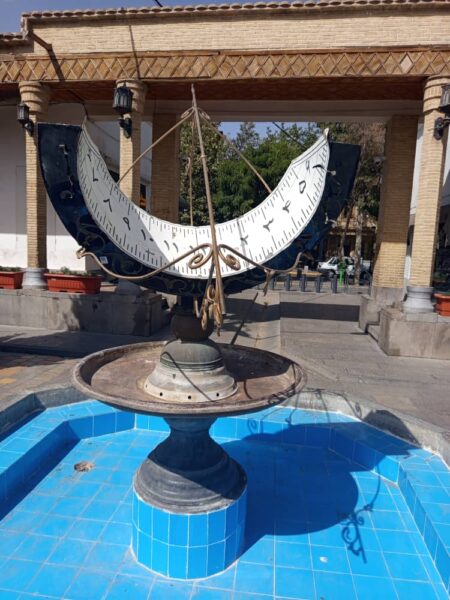
This sundial was constructed in 2016/1395 in the middle of a pool in Julfā Square, located in the Julfā quarter* beside Naẓar Street*, and stands between Isfahan’s three well-known churches—Vank Church*, St. Mary Church*, and Bethlehem Church*. The sundial is based on a planetary model and has an external diameter of 130cm. The angular settings of the structure were designed and executed according to the geographical coordinates of Julfā Square. The time scale is graduated at ten-minute intervals, and its reading accuracy is within approximately three minutes. The calculations incorporated into the gnomon make it possible not only to indicate standard time but also to determine the length of the day, the times of sunrise and sunset, and the time of the noon call to prayer. At night, by sighting along the axis of the gnomon, it is possible to locate the Pole Star and thereby identify the north celestial pole. The physical structure and computational design of this instrument were inspired by the Armillary Sphere, one of the classical astronomical instruments, and it is regarded as an advanced form of the classical sundial.34
- Sundial of the University of Isfahan
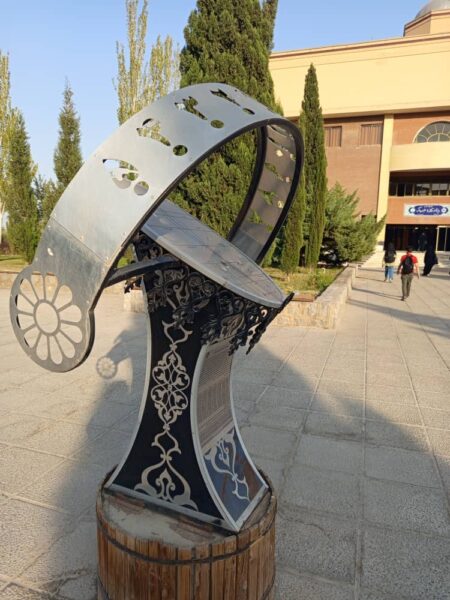
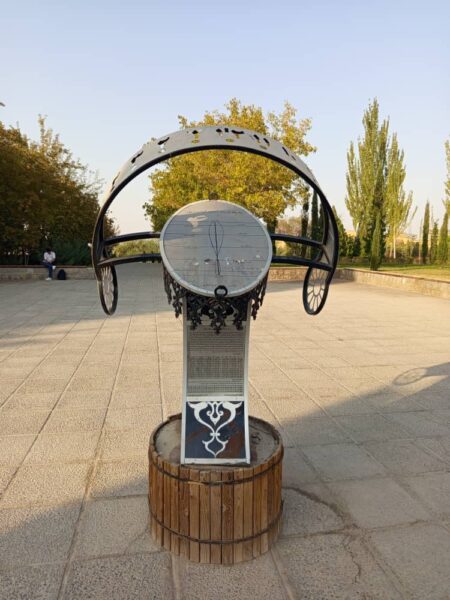
The University of Isfahan* sundial, installed opposite the Faculty of Physics, commemorates Aḥmad Kīyāsat-pūr (d. 2019/1398), Professor of Physics and Astronomy at the University of Isfahan. The calculations, design, and construction of the sundial were carried out in 2021/1400 by Īraj Ṣafāʾī, director of the observatory of the University of Kashan. The astronomical structure of this instrument is of the equatorial type and is capable of indicating time according to Iran’s official time. Unlike other types of sundials, in this example, as the Sun moves across the sky, sunlight passes through apertures cut in the form of Persian numerals in the dial plate and falls on the central gnomon, thereby indicating the time. Other daytime functions of the sundial include determining local noon or the time of the noon call to prayer, displaying the calendar according to the Iranian calendar system, and showing the Sun’s analemma throughout the year. This astronomical instrument also functions at night, making it possible to determine the approximate time on moonlit nights, also the position of the north celestial pole and the Pole Star. The complete specifications of the sundial are inscribed beneath the instrument.
Another sundial at the University of Isfahan is located on the southern side of the Faculty of Engineering building. It is an analemmatic sundial, constructed of stone and mosaic, and in fact forms part of the landscaping and outdoor space of the Faculty of Engineering. The analemmatic curve was calculated with precision and engraved on the ground. To read the time, a person stands on the mark corresponding to the date, and the person’s shadow indicates the time. The calculations, design, and construction of the sundial were carried out by Pāyān Amīnī in 2007/1386.
- Sundial of the Tomb of Aḥmad Kīyāsat-pūr
In addition to his professional activities in astronomy, Aḥmad Kīyāsat-pūr also played an important role in the development of amateur astronomy in Iran. A sundial has been constructed above his gravestone in the Distinguished Figures Section of Bāgh-e Reḍvān Cemetery*. Its initial design was prepared in collaboration with Muhammad Bāqerī, a retired member of the History of Science Department of the Encyclopaedia Islamica Foundation (Tehran). The calculations, design, and construction of this astronomical instrument were carried out by Reza Munajjemī, an amateur astronomer who formerly served as director of the Adīb Astronomy Centre in Isfahan.
- Sundial of the Isfahan Mathematics House
The Isfahan Mathematics House is located on Sa‛ādat-ābād Street and is one of the cultural institutions established by the Isfahan Municipality*. A sundial, designed and installed by Aḥmad Kīyāsat-pūr in 2008/1387, is mounted on the entrance pillar of the building.
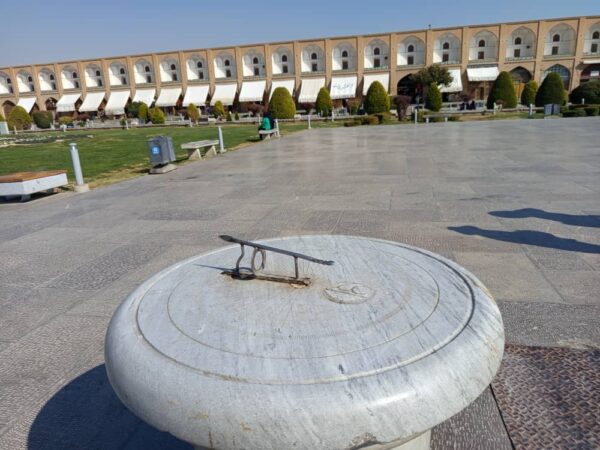
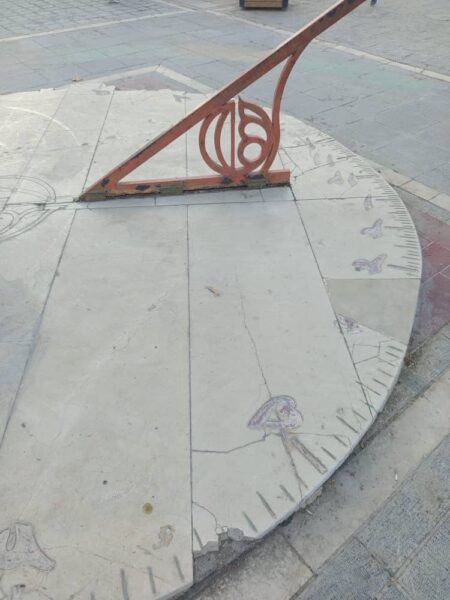
It should also be noted that Āqānūr Mosque, Nīmāvard madrasa*, and the Muṣallā Mosque* of Isfahan formerly possessed noon indicators or sundials, but these have either been destroyed or become inaccessible as a result of demolition or reconstruction. During the past three decades, the Isfahan Municipality has also installed a variety of sundials at different locations throughout the city. Among them is a ground-mounted sundial with a concrete dial plate at the entrance to Ghadīr Park, on the eastern side of the Isfahan ring road. Its gnomon is a triangular metal plate incorporating the emblem of the Isfahan Municipality. Another sundial has been installed in Ābshār-e Avval Park, between Khājū Bridge* and Buzurgmehr Bridge*. This is a horizontal sundial with a metal gnomon. Its circular dial, carved from a single block of stone with a diameter of two meters, bears engraved hour markings. Another sundial, with a monolithic stone base and dial plate and an inclined metal gnomon, is located on the northern side of the central pool in Naqsh-e Jahān Square.
Sundials outside the City of Isfahan
Several sundials and solar indicators are found elsewhere within the Isfahan region. Among them is an analemmatic sundial employing a human gnomon, constructed in 2019/1398 in the open area of the Faculty of Science at the University of Kashan. Another sundial, based on a planetary model and measuring two meters in diameter, was constructed and installed at Payam-e Nūr University of Ārān and Bīdgul, near Kashan city, in 2010/1389. A sundial is also located on the northern side of the roof of Jāme‛ Mosque of Dehāqān, where it was used to determine the time of the noon call to prayer. This sundial dates from the Qajar period. In addition, an equatorial sundial with a concrete dial plate and a metal gnomon was constructed at the Gulpāygān Dam in Isfahan by the builder of the dam in 1957/1336.
Before artificial timekeeping devices became widespread, the use of geographical features as natural timekeeping instruments was one means of determining time; such features served various purposes, including reckoning the hours of the day and identifying the prescribed noon and afternoon prayer times and the vernal equinox.35 One example is a phenomenon known as the Burūzād Sundial in Mubāreke County* (the Greater Lenjān region). This natural noon indicator consists of a massive cavity in the face of Shah Kūh, in the southwestern part of Isfahan Province, and is visible across a wide area. The mechanism of this natural sundial is such that, at the precise moment of the noon call to prayer, the shadow within the cavity disappears completely, thereby indicating local solar noon solely by the position of the Sun and without the aid of any man-made instrument.36 Another natural noon indicator, known as Key Shāpūrān, consists of sections of the eastern wall of a vertical valley, shaped like the numeral seven and extending along the north–south axis, on the southern slope of Shah Kūh. At noon, the shadow disappears at the base of one of these sections. The inhabitants of the two villages of Key Shāpūrān (Qah-shāpūrān) and Qal‛e Surkh traditionally used this phenomenon to determine local noon. Unlike the Burūzād Sundial, however, the Key Shāpūrān noon indicator, because of its lower elevation and more restricted angle of visibility, can be observed only from these two neighboring villages. Its principal function was to regulate the distribution of irrigation water, with the moment of local noon serving as the reference time for transferring water shares among farmers.37
/Muhammad-Amir Shivafar/
Bibliography
Bāqerī, Muhammad, “fehrest-e sā‛at-hā-ye āftābī-ye Iran,” mīrāth-e ‛elmī-ye Islam va Iran, 3/1, Spring–Summer 2014/1393.
Ferrari, Gianni, “sā‛at-hā-ye āftābī-ye ‛uthmānī,” translated by Mahdī Nurūzī-Bakhsh, mīrāth-e ‛elmī-ye Islam va Iran, 8/2, Autumn–Winter 2019/1398.
“hadīyye-ye nujūmī be masīḥīyān-e Isfahan,” Kashan University Observatory, 2017/1396. Retrieved July 1, 2026, from https://uko.kashanu.ac.ir/fa/achievement/74/
History of Science Museum, 2026. Retrieved Jul.1, 2026, from https://www. hsm.ox.ac.uk/collections-online#/item/hsm-catalogue-2972
Hoogendijk, Jan P., “asrār-e qeble-namāhā-ye Isfahn,” translated by Ṣamad Farrukh-Nehād, mīrāth-e ‛elmī-ye Islam va Iran, 1/1, Spring–Summer 2012/1391.
Hunarfar, Luṭfullāh, ganjīne-ye āthār-e tārīkhī-ye Isfahan, Isfahan: Thaqafī, 1971/1350.
Ja‛farī, Ali-Akbar, and Muhammad-Taqī Mashkūrīyān, neẓām-e zamān-shenākhtī dar Iran-e ‛aṣr-e ṣafavī, Isfahan: University of Isfahan, 2024–25/1403.
Kārgar, ‛Abd al-Reza, custodian of Jāme‛-e ‛Atīq Mosque of Isfahan, interview by Muhammad-Amir Shivafar, December 11, 2025/20 Āzar 1404.
King, D. A., “Mīḳāt. 2: Astronomical Aspects,” in The Encyclopaedia of Islam, 2nd edition, vol. 7, Leiden: Brill, 1993.
Māher al-Naqsh, Maḥmūd, me‛mārī-ye masjed-e ḥakīm, Tehran: Surūsh, 1997/1376.
“mu‛arrefī-ye shākheṣ-e nīmrūz-e ṭabī‛ī-ye Burūzād dar shahrestān-e Mubāreke,” Kashan University Observatory, 2021/1400. Retrieved July 1, 2026, from https://uko.kashanu.ac.ir/fa/news/17560/
Muẓaffarī, Muhammad, and Aḥmad Bādkūbe Hazāve, “mawāqīt va ḍavābeṭ-e nu-yāfte,” feqh va mabānī-ye ḥuqūq-e eslāmī, 43/1, Spring–Summer 2010/1389.
Reḍvānī, Pūyān, “sā‛at-e āftābī,” in dāneshnāme-ye jahān-e Eslām, under the supervision of Ghulām-Ali Ḥaddād ‛Ādel, 22, Tehran: Encyclopaedia Islamica Foundation, 2017/1396.
Rius-Pinis, Monica, “‛elm-e mīqāt va muwaqqet-hā-ye nāmdār dar gharb-e jahān-e Eslām,” translated by Pūyān Reḍvānī, mīrāth-e ‛elmī-ye Islam va Iran, 3/1, Spring–Summer 2014/1393.
Sa‛īdnīyā, Aḥmad, “rāz-e sang-e sā‛at-e masjed-e Emām (Shah ‛Abbāsī) Isfahan,” hunarhā-ye zībā: me‛mārī va shahrsāzī, 13/3, Autumn 2008/1387.
Ṣadrī Afshār, Ghulām-Hussein, “seyyed jalāl al-dīn Ṭehrānī,” mīrāth-e ‛elmī-ye Islam va Iran, 3/1, Spring–Summer 2014/1393.
Ṣafāʾī, Īraj, director of the Kashan University Observatory, interview by Muhammad-Amir Shivafar, October 2, 2025/10 Mehr 1404.
“shenāsāyī va mu‛arrefī-ye shākheṣ-e nīmrūz-e Key Shāpūrān,” Kashan University Observatory, 2021/1400. Retrieved July 1, 2026, from https://uko.kashanu.ac.ir/fa/news/17887/
Sotheby’s, 2026a. Retrieved Jul.1, 2026. Retrieved Jul.1, from
https://www.sothebys.com/en/auctions/ecatalogue/2016/arts-islamic-world-l16220/lot.90.html
Sotheby’s, 2026b.Retrieved Jul.1, 2026. Retrieved Jul.1, from
Waugh, Albert E., Sundials: their theory and construction, New York: Dover Publications, 1973.
- This section is based on the following work:Waugh, Albert E., Sundials: Their Theory and Construction, New York: Dover Publications, 1973.[↩]
- one twenty-fourth of the length of the day[↩]
- Bāqerī, p. 49.[↩]
- Ibid., p. 51.[↩]
- Waugh, pp. 35, 37.[↩]
- Ibid., pp. 52, 74.[↩]
- Ja‛farī and Mashkūrīyān, p. 108.[↩]
- Ibid., p. 29.[↩]
- Ibid., pp. 70–72.[↩]
- Ibid., pp. 108, 114.[↩]
- Ibid., pp. 135–136, 150.[↩]
- Ibid., p. 100.[↩]
- Ibid., p. 116.[↩]
- Ibid., pp. 174, 178.[↩]
- Reḍvānī, p. 461.[↩]
- Bāqerī, p. 50.[↩]
- For the science of mīqāt, see Rius-Pinis, pp. 88–96; Ja’farī and Mashkūrīyān, pp. 91–97; King, pp. 27–32.[↩]
- Reḍvānī, p. 462.[↩]
- Ibid.[↩]
- Bāqerī, p. 51.[↩]
- Muẓaffarī and Bādkūbe Hazāve, pp. 158–159.[↩]
- Ibid., p. 160.[↩]
- Ferrari, pp. 117–120.[↩]
- Reḍvānī, p. 462.[↩]
- Ibid., p. 463.[↩]
- Hoogendijk, p. 21. Examples of these instruments are preserved in important collections such as the History of Science Museum of the University of Oxford or have appeared in major international auctions, including Sotheby’s (in 2016 and 2019), as outstanding examples of Islamic art. See, for example: History of Science Museum, 2026; Sotheby’s, 2026a; Sotheby’s, 2026b.[↩]
- For these instruments and their functions and astronomical accuracy, see Hoogendijk, pp. 21–30.[↩]
- Sa‛īdnīyā, p. 13.[↩]
- Ibid., p. 11.[↩]
- Kārgar, interview dated December 11, 2025/20 Āzar 1404.[↩]
- Ibid.[↩]
- Hunarfar, p. 612.[↩]
- Māher al-Naqsh, p. 49.[↩]
- Ṣadrī Afshār, p. 141.[↩]
- “On Sunday, 29 Jumādā al-Ākhira 1351/21 October 1932/8 Ābān 1311 Sh., this stone was installed in the Chahārbāgh madrasa, in commemoration of my journey to Isfahan, by me, Seyyed Jalāl al-Dīn al-Ḥusaynī al-Ṭehrānī, for determining true noon. When the shadow on the western face of this stone disappears, true noon has occurred. It was installed during the custodianship of Āqā Muṣṭafā Mudarres, son of the late Seyyed ‛Abd al-Hussein Seyyed al-‛Erāqayn. The longitude of Isfahan is 51 degrees and 35 minutes east of Greenwich, its latitude is 32 degrees and 45 minutes north of the Equator, the qibla deviates 45 degrees and 11 minutes west of true south, and true geographic south lies 4 degrees and 54 minutes east of magnetic south as indicated by the compass. The elevation of Isfahan above sea level is between 1,475 and 1,520 meters. Owing to atmospheric refraction, the apparent length of the day throughout the year exceeds the true day by between three and seven minutes” (Ṣadrī Afshār, p. 141).[↩]
- Ṣafāʾī, interview dated October 2, 2025/10 Mehr 1404; “hadīyye-ye nujūmī be masīḥīyān-e Isfahan,” 2017/1396.[↩]
- For natural timekeeping instruments, see Ja‛farī and Mashkūrīyān, pp. 99–100.[↩]
- Ṣafāʾī, the same interview; “mu‛arrefī-ye shākheṣ-e nīmrūz-e ṭabīʿī-ye Burūzād dar shahrestān-e Mubāreke,” 2021/1400.[↩]
- Ṣafāʾī, the same interview; “shenāsāyī va mu‛arrefī-ye shākheṣ-e nīmrūz-e Key Shāpūrān,” 2021/1400.[↩]