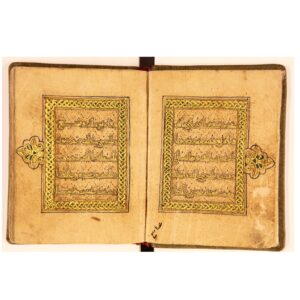
Tamhīd al-Qawā‛ed, A treatise on theoretical Sufism written in Arabic by Ṣāʾen al-Dīn Ali b. Muhammad Turke Eṣfahānī*, a philosopher and mystic of the 8th–9th/14th–15th century.1
The full title of the work is al-Tamhīd fī Sharḥ Resālat Qawā‛ed al-Tawḥīd.2 It is a commentary on Qawā‛ed al-Tawḥīd, a treatise authored by Abū Ḥāmed Ṣadr al-Dīn Muhammad Turke Eṣfahānī, a philosopher and mystic of the 7th–8th/13th–14th century and the grandfather of the commentator. The date of composition is not recorded in the printed edition, but according to catalogue descriptions of Ṣā‛en al-Dīn’s collected manuscripts,3 beneath the title Tamhīd al- Qawā‛ed the phrase “Monday, 830 [hijrah] in Shiraz” appears, which likely refers to the date of transcription.
Tamhīd al- Qawā‛ed begins with praise of God and salutations upon the Prophet Muhammad, his family, and his companions. The book is not divided into chapters or sections. Since the complete text of Qawā‛ed al-Tawḥīd is transmitted alongside it, the only marker distinguishing the commentary from the base text is a consistent pattern: each topic begins with the word qāla (he said), referring to the original author, followed by the commentator’s explanation, introduced by the phrase aqūl (I say).
Ṣāʾen al-Dīn distinguishes his mystical perspective on tawḥīd from that of rationalist thinkers who rely solely on formal reasoning and demonstrative proof. In his view,4 the reality of tawḥīd, as understood by the people of unveiling and intuitive witnessing (kashf and shuhūd), is not truly comprehended by those confined to dialectical argument—except for those among them who have both levels: rational demonstration and intuitive witnessing5 (shuhūd-e dhawqī).
Ṣāʾen al-Dīn regards ‘absolute being’ as the subject matter of the divine science of mysticism. He justifies this by noting that the term being is, in terms of scope and comprehensiveness, the most universal in meaning; in terms of intelligibility, the most familiar to human conception; and in terms of intellection and mental apprehension, the most primordial concept.6 He further notes that the consideration of being as the subject of metaphysics differs from its consideration as the subject of mysticism.7
Following a brief discussion on the conceptual and judgmental foundations (mabādī-ye taṣawwurī wa taṣdīqī) of mysticism and its major themes, the author proceeds to examine the meanings of certain key terms shared by both Peripatetic philosophers and mystics, such as the term existence. In his view, for the Peripatetic philosophers, existence is something superadded to quiddities, and the relation of quiddities to existence is analogous to that of corporeal substances to space.8 But for the mystics, existence is not something superadded to quiddities and existents; rather, all existents are diverse manifestations and disclosures of a single reality—absolute existence—which become distinguished from one another only through mental ascriptions added in the mind.9 Ṣāʾen al-Dīn reinforces and affirms his position by citing a passage from Enshāʾ al-Dawāʾer by Ebn ʿArabī (d. 638/1240) and expressing his astonishment at the argument of the Illuminator Sheikh (i.e. Sheikh al-Eshrāq, d. 587/1191) who regarded existence as an ideality.10 After a brief discussion on the meaning of the term kawn (coming-into-being or existence), the concepts of unity, the distinction between unity and multiplicity, the reality of unity, and the ideality of multiplicity,11 he begins his commentary by quoting the opening statement of Qawā‛ed al-Tawḥīd: that tawḥīd, in the doctrine of the mystics, is among the most difficult topics, and that theologians (the Mutakallemūn) and rationalist philosophers (the Peripatetics) are incapable of grasping it.12
The first major topic addressed in Tamhīd al- Qawā‛ed is the univocity of existence. Ṣadr al-Dīn affirms the univocity of existence, and Ṣāʾen al-Dīn explains the reason why the book begins with this particular proposition: because it can serve as an intermediary premise to establish rational proofs for subsequent doctrines, such as the necessity and unity of existence. To substantiate the doctrine of univocity, Ṣāʾen al-Dīn quotes passages from the author’s earlier philosophical works and offers a formal demonstration in support of the claim.13
The next topic addressed in the book concerns the reality of existence, for if existence were merely an ideality, any discussion of the unity of existence would be rendered meaningless. Accordingly, the commentator—following the author, who had presented arguments in defense of the reality of existence in other works such as al-E‛temād al-Kabīr, al-Ḥekmat al-Manī‛a, and al-Ḥekmat al-Rashīdīyya, and who had rejected the view of Sheikh al-Eshrāq that existence is an ideality—sets out to affirm that existence is indeed real, not merely conceptual.14
The discussion then turns to the necessity of the reality of existence. After quoting and expanding on Ṣadr al-Dīn’s argument for the intrinsic necessity of the reality of existence, Ṣāʾen al-Dīn presents five additional proofs in support of this claim and responds to related objections.15 He maintains that this ontological reality is conditioned by no qualification whatsoever—not even by the qualification of absoluteness.16The discussion proceeds to a critique of the view that the quiddity of the Necessary (ṭabī‛at-e wājeb) can be predicated universally and be instantiated in multiple individuals, whether that universal would be true one (kullī-ye ḥaqīqī), which have real concrete instances, or hypothetical universal (kullī-ye farḍī), which possess merely conceptual individuals in the mind, are rejected in this context. A counterexample argument (burhān-e naqḍī) offered by the Peripatetic is quoted and critically examined.17 The issue culminates in the question of how instantiation is impossible for the quiddity of the Necessary, while that very quiddity is nonetheless determinate and individuated.18 This leads to the next topic: the mode of individuation of the quiddity of the Necessary. Both the author and the commentator explain the key to this individuation and outline four distinct modalities of such determination.19
Following the presentation of the mystics’ proof for the necessity of absolute existence and the exposition and critique of objections raised by the Peripatetic philosophers,20 the discussion turns to the identity of the Necessary Existent as absolute being, and the manner in which the Most Beautiful Names (asmāʾ-e ḥusnā) emanate from it. In elaborating the author’s position, the commentator draws on a hadith attributed to Imam Ṣādeq: “Unity without distinction is heresy, and distinction without unity is negation; true tawḥīd lies in combining both.”21
The next chapter addresses the Necessary Being’s knowledge of His own essence, His knowledge of the attributes necessarily entailed by that essence, and His knowledge of that which follows from those attributes. The views of the Peripatetic philosophers on God’s knowledge of Himself and of other-than-Him are reported and critically examined.22 Subsequently, the discussion turns to the concepts of the Most Holy Emanation (feyḍ-e aqdas) and the Holy Emanation (feyḍ-e muqaddas). The manifestation of the Divine Essence, its attributes, and the implications of those attributes to the Essence itself, in the first level of determination (ta‛ayyun-e awwal), is referred to as the Most Holy Emanation. In this level, no concrete multiplicity or individuated manifestation is yet present. However, the Necessary Being manifests Himself in another, more outward determination, and through another emanation—known as the Holy Emanation—brings about actual external disclosures (tajalliyāt-e ‛aynī). It is through the Holy Emanation—also called the Breath of the All-Merciful (nafas-e raḥmānī) in the language of the mystics—that being is realized and external existents emerge into actuality.23
Regarding the realm or degree of humanity, the position of both the author and the commentator is that this level encompasses all degrees of manifestation and constitutes the final and most complete stage thereof. However, as this view is subject to objection, both the author and the commentator present the criticisms that have been raised and offer their respective responses.24
The discussion then turns to the necessity of the existence of the Perfect Human as well as to his all-comprehensiveness and perfection. Ṣāʾen al-Dīn,25 citing a passage from Ebn ‛Arabī’s Enshāʾ al-Dawāʾer, offers a proof for this necessity, and addresses potential objections based on theoretical principles and dialectical premises that may be raised against the foundations of this argument.26 In addition to such theoretical objections, he also considers criticisms based on the practical foundations of mysticism, including the claim that the acquisition of the perfection recommended in practical mysticism is impossible—on the grounds that the mystics define absolute perfection as a state which, even if attained, cannot be grasped through acquired knowledge (‛elm-e ḥuṣūlī). That is, the intellect (‛aql) can never abstract a conceptual form of absolute perfection and thus cannot comprehend it through discursive reasoning.27 In response, Ṣāʾen al-Dīn argues that while the intellect is incapable of directly accessing certain hidden truths, it can come to know them through the mediation of another faculty—one nobler than itself. Once these truths are apprehended through this superior faculty, they become, like all other known objects, accessible to the intellect.28
Another objection raised by both the author and the commentator concerns the claim that the practices recommended by the mystics may jeopardize physical health and temperamental balance, and may lead to hallucinations and delusions.29 In response to this objection, the general framework of practical mysticism is outlined, in order to show that many of the actions ascribed to the mystics are in fact unfounded accusations, and that authentic mystical methods are both rationally and religiously grounded. Ultimately, both the author and the commentator affirm that every condition regarded as essential in philosophy—namely, the removal of obstacles and the avoidance of factors that disturb the equilibrium of one’s temperament—is likewise fundamental in Sufism. Ensuring a balanced constitution and observing principles that maintain this balance are considered necessary in both philosophical and Sufi disciplines.30
The final topic addressed in Tamhīd al- Qawā‛ed is a recommendation directed toward the spiritual disciple (sālek) to pursue true and theoretical sciences—including logic—as a means of evaluating intuitive knowledge and distinguishing authentic unveilings from illusions.31 This counsel, however, is intended for that disciple who lacks a spiritual master. For one who is under the guidance of a master, there exist specific sciences at each stage and station of the path, suited to the disciple’s individual capacity. As the disciple advances through these sciences, appropriate criteria for verification are made available to him in proportion to his aptitude.32
Ṣadr al-Dīn Turkeh Eṣfahānī, in composing Qawā‛ed al-Tawḥīd, drew upon his own philosophical works—such as al-E‛temād al-Kabīr, al-Ḥekmat al-Rashīdīyya, and al-Ḥekmat al-Manī‛a—and occasionally referred the reader to them.33 Likewise, wherever he made use of other philosophical sources, explicitly cited either the name of the author or the title of the work.34 Notably, he drew most heavily from Ebn ‛Arabī’s Enshāʾ al-Dawāʾer and Fuṣūṣ al-Ḥekam.35
According to Henry Corbin,36 Tamhīd al- Qawā‛ed is of great significance for the study of Shiite philosophy. Sayyed Jalāl al-Dīn Āshtīyānī considered it the most important work to prove the existence of the Absolute and addressing several related issues.37 Muḥsen Jahāngīrī regarded the book as one of the most rigorous and authoritative texts in theoretical mysticism, and included its author among the commentators and promoters of Ebn ‛Arabī’s doctrine of unity of being.38
Since its composition, Tamhīd al- Qawā‛ed has held particular significance among scholars of mysticism and philosophy, exerting a lasting influence on subsequent philosophical and mystical currents.39 It was also used for many years as a textbook in traditional scholarly circles. Among the prominent teachers known to have taught this work are Sayyed Raḍī Lārījānī, Āqā Muhammad-Reza Qumsheʾī*, Āqā Mīrzā Hāshem Eshkevarī, Āqā Mīrzā Maḥmūd Qummī, Sayyed Abū al-Ḥasan Rafīʿī Qazvīnī, Sayyed Muhammad-Kāẓem ‛Aṣṣār Tehrānī, Muhammad-Hussein Fāḍel Tūnī, and Muhammad-Hussein Ṭabāṭabāʾī.40 ‛Abdullāh Javādī Āmulī also taught this work and later published his lectures in the form of a book entitled Taḥrīr-e Tamhīd al- Qawā‛ed (Tehran, 1372/1993).
Tamhīd al- Qawā‛ed was first published in lithograph in Tehran41 in 1315/1897, under the supervision of Sheikh Aḥmad Shīrāzī. It was later reprinted in 1355/1976, accompanied by the marginal notes of Āqā Muhammad-Reza Qumsheʾī and Mīrzā Maḥmūd Qummī,42 with a foreword by Sayyed Hussein Naṣr. In 1360/1981, it was published again with the same marginalia, this time with an introduction and critical edition by Sayyed Jalāl al-Dīn Āshtīyānī. Since then, the work has been reprinted multiple times in Tehran and Qum.
/Muhammad Zare and Muhammad-Baqer Karimiyan/
Bibliography
Āqā Buzurg Ṭehrānī, Muhammad-Muḥsen, al-Dharī‛a elā Taṣānīf al-Shī‛a, ed. Ali-Naqī Munzavī and Aḥmad Munzavī, Beirut: Dār al-Aḍwāʾ, 1983/1403.
Corbin, Henry, Tārīkh-e falsafeh-ye Islāmī, tr. Javād Ṭabāṭabāʾī, Tehran: Kavīr, 1998/1377.
Dāneshpazhūh, Muhammad-Taqī, “Majmū‛a-ye Rasāʾel-e Khujandī,” Farhang-e Īrān-zamīn, vol. 14, 1966–1967/1345–1346.
Jahāngīrī, Muḥsen, Muḥyī al-Dīn b. ‛Arabī: Chehreh-ye Barjasta-ye ‛Erfān-e Eslāmī, Tehran: University of Tehran, 1980/1359.
Jawādī Āmulī, ‛Abdullāh, Taḥrīr-e Tamhīd al- Qawā‛ed Ṣāʾen al-Dīn Ali b. Muhammad al-Turke, [Tehran]: al-Zahrāʾ, 1993/1372.
Kadīvar, Muḥsen and Muhammad Nūrī, Maʾkhadh-Shenāsī-ye ‛ulūm-e ‛aqlī: Manābi‛-e chāpī-ye ‛ulūm-e ‛aqlī az ebtedā tā 1375, Tehran: Ettelā‛āt, 2000/1379.
Mudarres Mūsavī, Ali, “Aḥvāl va āthār-e Ṣāʾen al-Dīn Turke Eṣfahānī,” in Majmū‛a-ye sukhanrānīhā va maqālāt dar bāre-ye falsafe va ‛erfān-e eslāmī, ed. Mahdī Muḥaqqeq and Hermann Landolt, Tehran: Muʾassase-ye Muṭāla‛āt-e Eslāmī-ye Dāneshgāh-e McGill, 1970/1349.
Mushār, Khānbābā, Fehrest-e ketābhā-ye chāpī-ye ‛Arabī, Tehran: Chāpkhāna-ye Rangīn, 1965/1344.
Ṣadr al-Dīn Shīrāzī, Muhammad b. Ebrāhīm, Mafātīḥ al-ghayb, with ta‛līqāt by ‛Alī Nūrī, ed. Muhammad Khwājūʾī, Tehran: Anjuman-e Eslāmī-ye Ḥekmat va Falsafe-ye Iran, 1984/1363.
Turke Eṣfahānī, Ali b. Muhammad, Tamhīd al- Qawā‛ed, ed. Jalāl al-Dīn Āshtīyānī, Tehran: Anjuman-e Eslāmī-ye Ḥekmat va Falsafeh-ye Iran, 1981/1360.
- This article was previously printed in the Encyclopaedia of the World of Islam, vol. 8, pp. 203–205, and has been published in the Encyclopaedia Isfahanica with minor modifications.[↩]
- Turke Eṣfahānī, p. 11.[↩]
- Dāneshpazhūh, p. 310–311; Mudarres Mūsavī, p. 117.[↩]
- Turke Eṣfahānī, pp. 4–5. [↩]
- Ibid., pp. 6–7.[↩]
- Ibid., pp. 18–19.[↩]
- Ibid., pp. 14–17.[↩]
- Ibid., pp. 26–27.[↩]
- Ibid., p. 32.[↩]
- Ibid., pp. 32–33.[↩]
- Ibid., pp. 34–47.[↩]
- Ibid., p. 48.[↩]
- Ibid., p. 55; for a formulation of this argument, see: Javādī Āmulī, p. 251.[↩]
- Turke Eṣfahānī, pp. 56–57.[↩]
- Ibid., pp. 60–63. [↩]
- Ibid., pp. 64–65; see also: Javādī Āmulī, pp. 271–274.[↩]
- Turke Eṣfahānī, pp. 71–74.[↩]
- Ibid., p. 74.[↩]
- Ibid., pp. 87–95.[↩]
- Ibid., pp. 95-109.[↩]
- Ibid., pp. 115-116.[↩]
- Ibid., pp. 133-137.[↩]
- Ibid., pp. 141-166.[↩]
- Ibid., pp. 167-172[↩]
- Ibid., p. 176. [↩]
- Ibid., pp. 172-202.[↩]
- Ibid., pp. 206-212.[↩]
- Ibid., pp. 248-249.[↩]
- Ibid., p. 252.[↩]
- Ibid., pp. 260-262.[↩]
- Ibid., pp. 270-273.[↩]
- Ibid., p. 274.[↩]
- For examples, see: Ibid., pp. 55–56, 144, 161.[↩]
- For examples, see: Ibid., pp. 15, 61.[↩]
- For examples, see: Ibid., pp. 176, 186.[↩]
- Corbin, p. 469. [↩]
- Turke Eṣfahānī, introduction by Āshtīyānī, p. 12.[↩]
- Jahangīrī., pp. 433–434. [↩]
- For an example, see: Ṣadr al-Dīn Shīrāzī, pp. 493–495[↩]
- Javādī Āmulī, introduction, p. 7. [↩]
- Āqā Buzurg Ṭehrānī, vol. 17, p. 181; Mushār, col. 217.[↩]
- Kadīvar and Nūrī, vol. 1, p. 25.[↩]