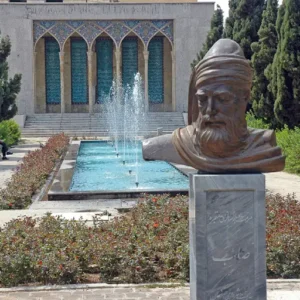
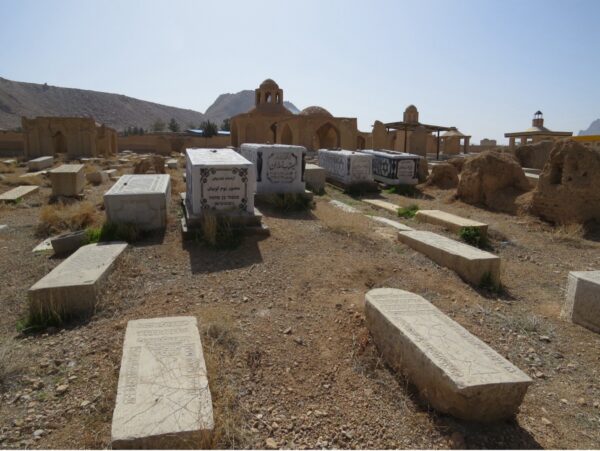
Esther Khātūn, one of the most renowned Jewish pilgrimage sites in Iran, is located in the town of Pīrbakrān, in the county of Falāvarjān*, near the Zāyande-Rūd* River. After the tomb of Esther and Mordechai in Hamadan,1 Esther Khātūn, situated twenty-seven kilometers southwest of Isfahan, is among the most significant Jewish shrines in Iran.2 The Jewish community venerates this site as the shrine or footstep place of Sarah bat Asher, also known as “Māmān Sārā,” while local inhabitants refer to it as Estherā Khātūn or Sārā Khātūn. Adjacent to the shrine lies a relatively large cemetery where, every year, Jews celebrate the Hebrew New Year concurrently with the first day of the month of Tishri, corresponding to Shahrivar (September) and Mehr (October).3
Associations
The Esther Khātūn shrine in Pīrbakrān is associated with three women: (1) Sarah, the daughter of Asher and granddaughter of Jacob; (2) Esther; and (3) Shūshendukht.
(1) Sarah. According to Jewish tradition, Sarah was one of the seventy members of Jacob’s family who migrated from Canaan to Egypt: “…and the sons of Asher: Jimnah, Ishuah, Isui, and Beriah, and their sister Sarah…”.4 Her name is also mentioned in the census of the Israelites commanded by Moses: “And the name of Asher’s daughter was Sarah.”5 In one narration, Jacob blessed her with immortality after she brought him the news that Joseph was still alive.6 A legendary account relates that while searching for a lost sheep in Jerusalem, Sarah entered a cave and emerged near Pīrbakrān*.7 According to Ernst Herzfeld*, Sarah never came to Pīrbakrān, and the narratives concerning her are purely mythical. He believed that Jews from the tribe of Asher had probably settled in this area, and that these stories evolved over time.8
(2) Esther. A Jewish woman of the Achaemenid era, Esther became the wife of Aḥshūresh (Xerxes I of the Achaemenid dynasty) and, through her wisdom and prudence, foiled the plot of Haman, the king’s minister, who sought to exterminate the Jews. This event, recorded in the Book of Esther, led to the institution of the Purim festival, which holds great significance for Jews. Although the historical accuracy of this account has been questioned, it has had a profound cultural impact on Jewish history and has come to symbolize the salvation of the Jewish people from destruction. Some scholars believe that the story of Esther contains mythical and ritual elements and reflects the cultural and social ties of the Jews at the Achaemenid court.9 The question arises: if, from the Jewish perspective, this shrine belongs to Sarah, why is it commonly known among the people as Esther Khātūn? Several key factors may explain this transformation of identity: 1-Because Esther was better known in Iranian culture and held a prominent place in Persian literature and folklore, the Iranian public—familiar with the tomb of Esther in Hamadan—regarded her as a sacred figure and associated this shrine with her name. The title Khātūn, meaning a noble or venerated lady, became attached to Esther in the Iranian cultural context. The word Khātūn in Iranian and Islamic usage refers to aristocratic women and the wives of princes, and it originates from the Sogdian language, meaning “princess” or “queen.”10 2- In societies dominated by oral traditions, names and stories often undergo gradual transformations. Such changes may have led to the replacement of “Sarah bat Asher” with “Esther Khātūn,” since the story of Esther was more familiar and appealing to the people. 3- The absence of written records or reliable historical documents about this shrine facilitated the gradual alteration of its identity in collective memory, leading to the association of Esther —as a symbol of a holy Jewish woman—with this site. 4- Women such as Esther and Shūshendukht have held distinguished positions in Iranian history and culture, and their general popularity and reverence likely contributed to the shrine’s identification with Esther.
In addition to these, there are notable similarities between the names Hadassah and Hautusa (Atossa), which are linguistically, culturally, and historically significant: (a) Linguistic and cultural origin. The name Hadassah, mentioned in the Book of Esther as Esther’s original name,11 likely has a Babylonian or Akkadian root and appears as a Hebrew Jewish name in the Bible. Names of this type in the ancient Mesopotamian languages often carried symbolic meanings, and Hadassah may have belonged to this category. In contrast, the name Hautusa (Atossa) has a Persian origin. Atossa, daughter of Cyrus the Great and wife of Darius I, was one of the most prominent women of the Achaemenid court.12 (b) Phonetic resemblance. Phonetically, the names Hadassah and Hautusa bear certain similarities. In ancient languages such as Akkadian and Old Persian, phonetic transformations during the transfer of names between cultures were common, and such parallel sound structures may have drawn attention to the two names. (c) Cultural and historical connections. Both Esther and Atossa lived in overlapping historical contexts. Esther was the probable wife of Xerxes I who prevented the annihilation of the Jews, while Atossa, wife of Darius the Great, held a pivotal role in the Achaemenid court. This temporal and geographical proximity may have facilitated cultural exchange between Jews and Iranians, leading to shared traits or similar names across the two traditions. (d) Mythical and symbolic dimensions. In mythological and religious texts, names often possess symbolic meanings and are sometimes employed to express cultural or political connections. Historical names can reflect interactions among communities, and it is likely that Hadassah and Hautusa, in religious and mythic literature, came to symbolize the cultural and historical links between the Jews and the Achaemenes.
Although there is no conclusive evidence to prove a direct connection between the two names, the similarities between them may open new perspectives on the cultural and linguistic interactions between the Jews and the Achaemenes, and thus merit further study.
(3) Shūshandukht. In Iranian sources, she is known as the Jewish queen of Yazdegerd I, the Sasanian monarch, who played a prominent role in strengthening the position of Jews at the Sasanian court and in consolidating their cultural and social ties. According to some accounts, she helped improve the social status of Jews during the Sasanian period. Ernst Herzfeld believed that both the tomb attributed to Esther in Hamadan and the remains at Pīrbakrān actually belong to Shūshandukht.13 However, no evidence has been found in the Talmud to support the claim that the wife of Yazdegerd was Jewish,14 and Habib Levy likewise rejected the theory linking these sites to Shūshandukht.15
The figures of Sarah, Esther, and Shūshandukht belong to the realm of legend, and there is insufficient historical or scholarly evidence to confirm their historicity. Nevertheless, within Jewish tradition, such narratives—where prominent figures appear in divine form or embark on miraculous journeys to distant lands—have played an important role in fostering spiritual and cultural connections with sacred places. These sites, because of their spiritual and historical associations with Sarah, have held special attraction for pilgrims and local Jewish communities, serving as symbols of the bond between the Jews and their ancestors and sacred history. Moreover, the stories of figures like Esther and Shūshandukht reflect the cultural interactions of the Jews with Iranian dynasties and illustrate their role in the history of Iran, particularly in the social, cultural, and political relations of the Jewish community.
Architecture of the Shrine
Apparently, contemporary researchers have not paid much attention to the architectural features of the Esther Khātūn tomb, in contrast to the Pīrbakrān Mausoleum*.16 The structure of the shrine includes two synagogues, two washhouses (ghassāl-khāne), and a guesthouse. One of its oldest and most distinctive parts, known as the chele-khāne17 or Ṣuffeh-ye Sayyed Mūsā, is notable for its bulbous dome and a small entrance, about one meter high, once secured by a stone door.18 The stone door was later transferred to the Keter Dāvīd synagogue*, and a metal door has replaced it. Inside the chele-khāne, a cone-shaped stone serves as a candlestick. The existing seven-colored tiles* reflect the characteristics of the Safavid* period, indicating that the structure was either built or reconstructed during that era.19 Herzfeld’s photograph of the chele-khāne, considered one of the earliest surviving sections of the site, also dates to the Safavid period.20 The synagogues*, based on their pointed arches and structural design, likewise appear to belong to the Safavid era. The old washhouse, slightly below ground level, features pointed arches and round stone columns typical of the Safavid period, reminiscent of the Ali-Qulī-Āqā bathhouse* in Bīdābād* quarter of Isfahan. The oldest tombstone discovered in the area also dates to the Safavid period.21 Mahmūd Zāre‛ī, a scholar and expert on Isfahan studies, citing historical and field sources, has located the old Jewish cemetery in the Jūbāreh* quarter.22 In addition, Habib Levy mentions three ancient Jewish cemeteries in Isfahan that remained in use even into modern times.23 On the other hand, historical accounts describing the harsh treatment of Jews under the Safavids suggest the difficult circumstances faced by the Jewish community during that period.24
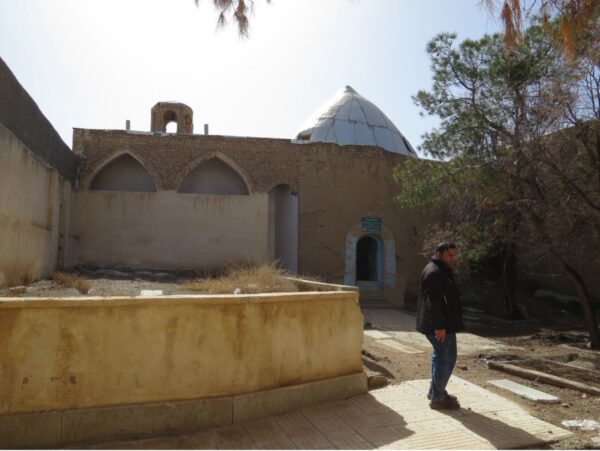
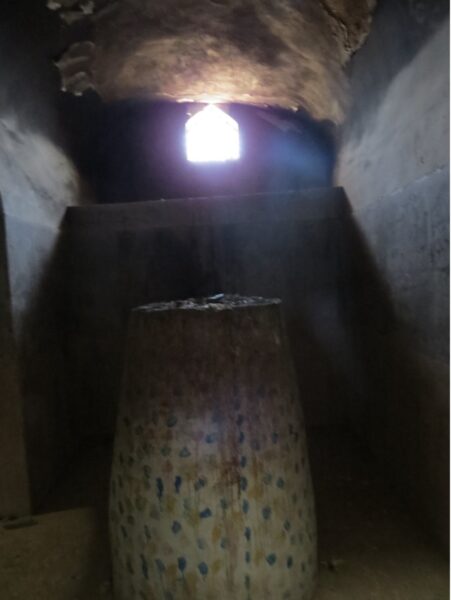
Considering all the available architectural evidence and discovered artifacts—such as the seven-colored tiles, the bulbous dome, and the oldest tombstone found at the site—it appears that they all date back to the Safavid period. Moreover, given the difficult circumstances faced by Jews during that era, it is likely that burials at Esther Khātūn began in the Safavid period, when Jewish communities from Isfahan and other cities brought their deceased to be interred there. However, archaeological excavations are essential to confirm this hypothesis.
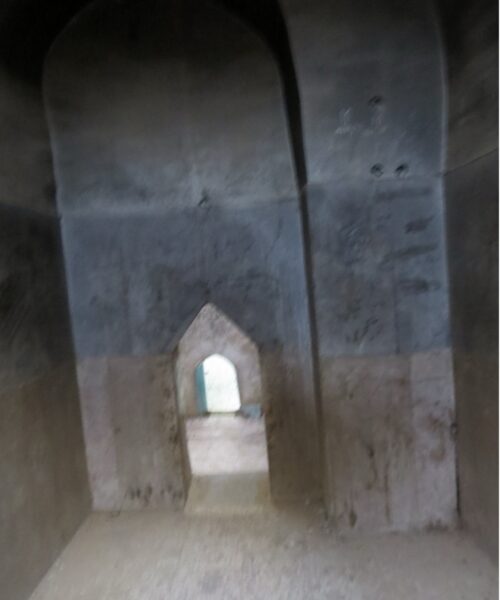
Other parts of the complex, such as the guesthouse courtyard and various annexes, are more recent additions and were likely constructed after Herzfeld’s visit, since his writings and photographs make no reference to them. These structures appear to date from the Pahlavi period onward. In the cemetery area, there are several four-arched and multi-arched structures (chahār-tāq va chand-tāq) that serve as family mausoleums belonging to notable and affluent individuals of the modern era.
The oldest known evidence of Jewish presence in this area is an inscribed stone discovered during the 1943–1944/1322–1323 renovations near the chele-khāne. The inscription, measuring 95 × 75 cm, is now preserved in the Keter Dāvīd synagogue. Its translated text reads: “Open to me the gates of righteousness, that I may enter and praise the Lord.25 This stone I have set up as a pillar, that it may become the house of God; and of all that Thou shalt give me, I will surely give the tenth unto Thee.26 Behold, I send an angel before thee, to keep thee in the way and to bring thee into the place which I have prepared.27 The Lord shall fight for you, and ye shall hold your peace.28 Dated Thursday, the 26th of the month of Av (‘which turns to good’) in the year G (J) T T Ṣ of creation. Peace be upon all Israel.
Servant of this sanctuary, Ya‛qob ben Dāwud.”29
It is noteworthy that the date “26th of the month of Av,” written in Hebrew abjad letters as “G (J) T T Ṣ,” corresponds to the year 3890 of Creation, equivalent to August 18, 130 CE, during the reign of Vologases II of the Arsacid dynasty. However, Habib Levy, based on linguistic evidence, argues that the sequence “J T T Ṣ” cannot be correct and that it was most likely “D T T Ṣ,” representing the year 4890 of Creation, equivalent to 1130 CE—coinciding with the first year of the rule of Sultan Mahmūd ebn Muhammad ebn Malekshāh al-Saljūqī*.30 Levy’s interpretation appears to be more accurate, although it is possible that the inscribed stone originally belonged to another site and was later moved here. To verify these hypotheses, further archaeological and linguistic investigations are essential.
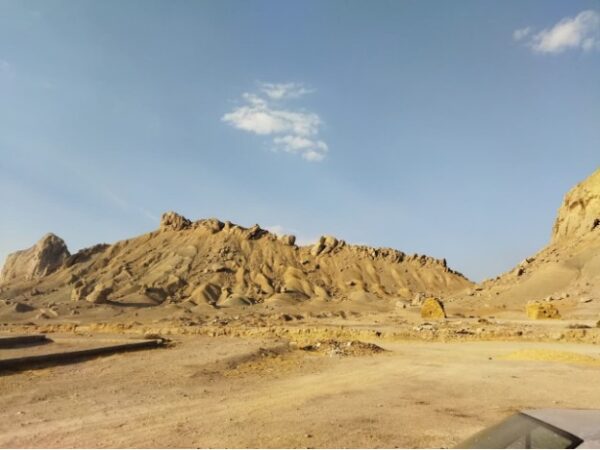
One of the most remarkable monuments of the Ilkhanid* period located near this shrine is the mausoleum of Muhammad b. Bakrān (Pīr-Bakrān)31. During the author’s field visit, several kilometers from the shrine of Sarah, north of the village of Zūdān, architectural remains and several ancient mounds were observed, whose origins probably date back to the Sasanian period. A considerable quantity of pottery from the Sasanian to the Islamic periods has been found there. Given the proximity of the village of Dārgān—whose name derives from Ādhargān, meaning “place of fire”—it is likely that these structures were religious sites devoted to fire worship. Further along the gorge, behind the Gīlī-Mīlī or Sayyed Mūsā mountain, lies the Kūkūlū cave, which contains a spring and an ancient plane tree. This site was venerated by both Muslims and Jews; on the Sīzda-be-dar festival (a Persian spring festival held on the thirteenth day of Farvardin, when people go outdoors to celebrate and enjoy nature and refrain from the evil of that day), people would visit it and tie pieces of cloth to the tree as votive offerings. Because of restricted access—due to its location within the protected zone of the Pīr-Bakrān mine—close examination was not possible. Residents of Zūdān have also reported the existence of a Jewish cemetery east of these ruins, though no trace of it has been found. However, in March 2025/Esfand1403, archaeological excavations in this same area uncovered a human body, probably dating from the Sasanian period, though the author did not have access to the excavation report.
/Hamed Sharifian/
Bibliography
In addition to the Holy Bible, Old Testament.
Blair, Sheila & Bloom, Jonathan M. hunar va me‛mārī-ye eslāmī ]The art and architecture of Islam[. Translated by Ardeshīr Eshrāqī. Tehran: Surūsh, 2006/1385.
Pope, Arthur Upham. me‛mārī-ye Iran. Translated by Ghulām-Hussein Ṣadrī Afshār. Tehran: Nashr-e Akhtarān, 2009/1388.
Khākshūr, Bījan. “estrā khātūn: duvvumīn Esther Iran.” Association of the Jews of Tehran, 2020/1399.
Retrieved October 4, 2025, from https://www.iranjewish.com/essay/Essay_53_bina_04Esterakhatoon.htm
Dānīyālī, Le’ā, member of the Jewish Association, interview, interviewer: Hamed Sharifīan, 25 October 2024/3 Ābān 1403.
Rawlinson, George. “Dudmān-e Hakhamaneshī,” in Pazhūheshhā-ye hakhamaneshī: shāmel-e hasht maqāle dar bāb-e tārīkh va bāstānshenāsī-ye hakhamaneshī be-qalam-e dāneshvārān-e gharbī, trans. by ‛Alīrezā Shāpur Shahbāzī. [Shīrāz]: Muʾassese-ye Taḥqīqāt-e Hakhamaneshī, 1975/1354.
Zāre‛ī Sūdānī, Maḥmūd, a Literary figure and scholar in Isfahan studies, interview, interviewer: Ḥāmed Sharīfīān, 8 October 2024/17 Mehr 1403.
“Sārah bat Asher,” in farzandān-e Esther: majmū‛e maqālātī darbāre-ye tārīkh va zendegī-ye yahūdīān dar Iran, ed. by Hūman Sarshār, trans. by Mehrnāz Naṣrīyye. Tehran: Nashr-e Kārang, 2005/1384.
Shafaqī, Sīrūs. jughrāfiyā-ye Isfahan: be dhamīme-ye yek ṣad va panjāh qeṭ‛e naqshe, nemūdār va ‛aks, 2nd ed. Isfahan: Dāneshgāh-e Isfahan, 2002/1381.
Ṣeddīqpūr, Sulaymān, rabbi of the Jews of Isfahan, interview, interviewer: Hamed Sharifian, 16 September 2003/25 Shahrīvar 1382.
‛Arabzāde Sarbanānī, Murtaḍā. afsāne-ye Ester va Murdkhāy: vākāvī-ye khāstgāh-e jashn-e purim. Tehran: Quqnūs, 2023/1402
Ghanī, Yāsamīn. “barresī-ye seḥḥat-e tārīkhī-ye vāqe’e-ye purīm az dīdgāh-e muvāfeqān va mukhālefān, dar nakhustīn kungere-ye mellī-ye irānshenāsī-ye Iran.” In First National Congress of Iranian Studies, Civilica, 2024/1403.
Retrieved October 4, 2025, from https://civilica.com/doc/2049449
Herzfeld, Ernst. Ancient History of Iran on the Basis of Archaeology. Translated by Ali-Asghar Hekmat. Tehran: Anjoman-e Āsār-e Melli, 1975/1354 Sh.
Hunarfar, Lutfullah. “āthār-e tārīkhī-ye Lenjān-e Isfahan.” Vahīd, no. 18, June 1965/Khurdād 1344.
Hunarfar, Lutfullah. “Pīr Bakrān and Ushturjān.” Hunar va Mardum [Art and People], no. 138, April 1974/Farvardīn 1353.
Levy, Habib. tārīkh-e yahūd-e Iran. Tehran: Ketābfurūshī-ye Burūkhīm, 1955–1960/1334–1339.
Muhammadī, Marḍīyyeh. “barresī-ye me‛mārī-ye zīyāratgāh-e sāreḥ bat āsher: negāhī bar sāze-ye yahūdīyān.” In International Conference on Human, Architecture, Civil Engineering and City, Tabriz, June 2015/Khurdād 1394, Civilica, 2015.
Retrieved October 4, 2025, from https://civilica.com/doc/410046
Munfared, Afsane. “Khātūn.” In Dāneshnāmeh-ye Jahān-e Eslām, ed. by Ghulam-Ali Haddad-Adel, vol. 14. Tehran: Foundation for the Islamic Encyclopedia, 2010/1389.
Netzer, Amnon. “shāhān-e sāsānī dar talmūd: shāpūr-e avval, shāpūr-e duvvum va yazdegerd-e avval.” Journal of the Faculty of Literature and Humanities of the University of Tehran, vol. 19, nos. 1 & 2, November 1972/Ābān 1351.
Smithsonian, 2025.Retrieved Oct.4, 2025, from https://www.si.edu/object/archives/components/sova-fsa-a-06-ref28297#
- Shafaqī, p. 522.[↩]
- Hunarfar, 1965/1344, p. 49; idem, 1974/1353, p. 2.[↩]
- Ṣeddīqpūr, interview dated 25 Shahrīvar 1382/16 September 2003.[↩]
- Genesis, 17: 46.[↩]
- Numbers, 26: 46.[↩]
- Khākshūr, 2020/1399.[↩]
- “Sārah bat Asher,” p. 353.[↩]
- Herzfeld, p. 178.[↩]
- On this see: ‛Arabzāde Sarbanānī, 2023/1402; also see: Ghanī, 2024/1403.[↩]
- For further information see: Munfared, pp. 589–591.[↩]
- Book of Esther 2: 7.[↩]
- Rawlinson, p. 9.[↩]
- Herzfeld, p. 177.[↩]
- Netzer, p. 23.[↩]
- Levy, vol. 2, p. 268.[↩]
- Cf. Pope, p. 183, on the architecture of Pir Bakrān, and Blair & Bloom, p. 23, on Ilkhanid architecture, who make no mention of the shrine of Sārah bat Asher.[↩]
- A place where the disciple engages with prayer for forty days.[↩]
- Herzfeld, p. 178.[↩]
- Muhammadī, p. 9.[↩]
- Smithsonian, 2025.[↩]
- Dānīyālī, interview dated 3 Ābān 1403/25 October 2024.[↩]
- Zāre‛ī Sūdānī, interview dated 17 Mehr 1403/8 October 2024.[↩]
- Levy, vol. 5, p. 129.[↩]
- “Sārah bat Asher,” p. 353.[↩]
- Book of Psalms 118: 19.[↩]
- Genesis, 28: 22.[↩]
- Exodus, 23: 22.[↩]
- Exodus, 14: 14.[↩]
- Shafaqī, p. 553; Levy, vol. 4, p. 249.[↩]
- Levy, ibid.[↩]
- See: article “Pīr Bakrān, Buq‛e”*[↩]